
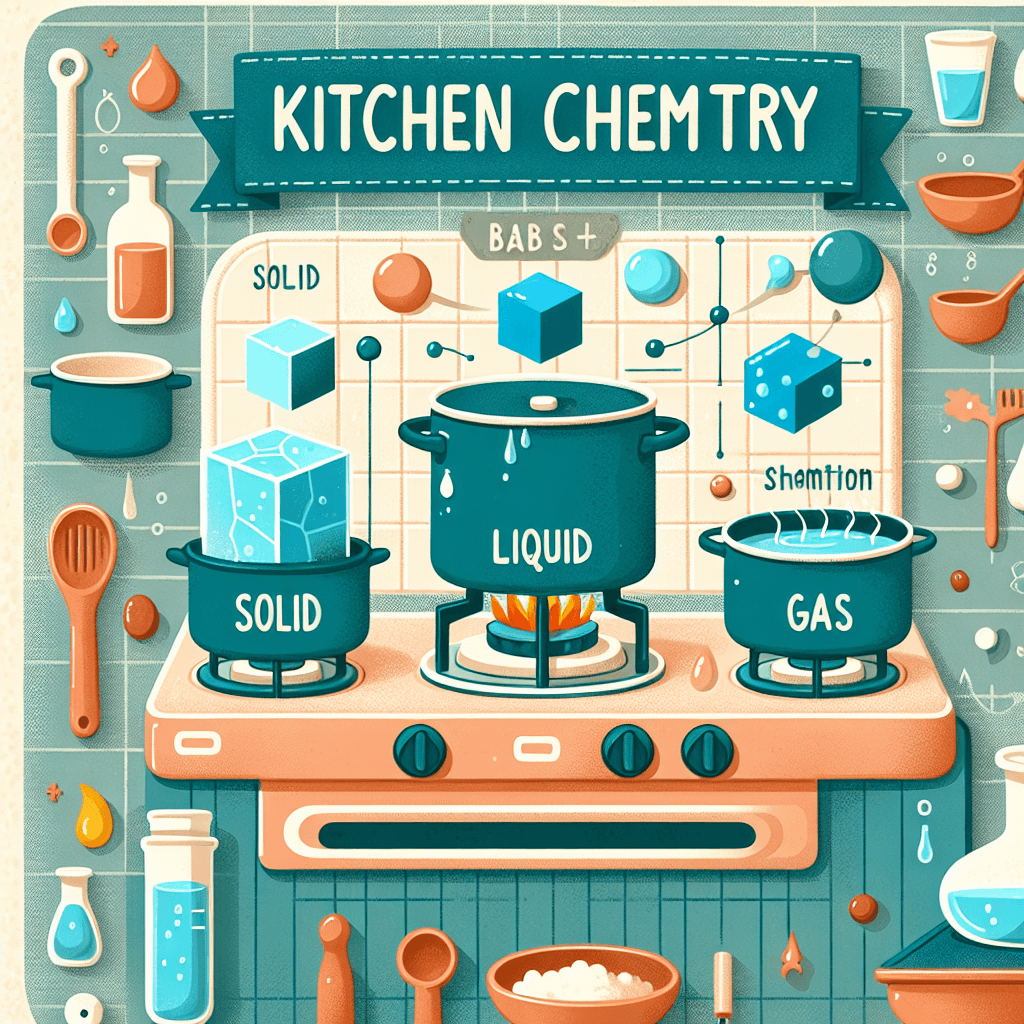
Inquiry Framework
Question Framework
Driving Question
The overarching question that guides the entire project.How can we, as food scientists, explore the changing states of matter in the kitchen to transform ingredients and create delicious dishes?Essential Questions
Supporting questions that break down major concepts.- How do the states of matter change during cooking?
- What are the properties of solids, liquids, and gases in food?
- How do temperature changes affect the states of matter in food?
- How does the state of matter impact the texture and taste?
- What are some examples of physical and chemical changes in cooking?
Standards & Learning Goals
Learning Goals
By the end of this project, students will be able to:- Students will be able to explain how energy transfer affects the states of matter of ingredients during cooking.
- Students will be able to identify and describe the characteristics of solids, liquids, and gases in food.
- Students will be able to differentiate between physical and chemical changes in food as it cooks.
- Students will be able to design and conduct an experiment demonstrating state change in food.
Entry Events
Events that will be used to introduce the project to studentsEdible Experiments
**Hook:** Imagine you're a food scientist tasked with creating a new dessert that changes states of matter as you eat it. Present students with a dish like Baked Alaska (hot and cold at once) or Dippin' Dots (liquid nitrogen ice cream). **Core Question:** How can we use culinary techniques to manipulate and explore the states of matter of food? **Connection to Standards:** Directly addresses states of matter through observation and experimentation with food. **Engagement:** Connects to food, a familiar and exciting topic, and introduces the concept of food science. **Investigation Pathways:** 1. Explore the science behind specific dishes and their state changes. 2. Design their own dish that features a unique transformation of matter.Portfolio Activities
Portfolio Activities
These activities progressively build towards your learning goals, with each submission contributing to the student's final portfolio.Water Works Wonders: A States of Matter Lab
Students will explore the properties of solids, liquids, and gases using water as an example. They will observe and document its changing states through freezing, melting, and boiling.Steps
Here is some basic scaffolding to help students complete the activity.Final Product
What students will submit as the final product of the activityA comprehensive lab report detailing observations, explanations of state changes, and diagrams of particle arrangement in each state.Alignment
How this activity aligns with the learning objectives & standardsAddresses the characteristics of solids, liquids, and gases, and how energy transfer affects state changes.Recipe Remix: States of Matter in Action
Students will select a recipe and analyze the ingredients, classifying them based on their states of matter. They will then observe how the states of matter change during the cooking process.Steps
Here is some basic scaffolding to help students complete the activity.Final Product
What students will submit as the final product of the activityA detailed chart listing each ingredient's initial state of matter, its state after cooking, and an explanation of the observed changes.Alignment
How this activity aligns with the learning objectives & standardsFocuses on classifying ingredients by their state of matter and observing state changes during cooking.Culinary Transformations: Physical vs. Chemical Changes
Students will further investigate the difference between physical and chemical changes using various cooking processes as examples.Steps
Here is some basic scaffolding to help students complete the activity.Final Product
What students will submit as the final product of the activityA presentation comparing and contrasting physical and chemical changes in cooking, supported by specific examples and explanations of how they impact the food's properties.Alignment
How this activity aligns with the learning objectives & standardsReinforces the understanding of physical and chemical changes through culinary examples.Culinary Alchemy: Designing State Change Dishes
Students will apply their understanding of states of matter to design and create a dish demonstrating a specific state change.Steps
Here is some basic scaffolding to help students complete the activity.Final Product
What students will submit as the final product of the activityA final dish presentation, including a written explanation of the chosen state change, the recipe, the science behind the transformation, and a sensory evaluation.Alignment
How this activity aligns with the learning objectives & standardsCulminates in applying knowledge of states of matter and their changes to design a unique culinary creation.Rubric & Reflection
Portfolio Rubric
Grading criteria for assessing the overall project portfolioKitchen Chemistry Exploration Rubric
Conceptual Understanding
Evaluation of student's grasp on scientific concepts regarding states of matter and energy transfer in food.States of Matter
Demonstrates understanding of solids, liquids, and gases in the context of food science.
Exemplary
4 PointsShows sophisticated understanding of states of matter, providing comprehensive examples and in-depth explanations of changes in food.
Proficient
3 PointsDemonstrates thorough understanding with clear examples and explanations of changes in food states.
Developing
2 PointsShows emerging understanding with basic examples, but incomplete explanations of changes in food states.
Beginning
1 PointsShows initial understanding with limited examples and explanations of changes in food states.
Energy Transfer
Explains how energy transfer affects the states of matter in culinary scenarios.
Exemplary
4 PointsArticulates complex energy transfer processes with detailed examples from culinary experiments.
Proficient
3 PointsExplains energy transfer clearly with relevant examples from culinary scenarios.
Developing
2 PointsDescribes basic energy transfer processes with limited examples.
Beginning
1 PointsDemonstrates minimal understanding of energy transfer with poor or no examples.
Physical and Chemical Changes
Differentiates between physical and chemical changes during cooking.
Exemplary
4 PointsProvides comprehensive differentiation with vivid culinary examples illustrating changes.
Proficient
3 PointsAccurately differentiates with clear examples and descriptions of cooking processes.
Developing
2 PointsIdentifies some differences with limited examples.
Beginning
1 PointsStruggles to differentiate, presenting few or incorrect examples.
Practical Application
Assessment of student's ability to apply scientific concepts to real-world culinary tasks.Experiment Design
Develops and conducts a culinary experiment demonstrating a state change.
Exemplary
4 PointsDesigns an innovative experiment with creative application of state changes and detailed execution.
Proficient
3 PointsDesigns a sound experiment with correct application of state changes and clear execution steps.
Developing
2 PointsAttempts an experiment with basic application and execution, showing some understanding.
Beginning
1 PointsStruggles with experiment design and execution, demonstrating limited application.
Observation and Documentation
Records observations and documents changes in states of matter accurately.
Exemplary
4 PointsProvides detailed, accurate observations and documentation with clear organization.
Proficient
3 PointsProvides accurate records and documentation but lacks extensive detail.
Developing
2 PointsProvides some observations but fails to document comprehensively or accurately.
Beginning
1 PointsStruggles with recording observations and providing accurate documentation lacking organization.
Communication
Evaluation of student's ability to communicate scientific findings and insights effectively through written and oral presentations.Clarity and Organization
Presents culinary science findings clearly and structured.
Exemplary
4 PointsUtilizes exceptional clarity and organization, presenting culinary science findings in a highly engaging way.
Proficient
3 PointsPresents findings clearly with logical organization, ensuring understanding.
Developing
2 PointsConveys basic information, but lacks coherent structure or clarity.
Beginning
1 PointsStruggles with conveying findings clearly or organizing content logically.
Visual and Sensory Presentation
Incorporates visual aids and sensory evaluations in presenting culinary findings.
Exemplary
4 PointsIncorporates highly effective visuals and sensory details that significantly enhance understanding.
Proficient
3 PointsUses effective visuals and sensory details to support understanding.
Developing
2 PointsIncorporates some visuals but lacks impact and relevance.
Beginning
1 PointsStruggles to use visuals or sensory details effectively, impacting clarity.