
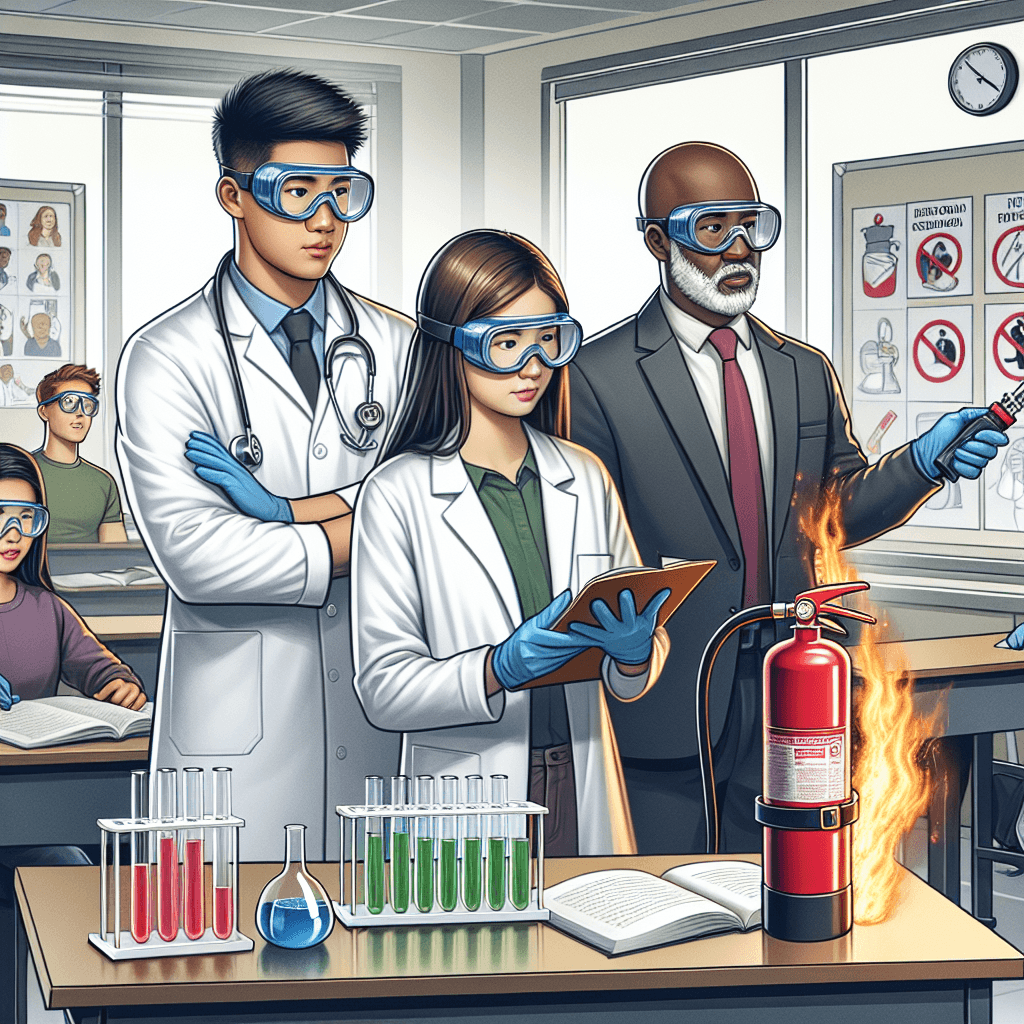
Lab Safety Essentials for Health Science Students
Inquiry Framework
Question Framework
Driving Question
The overarching question that guides the entire project.How can we create a comprehensive lab safety guide that ensures a safe working environment in the health science lab while understanding the importance of following proper protocols and regulations?Essential Questions
Supporting questions that break down major concepts.- Why is lab safety crucial in a health science setting?
- How can personal protective equipment (PPE) prevent the spread of infections in a lab environment?
- What are the potential consequences of not following lab safety protocols?
- How does understanding the chain of infection help in controlling the spread of pathogens?
- What are the roles of OSHA and CDC regulations in ensuring personal safety in health science labs?
- Why is it important to comply with safety signs, symbols, and labels in the lab?
- How should one respond to fire alarms, weather alerts, and other emergencies in the health science lab?
Standards & Learning Goals
Learning Goals
By the end of this project, students will be able to:- Understand and explain the importance of lab safety in health science settings.
- Demonstrate the ability to identify potential hazards and employ safe work practices in a lab setting.
- Describe principles of infection transmission and methods to control the spread of pathogens.
- Apply OSHA and CDC regulations for personal safety and demonstrate proper use of PPE in labs.
- Recognize and respond appropriately to emergency alerts and protocols in a lab environment.
NGSS
Common Core Standards for Literacy in Science and Technical Subjects
Common Core Standards for Speaking and Listening
Entry Events
Events that will be used to introduce the project to studentsLab Safety Olympics
Host a Lab Safety Olympics, where student teams compete in tasks that test their knowledge and application of lab safety protocols, such as correctly using PPE or responding to simulated emergencies. Each event challenges conventional thinking by turning routine safety practices into competitive, timed events, thereby enhancing engagement through gamification.Portfolio Activities
Portfolio Activities
These activities progressively build towards your learning goals, with each submission contributing to the student's final portfolio.Safety Protocol Power-Up
This activity enables students to explore and list the fundamental lab safety rules specific to a health science lab. They learn to identify prohibitions and requirements for safe practice. This foundation will be built upon in subsequent activities to deepen understanding of lab safety.Steps
Here is some basic scaffolding to help students complete the activity.Final Product
What students will submit as the final product of the activityA comprehensive chart listing dos and don'ts of lab safety in a health science setting.Alignment
How this activity aligns with the learning objectives & standards1113-HS-LS1-3: Provides foundation for understanding lab safety to maintain a safe environment.Rubric & Reflection
Portfolio Rubric
Grading criteria for assessing the overall project portfolioLab Safety Protocol Assessment Rubric
Understanding of Safety Protocols
Evaluate student's ability to understand and articulate the lab safety rules specific to a health science lab, their importance, and potential consequences of non-compliance.Comprehension of Rules
Measures the student's understanding of lab safety rules, including prohibitions and requirements.
Exemplary
4 PointsDemonstrates comprehensive understanding of all lab safety rules, providing detailed explanations of their importance and potential risks of non-compliance.
Proficient
3 PointsDemonstrates thorough understanding of most lab safety rules, explaining main concepts and potential risks.
Developing
2 PointsShows emerging understanding of lab safety rules, with basic explanations and limited identification of potential risks.
Beginning
1 PointsShows limited understanding of lab safety rules and struggles to articulate basic concepts.
Identification of Hazards
Assesses the ability to identify potential hazards in lab environments and predict consequences of unsafe practices.
Exemplary
4 PointsIdentifies all potential hazards accurately and predicts comprehensive consequences of non-compliance.
Proficient
3 PointsIdentifies most potential hazards and predicts reasonable consequences of non-compliance in common situations.
Developing
2 PointsIdentifies some potential hazards with limited prediction of consequences.
Beginning
1 PointsStruggles to identify potential hazards or predict any consequences correctly.
Application of Safety Gear and Protocols
Evaluates student ability to demonstrate and explain the use of personal protective equipment (PPE) and adherence to OSHA and CDC guidelines.Use of PPE
Measures accuracy and efficacy in deploying personal protective equipment suitable for various lab scenarios.
Exemplary
4 PointsDemonstrates flawless application and explanation of PPE usage, aligned with OSHA and CDC protocols.
Proficient
3 PointsConsistently applies and explains PPE usage correctly, with minor omissions or errors.
Developing
2 PointsApplies PPE with occasional errors and demonstrates basic understanding of its importance.
Beginning
1 PointsStruggles with correct PPE application and offers minimal or flawed explanations.
Adherence to Protocols
Assesses ability to follow established lab protocols during activities and in response to emergencies.
Exemplary
4 PointsFlawlessly follows all protocols, including emergency procedures, demonstrating leadership and initiative.
Proficient
3 PointsFollows most protocols accurately and responds appropriately to emergencies.
Developing
2 PointsFollows protocols inconsistently and needs prompting during emergencies.
Beginning
1 PointsStruggles to follow protocols and requires significant support in emergencies.
Collaborative Discussion and Critical Thinking
Evaluates participation in group discussions, contributions to creating a comprehensive safety guide, and application of critical thinking to discuss lab safety implications.Discussion Participation
Measures quality and quantity of participation in group discussions, including setting goals and collaborative involvement.
Exemplary
4 PointsLeads discussions, sets insightful goals, and fosters collaboration to enhance group understanding.
Proficient
3 PointsActively participates in discussions, contributing valuable ideas and working well with peers.
Developing
2 PointsParticipates occasionally, providing basic input and requiring encouragement to engage more deeply.
Beginning
1 PointsRarely participates, and when doing so, provides minimal input with little relevance to discussions.