
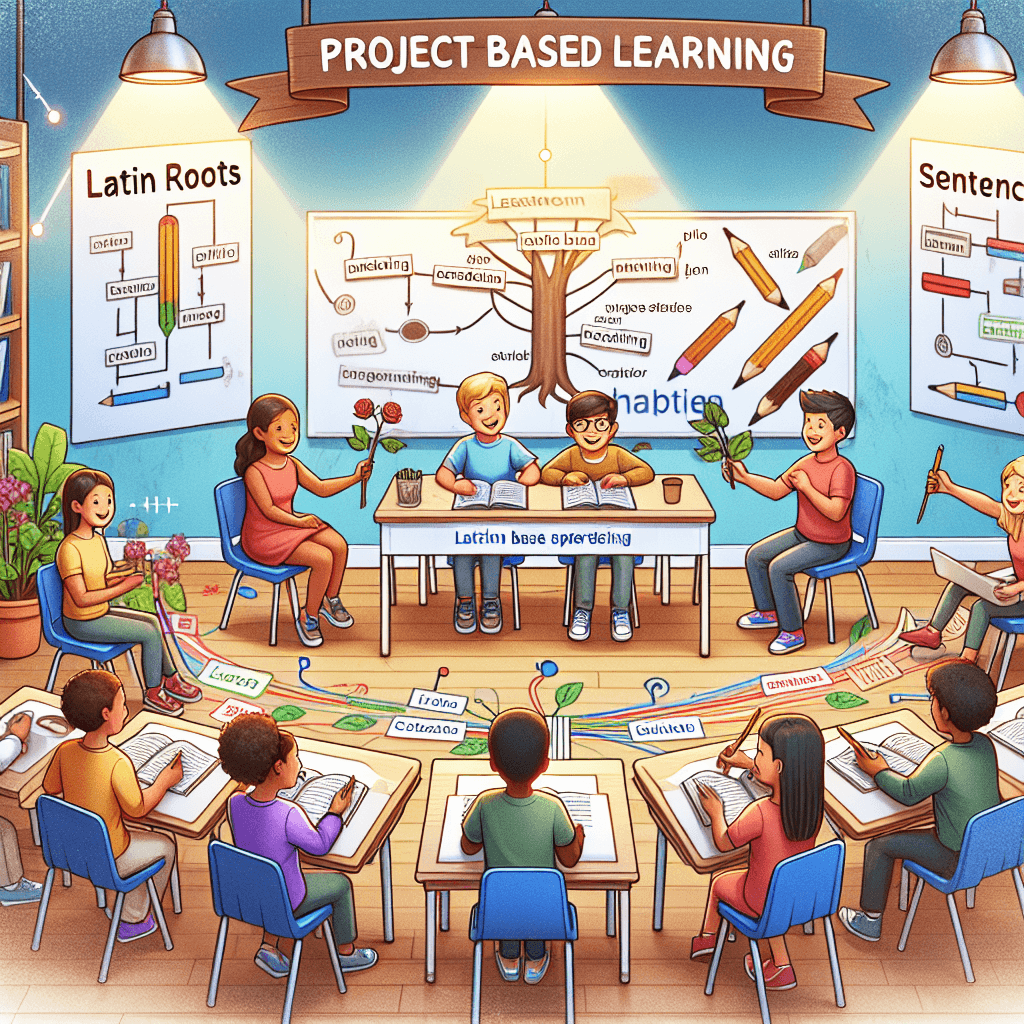
Latin Roots and Sentence Mastery
Inquiry Framework
Question Framework
Driving Question
The overarching question that guides the entire project.How can we use our understanding of Latin affixes and roots, phonics, and sentence structure to enhance our reading and writing across various subjects?Essential Questions
Supporting questions that break down major concepts.- What are the commonly occurring Latin affixes and roots, and how do they help in understanding the meaning of words and phrases?
- How can identifying phonics patterns improve our spelling and reading skills?
- Why is it important to recognize and revise fragment and run-on sentences?
- How does understanding word structure benefit us in technology, science, and social studies contexts?
- In what ways can decoding skills enhance our ability to understand complex texts across different subjects?
Standards & Learning Goals
Learning Goals
By the end of this project, students will be able to:- Students will be able to identify and use commonly occurring Latin affixes and roots to determine the meanings of words and phrases.
- Students will apply phonics and word analysis skills in both decoding and encoding (spelling) to read and write more effectively.
- Students will recognize and revise fragment and run-on sentences to improve their sentence structure in writing and speaking.
- Students will enhance their ability to comprehend complex texts across various subjects by utilizing their understanding of word structure.
- Students will explore the connections between language skills and other subjects like technology, science, and social studies.
Common Core Standards
Entry Events
Events that will be used to introduce the project to studentsWord Warriors: The Spelling Quest
Set in a storyline where students are part of an ancient guild of 'Word Warriors', they must journey through a series of challenges involving decoding words with Latin affixes and composing sentences, exploring the intersection of language, history, and strategy.Portfolio Activities
Portfolio Activities
These activities progressively build towards your learning goals, with each submission contributing to the student's final portfolio.Affix Adventure: Unlocking Latin Roots
Students embark on a quest to uncover the mysteries of commonly occurring Latin affixes and roots. Through engaging exploration, students will learn how these elements contribute to word meanings, enhancing their vocabulary and comprehension across subjects.Steps
Here is some basic scaffolding to help students complete the activity.Final Product
What students will submit as the final product of the activityA short story featuring newly created words using Latin affixes and roots.Alignment
How this activity aligns with the learning objectives & standardsAligns with CCSS.ELA-LITERACY.L.4.4.B as students use Latin affixes and roots to determine word meanings.Phonics Puzzle: The Sound Decoder
This activity strengthens phonics and word analysis skills by challenging students to decode multisyllabic words using syllabication and phonics rules. Students will enhance their ability to read both familiar and unfamiliar words.Steps
Here is some basic scaffolding to help students complete the activity.Final Product
What students will submit as the final product of the activityCompleted phonics puzzle worksheet and oral presentation of words broken down by phonics patterns.Alignment
How this activity aligns with the learning objectives & standardsAligns with CCSS.ELA-LITERACY.RF.4.3.A as it develops skills to read unfamiliar multisyllabic words using phonics knowledge.Sentence Architect: Fragment Fixer
Students learn to identify and correct fragment and run-on sentences through the role of a 'Sentence Architect'. They will explore sentence structure, editing their writing to form complete and coherent sentences.Steps
Here is some basic scaffolding to help students complete the activity.Final Product
What students will submit as the final product of the activityA revised paragraph with corrected sentence fragments and run-ons.Alignment
How this activity aligns with the learning objectives & standardsMeets CCSS.ELA-LITERACY.L.4.1.F by focusing on producing and correcting complete sentences.Interdisciplinary Investigator: Words Across Worlds
This activity allows students to apply their understanding of word structures like Latin roots and phonics skills to comprehend complex texts in technology, science, and social studies. They become 'Interdisciplinary Investigators' deciphering meanings in various contexts.Steps
Here is some basic scaffolding to help students complete the activity.Final Product
What students will submit as the final product of the activityAnnotated texts with highlighted word structures and explanations of decoded terms.Alignment
How this activity aligns with the learning objectives & standardsSupports CCSS.ELA-LITERACY.L.4.4.B and LA.4.F.3 by applying word analysis skills in diverse academic texts.Rubric & Reflection
Portfolio Rubric
Grading criteria for assessing the overall project portfolioLatin Roots and Phonics Mastery Rubric
Understanding Latin Roots
Assesses the student's ability to identify and apply Latin affixes and roots to derive meaning in various contexts.Identification of Latin Roots
Ability to identify Latin affixes and roots in words correctly.
Exemplary
4 PointsAccurately identifies all given Latin roots and affixes in a range of words with minimal or no assistance.
Proficient
3 PointsCorrectly identifies most given Latin roots and affixes in words with occasional assistance.
Developing
2 PointsIdentifies some Latin roots and affixes but may confuse meanings or require significant guidance.
Beginning
1 PointsStruggles with identifying Latin roots and affixes without significant help.
Application in Word Creation
Ability to use Latin affixes and roots to create meaningful new words in context.
Exemplary
4 PointsCreatively combines numerous Latin roots and affixes to produce innovative new words that are contextually appropriate.
Proficient
3 PointsUses some Latin roots and affixes effectively to create relevant new words.
Developing
2 PointsAttempts to create new words but shows limited understanding of affix application.
Beginning
1 PointsStruggles with creating new words with Latin roots and affixes without help.
Integration in Writing
Evaluates the effectiveness of using newly created words in writing.
Exemplary
4 PointsIntegrates newly created words seamlessly into story and sentence flows, showing deep understanding.
Proficient
3 PointsUses newly created words accurately in writing, though with less fluidity.
Developing
2 PointsUses newly created words with errors that affect story clarity and coherence.
Beginning
1 PointsStruggles to use newly created words meaningfully in writing without significant help.
Phonics and Syllabication
Assesses the ability to decode and pronounce multisyllabic words using phonics and syllabication strategies.Decoding of Multisyllabic Words
Effectiveness in breaking down words into syllables and applying phonics rules for decoding.
Exemplary
4 PointsPrecisely breaks down and decodes complex multisyllabic words independently with clarity in pronunciation.
Proficient
3 PointsAdequately decodes most multisyllabic words with minor pronunciation guidance needed.
Developing
2 PointsDecodes words with frequent errors and requires substantial pronunciation assistance.
Beginning
1 PointsStruggles to decode multisyllabic words without substantial guidance.
Sentence Structure Mastery
Evaluates the student's ability to identify, revise, and produce complete sentences in writing.Identification of Sentence Errors
Ability to recognize fragment and run-on sentences.
Exemplary
4 PointsIdentifies fragment and run-on sentences consistently without errors, contributing to logical text structure.
Proficient
3 PointsCorrectly identifies most sentence errors with occasional lapses.
Developing
2 PointsRecognizes some sentence errors but often needs assistance to identify correctly others.
Beginning
1 PointsStruggles to identify sentence errors without explicit guidance.
Correction of Sentence Errors
Ability to revise incorrect sentences into complete ones.
Exemplary
4 PointsAccurately revises all examples of fragments and run-on sentences into complete sentences autonomously.
Proficient
3 PointsSuccessfully revises most sentence errors with minor assistance.
Developing
2 PointsAttempts to revise sentence errors but often needs guidance to produce correct sentences.
Beginning
1 PointsFinds it challenging to revise sentences without substantial help.
Interdisciplinary Application
Assesses the use of language skills to understand terms in science, technology, and social studies contexts.Comprehension Across Disciplines
Ability to apply language skills to understand and explain academic vocabulary in different subject areas.
Exemplary
4 PointsEffectively applies word analysis skills to decode and explain complex terminology across different subjects autonomously.
Proficient
3 PointsAccurately uses word analysis to understand most academic terms with minimal assistance.
Developing
2 PointsUnderstands some vocabulary with substantial assistance and struggles with complex terms.
Beginning
1 PointsRequires significant support to decode and understand academic vocabulary across subjects.