
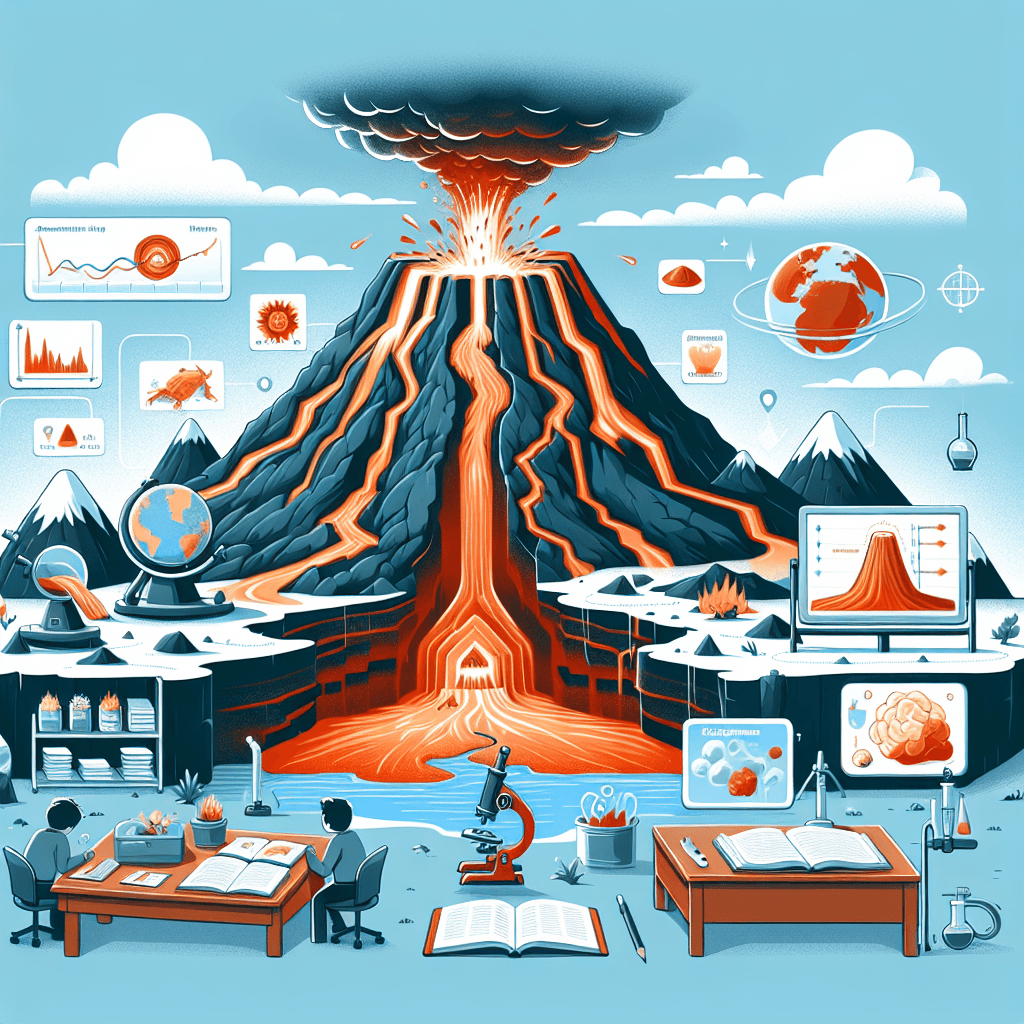
Lava Origins: Exploring Volcanoes and Intrusive Activity
Inquiry Framework
Question Framework
Driving Question
The overarching question that guides the entire project.How does the study of volcanoes and their formations, eruptions, and related activities reveal insights about Earth's internal dynamics, and what are the broader implications for the planet's systems, climate, ecosystems, and human society?Essential Questions
Supporting questions that break down major concepts.- What processes lead to the formation of volcanoes and how do they relate to Earth's structure?
- How do volcanic eruptions impact Earth's systems and human activities?
- What is the connection between volcanoes and Earth's internal and external energy flow?
- How can studying volcanoes help us understand Earth's past and predict future geological activity?
- In what ways do volcanoes affect climate and ecosystems both locally and globally?
Standards & Learning Goals
Learning Goals
By the end of this project, students will be able to:- Explain the processes that lead to the formation of volcanoes and their eruption.
- Analyze the impact of volcanic eruptions on Earth's systems and human activities.
- Understand the relationship between volcanoes and Earth's internal and external energy flows.
- Explore how the study of volcanoes can provide insights into Earth's past and future geological activities.
- Evaluate the effects of volcanic activity on climate and ecosystems locally and globally.
NGSS
Entry Events
Events that will be used to introduce the project to studentsVolcano VR Adventure
Students will start with a virtual reality field trip inside an active volcano, where they can observe the “birth” of lava and magma chambers in real-time. This immersive experience not only sparks curiosity but also sets the stage for deeper inquiry into geological processes and volcanic activity’s impact on the earth.Eruption Simulation Challenge
Students are given a scenario to prevent a virtual city from a volcano eruption by simulating volcanic eruptions and predicting lava flows. They will be tasked with devising strategies based on real-world volcano data and eruption patterns, connecting the project to real-life scientific practices.Portfolio Activities
Portfolio Activities
These activities progressively build towards your learning goals, with each submission contributing to the student's final portfolio.Lava Flow Forecast
In this data-driven activity, students analyze past and present volcanic eruptions to predict future lava flow paths. They will examine geological maps and eruption data to understand patterns and hazards associated with volcanoes.Steps
Here is some basic scaffolding to help students complete the activity.Final Product
What students will submit as the final product of the activityA comprehensive report and map overlay predicting potential future lava flow paths in a given area.Alignment
How this activity aligns with the learning objectives & standardsSupports hs-ess2-1 (Earth's processes and features) by using data analysis to model and predict geological phenomena.Volcanic Systems and Feedback Loops
Students will explore how a single volcanic eruption can affect other Earth systems, creating feedback loops. By analyzing case studies, they will identify the changes to Earth's systems and understand the broader implications for climate and ecosystems.Steps
Here is some basic scaffolding to help students complete the activity.Final Product
What students will submit as the final product of the activityA detailed flowchart and class presentation outlining feedback loops caused by volcanic activity.Alignment
How this activity aligns with the learning objectives & standardsAligns with hs-ess2-2 (feedbacks and Earth systems) by recognizing and mapping feedback loops arising from volcanic eruptions.Convection Connection
This activity focuses on the cycling of matter through Earth's interior via thermal convection. Students will build a model to visualize how matter moves, demonstrating the underlying processes that fuel volcanic activity and influence volcanic formations.Steps
Here is some basic scaffolding to help students complete the activity.Final Product
What students will submit as the final product of the activityA working model demonstrating thermal convection currents, accompanied by a reflective discussion on volcanic processes.Alignment
How this activity aligns with the learning objectives & standardsRelates to hs-ess2-3 (cycling of matter through thermal convection) by visualizing convection currents that drive volcanic activity.Volcanoes and Climate Connection
This investigatory simulation helps students understand the impact of volcanic eruptions on climate. By using climate models and historical data, students will analyze how eruptions alter atmospheric conditions and contribute to climate change.Steps
Here is some basic scaffolding to help students complete the activity.Final Product
What students will submit as the final product of the activityA detailed report backed by simulations, explaining volcanic impacts on climate and their broader implications.Alignment
How this activity aligns with the learning objectives & standardsAligns with hs-ess3-1 (natural hazards and climate change) by exploring volcanic impacts on atmospheric conditions and human activity.The Magma Chamber Mystery
Students will explore the internal dynamics of a volcano by creating a simple model of a magma chamber. This activity helps students understand the formation of magma, its journey through Earth's crust, and how it leads to volcanic eruptions. Through this hands-on activity, students link theoretical concepts with physical representation.Steps
Here is some basic scaffolding to help students complete the activity.Final Product
What students will submit as the final product of the activityA clay model of a volcano with a functional magma chamber that demonstrates how volcanic eruptions occur.Alignment
How this activity aligns with the learning objectives & standardsAligns with hs-ess1-6 (Earth's formation and volcanic activity) by modeling internal volcanic structures and processes.Rubric & Reflection
Portfolio Rubric
Grading criteria for assessing the overall project portfolioVolcano Exploration and Impact Assessment
Data Analysis and Interpretation
Assessment of students' ability to collect, analyze, and interpret volcanic data to make informed predictions and understand geological phenomena.Data Collection and Accuracy
Measures the precision and thoroughness of data gathered on historical and recent volcanic eruptions.
Exemplary
4 PointsData collected is comprehensive, accurate, and consistently relevant to the inquiry questions, showing an exceptional grasp of historical and current volcanic data.
Proficient
3 PointsData collected is accurate and relevant to the inquiry questions, demonstrating a good understanding of volcanic data.
Developing
2 PointsData collected is somewhat accurate but lacks thoroughness and relevance to fully address the inquiry questions.
Beginning
1 PointsData collected is inaccurate and lacks relevance, showing an initial understanding of volcanic data.
Data Analysis and Conclusion
Evaluates the ability to analyze volcanic data and draw meaningful conclusions about eruptions and their impacts.
Exemplary
4 PointsAnalysis is insightful, showing a deep understanding of volcanic processes and impacts; conclusions are evidence-based and nuanced.
Proficient
3 PointsAnalysis is clear and shows a good understanding of volcanic impacts; conclusions are well-supported by data.
Developing
2 PointsAnalysis shows a basic understanding; conclusions are drawn but lack strong support from the data.
Beginning
1 PointsAnalysis is limited and conclusions are unsupported, showing minimal understanding.
Model Development
Evaluation of students' ability to develop models that illustrate volcanic processes and their effects on Earth.Model Construction Quality
Assesses the quality and accuracy of physical or digital models constructed to represent volcanic processes.
Exemplary
4 PointsModel is highly accurate, detailed, and creatively demonstrates volcanic processes, showing advanced understanding.
Proficient
3 PointsModel is accurate and detailed, effectively demonstrating volcanic processes.
Developing
2 PointsModel demonstrates basic volcanic processes but lacks detail and accuracy.
Beginning
1 PointsModel is incomplete and lacks a clear representation of volcanic processes.
Scientific Explanation
Evaluates the ability to explain scientific concepts through models, showing understanding of underlying volcanic processes.
Exemplary
4 PointsExplanations are thorough and demonstrate a sophisticated understanding of volcanic processes and their broader implications.
Proficient
3 PointsExplanations are clear and show good understanding of volcanic processes.
Developing
2 PointsExplanations show basic understanding but lack depth.
Beginning
1 PointsExplanations are vague and show minimal understanding.
Impact Analysis and Prediction
Assessment of students' ability to predict volcanic impacts on earth systems and articulate these effects.Impact Prediction
Measures the ability to predict potential volcanic impacts based on data analysis.
Exemplary
4 PointsPredictions are highly accurate and consider multiple variables, showing comprehensive understanding.
Proficient
3 PointsPredictions are accurate and consider key variables, showing good understanding.
Developing
2 PointsPredictions are basic and miss several variables, showing limited understanding.
Beginning
1 PointsPredictions are inaccurate, lacking consideration of relevant variables.
Impact Explanation
Evaluates students' explanations of how volcanic activity affects Earth's systems, climate, and society.
Exemplary
4 PointsExplanations are detailed, showing an exceptional understanding of volcanic impact on multiple earth systems, climate, and human society.
Proficient
3 PointsExplanations are clear and demonstrate a good understanding of volcanic impacts.
Developing
2 PointsExplanations provide a basic view but lack depth and detail.
Beginning
1 PointsExplanations are superficial and show minimal understanding of impacts.