
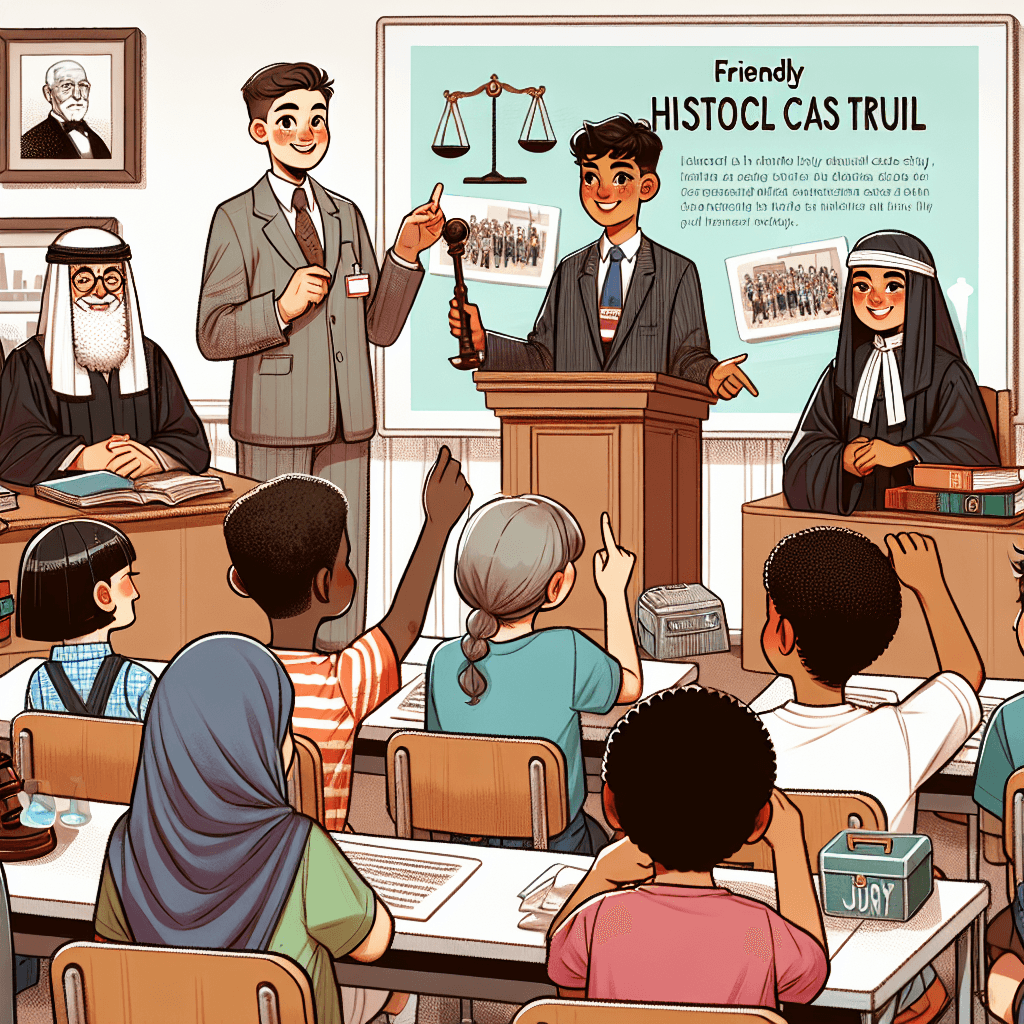
Lawmakers' Mock Trial: Historical Case Study
Inquiry Framework
Question Framework
Driving Question
The overarching question that guides the entire project.How can understanding the general provisions of criminal law, case laws, and various sources of law help us conduct a mock trial to evaluate the judicial process in historical case studies and its impact on modern legal practices?Essential Questions
Supporting questions that break down major concepts.- What are the general provisions of criminal law that are crucial in a trial?
- How do case laws influence the judgment in historical trials?
- What are the key roles in a trial and how do they contribute to the judicial process?
- How do different sources of law impact the judicial outcomes?
- Why is understanding historical case studies important for modern legal practices?
Standards & Learning Goals
Learning Goals
By the end of this project, students will be able to:- Students will understand and explain the general provisions of criminal law and case law.
- Students will analyze historical case studies to identify the influence of case laws on trial outcomes.
- Students will identify and describe the key roles in a trial and their contributions to the judicial process.
- Students will evaluate how different sources of law affect judicial outcomes.
- Students will discuss the significance of historical case studies in understanding modern legal practices.
State Social Studies Standards
Common Core Standards
Entry Events
Events that will be used to introduce the project to studentsThe Unsolved Mystery Box
Present students with a locked box containing 'evidence' and artifacts from a past case, requiring them to solve riddles and puzzles to unveil its contents. This engaging mystery format excites curiosity and lays the foundation for exploring legal concepts as they 'unlock' each piece of the trial.Portfolio Activities
Portfolio Activities
These activities progressively build towards your learning goals, with each submission contributing to the student's final portfolio.Law Fundamentals Explorer
Students will dive into the basics of criminal and case law by exploring general provisions and different sources of law. This activity sets the foundation for their understanding needed in the mock trial.Steps
Here is some basic scaffolding to help students complete the activity.Final Product
What students will submit as the final product of the activityA comprehensive mind map summarizing criminal and case law provisions and sources of law.Alignment
How this activity aligns with the learning objectives & standardsAligns with Standard SS.10.2.01 and SS.10.2.02 by building foundational knowledge of criminal and case law, and various sources of law.Historical Case Study Detective
Students investigate a historical case study to understand its legal context and impact. They will analyze primary and secondary sources to identify influential case laws and their application in the trial.Steps
Here is some basic scaffolding to help students complete the activity.Final Product
What students will submit as the final product of the activityA detailed report that compares and contrasts the primary and secondary sources, focusing on the influence of case laws on the trial outcome.Alignment
How this activity aligns with the learning objectives & standardsMeets CCSS.ELA-LITERACY.RH.9-10.9 and SS.10.2.01 by analyzing historical case studies and evaluating law applications.Role Play Preparation
In preparation for the mock trial, students will take on key roles such as judges, attorneys, and witnesses to understand their contributions to the judicial process. This activity will help them articulate legal arguments and witness testimonies.Steps
Here is some basic scaffolding to help students complete the activity.Final Product
What students will submit as the final product of the activityRole-prepared scripts or outlines, demonstrating a clear understanding of trial roles and potential legal arguments.Alignment
How this activity aligns with the learning objectives & standardsSupports CCSS.ELA-LITERACY.SL.9-10.1 by encouraging effective participation in collaborative discussions and role-play scenarios.Mock Trial Execution
Students will conduct a mock trial, applying their knowledge of criminal law, case law, and historical case studies. This activity allows them to synthesize their research and role preparations in a courtroom setting.Steps
Here is some basic scaffolding to help students complete the activity.Final Product
What students will submit as the final product of the activityA conducted mock trial with documented reflections on the judicial process and historical legal impacts.Alignment
How this activity aligns with the learning objectives & standardsAligns with SS.10.2.01 and CCSS.ELA-LITERACY.W.9-10.2, as it involves practical application of legal understanding and clear communication.Rubric & Reflection
Portfolio Rubric
Grading criteria for assessing the overall project portfolioMock Trial Learning Assessment Rubric
Understanding of Legal Concepts
Assessment of students' grasp of general provisions of criminal and case law, as well as the impact of different sources of law.Knowledge of Criminal Law Provisions
Evaluate the understanding of the foundational principles of criminal law covered in the project.
Exemplary
4 PointsDemonstrates sophisticated understanding of criminal law provisions, articulated clearly and connected to historical case contexts.
Proficient
3 PointsShows thorough understanding of criminal law provisions, with clear explanations and relevance to case studies.
Developing
2 PointsDemonstrates emerging understanding with basic explanations that partially connect to case examples.
Beginning
1 PointsShows initial understanding with minimal connection to case materials or legal principles.
Understanding of Case Law Influence
Examine students' ability to analyze how specific case laws influence trial outcomes in historical contexts.
Exemplary
4 PointsProvides comprehensive analysis of case law influences, showing advanced synthesis of historical precedents and outcomes.
Proficient
3 PointsDelivers clear analysis of case law and its historical impact, demonstrating competent critical evaluation.
Developing
2 PointsOffers basic analysis of case laws, with some connections to historical case outcomes.
Beginning
1 PointsAttempts analysis with limited understanding of case law impacts on outcomes.
Role Preparation and Execution
Evaluation of students' preparation and performance in assigned legal roles during the mock trial.Role Understanding
Assess students' grasp of their assigned trial role responsibilities and their educational impact.
Exemplary
4 PointsShows exceptional understanding and embodiment of trial roles with insightful performance impacting trial success.
Proficient
3 PointsDemonstrates solid understanding and effective portrayal of assigned roles, contributing positively to the trial.
Developing
2 PointsExhibits partial understanding, attempting to embody roles with varying levels of success.
Beginning
1 PointsMinimal understanding of role responsibilities, impacting overall trial performance.
Argument Development and Presentation
Consider students' ability to develop and deliver their arguments and testimonies persuasively.
Exemplary
4 PointsCrafts and presents compelling, well-structured arguments, integrating historical case references deftly.
Proficient
3 PointsPresents well-developed arguments with logical structure and historical references.
Developing
2 PointsProvides basic argumentation with partial structure, occasionally referencing relevant case details.
Beginning
1 PointsAttempts argumentation with limited clarity and historical linkage.
Reflection and Debrief
Measures the reflection and understanding of trial outcomes and historical impacts compared to modern practices.Reflective Insights
Evaluate the depth and quality of students' reflections on the mock trial and its relationship to real-world legal systems.
Exemplary
4 PointsProvides thorough, insightful reflection connecting trial experiences to modern legal systems and practices.
Proficient
3 PointsOffers clear reflection with meaningful connections to contemporary legal contexts.
Developing
2 PointsDelivers brief reflections with some links to modern legal practices.
Beginning
1 PointsAttempts reflection with minimal connections to current legal systems.