
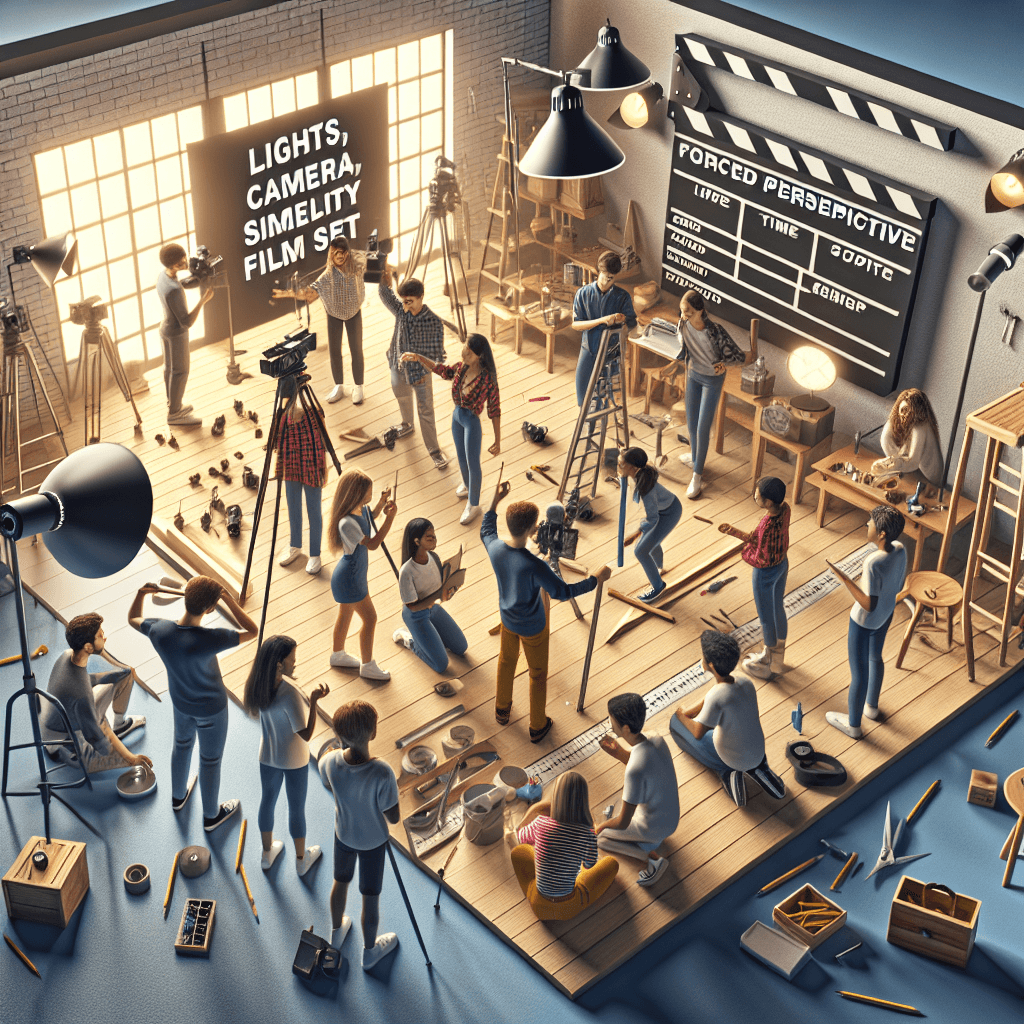
Lights, Camera, Similarity: Designing Forced Perspective Film Sets
Inquiry Framework
Question Framework
Driving Question
The overarching question that guides the entire project.How can we, as visual effects designers, use the geometry of similarity and dilations to create a cinematic illusion that seamlessly blends miniature sets with reality?Essential Questions
Supporting questions that break down major concepts.- How can we use the geometry of similarity to manipulate visual perception and create cinematic illusions?
- In what ways do the properties of dilations (center and scale factor) determine the realism of a forced perspective shot?
- How can we use proportional reasoning and scale factors to bridge the gap between a miniature set and a life-sized actor?
- How do similar triangles and the AA criterion allow us to predict where an object must be placed to achieve a specific visual effect?
- How can we mathematically prove that two objects of different sizes will appear identical from a specific camera lens perspective?
Standards & Learning Goals
Learning Goals
By the end of this project, students will be able to:- Calculate scale factors and distances using the properties of dilations to align miniature sets with real-world objects from a fixed camera perspective.
- Apply the AA (Angle-Angle) criterion and the definition of similarity to prove that two objects will appear identical in a filmed frame.
- Construct a physical miniature set that maintains precise geometric similarity to a full-scale environment.
- Communicate mathematical reasoning through a 'VFX Breakdown' that justifies object placement using proportional reasoning and coordinate geometry.
Common Core State Standards for Mathematics
Entry Events
Events that will be used to introduce the project to studentsThe Viral Illusion Challenge
Students watch a series of 'impossible' social media clips (e.g., someone 'holding' the sun or stepping over a skyscraper) and are challenged to replicate one perfectly in the classroom within 15 minutes. To succeed, they must reverse-engineer the distance-to-size ratio, discovering how the camera acts as the center of dilation for two similar objects.Portfolio Activities
Portfolio Activities
These activities progressively build towards your learning goals, with each submission contributing to the student's final portfolio.Lens to Landmark: The Dilation Map
Before building sets, students must understand how light travels from a lens to objects in space. In this activity, students will create a 'Sightline Blueprint' by mapping out rays (lines) that originate from a single point—the camera lens—and pass through a miniature object to a larger background area. This introduces the concept that the camera is the center of dilation ($C$) and the objects in the frame are dilated versions of one another.Steps
Here is some basic scaffolding to help students complete the activity.Final Product
What students will submit as the final product of the activityA physical or digital Ray-Tracing Diagram that maps the 'cone of vision' from the camera lens to at least two objects of different sizes.Alignment
How this activity aligns with the learning objectives & standardsThis activity aligns with HSG-SRT.A.1, which requires students to verify the properties of dilations given by a center and a scale factor. By using the camera as a fixed point, students experimentally identify it as the 'center of dilation.'The Parallel Perspective Challenge
A forced perspective illusion breaks if the lines of a miniature set aren't perfectly parallel to the lines of the real-world environment. Students will experiment with placing 'horizon lines' and 'vertical supports' in their miniature set. They must demonstrate that if the line doesn't pass through the camera lens, its dilated counterpart must be parallel to it in the background to fool the eye.Steps
Here is some basic scaffolding to help students complete the activity.Final Product
What students will submit as the final product of the activityA 'Parallelism Photo Portfolio' consisting of two photos: one where the lines are skewed (breaking the illusion) and one where they are perfectly parallel (preserving the illusion), accompanied by a geometric explanation.Alignment
How this activity aligns with the learning objectives & standardsThis activity aligns with HSG-SRT.A.1.a, focusing on the property that a dilation takes a line not passing through the center to a parallel line. Students must prove that the 'horizon' or 'structural' lines of their miniature remain parallel to the real world to maintain the illusion.Ratio Architects: Scaling the Set
Now that students have the layout, they need the math. If an actor is 180cm tall and a miniature figure is 10cm tall, students must calculate the exact scale factor ($k$). They will then use this ratio to determine exactly how many centimeters the miniature must be from the camera versus how many meters the actor must be from the camera to appear the same height.Steps
Here is some basic scaffolding to help students complete the activity.Final Product
What students will submit as the final product of the activityA 'Similarity Specification Sheet'—a table of values including scale factors, distances from the camera ($CP$ and $CP'$), and object heights used to plan their final film shot.Alignment
How this activity aligns with the learning objectives & standardsThis activity aligns with HSG-SRT.A.1.b and HSG-SRT.A.2. Students calculate the scale factor (k) based on the ratio of distances from the center (camera) and use similarity transformations to ensure the miniature and real object are proportional.The Sightline Proof: Establishing AA Similarity
To be professional VFX designers, students must prove their work. In this activity, students will draw the two nested triangles formed by the camera, the miniature, and the actor. They will use the AA criterion (the shared angle at the camera lens and the 90-degree angle of the objects to the floor) to establish a formal geometric proof of similarity.Steps
Here is some basic scaffolding to help students complete the activity.Final Product
What students will submit as the final product of the activityA Formal Geometric Proof (Two-Column or Flow Chart) that uses the AA criterion to prove the similarity of the 'Sightline Triangles.'Alignment
How this activity aligns with the learning objectives & standardsThis activity aligns with HSG-SRT.A.3, using the AA (Angle-Angle) criterion. Students will prove that the triangles formed by the sightlines are similar, establishing the mathematical validity of their optical illusion.The Cinematic Illusion & VFX Master Breakdown
Students will film their 15-30 second cinematic illusion. Following the film, they will create a 'Director's VFX Breakdown.' This is a video overlay or presentation where they 'pull back the curtain' to show the math. They will show the actual distances, the scale factors used, and the geometric proofs that made the shot possible.Steps
Here is some basic scaffolding to help students complete the activity.Final Product
What students will submit as the final product of the activityThe 'Forced Perspective Short' (Film Clip) and a 'VFX Breakdown' (Presentation or Video Overlay) detailing the geometric similarity used in the design.Alignment
How this activity aligns with the learning objectives & standardsThis final activity synthesizes all standards (HSG-SRT.A.1-3). It requires the application of similarity transformations, scale factors, and geometric properties to solve a complex design problem.Rubric & Reflection
Portfolio Rubric
Grading criteria for assessing the overall project portfolioForced Perspective Cinema: Geometric Similarity Rubric
Foundations of Dilation
Assessment of the student's ability to experimentally verify and apply the properties of dilations using a fixed center.Dilation Mapping & Ray Tracing (HSG-SRT.A.1)
Focuses on the ability to identify the camera lens as the center of dilation (C) and accurately map rays from the lens through the miniature to the background.
Exemplary
4 PointsDiagram provides a sophisticated and precise mapping of the cone of vision; ray-tracing is used innovatively to predict exact placement; identifies the camera lens as the center of dilation with absolute clarity and technical detail.
Proficient
3 PointsRay-tracing diagram is accurate and clear; correctly identifies the camera as the center of dilation and uses rays to map the relationship between the miniature and the background object.
Developing
2 PointsRay-tracing diagram is attempted but contains minor errors in line projection or placement; identification of the center of dilation is present but lacks precision.
Beginning
1 PointsDiagram is incomplete or shows significant misconceptions regarding how rays travel from the center of dilation; fails to identify the camera lens as the fixed point.
Parallelism & Spatial Alignment (HSG-SRT.A.1.a)
Evaluates the student's ability to ensure that structural lines in the miniature set remain parallel to the real-world environment to maintain the optical illusion.
Exemplary
4 PointsDemonstrates a sophisticated understanding of parallel lines in dilation; creates a flawless illusion where lines are perfectly aligned; provides a deep geometric explanation of why skewed lines break the illusion.
Proficient
3 PointsAccurately positions the miniature so that its lines are parallel to the real-world environment; successfully maintains the illusion and provides a correct geometric explanation for the alignment.
Developing
2 PointsLines are mostly parallel but the illusion is slightly inconsistent; explanation of the geometric property (HSG-SRT.A.1.a) is partial or contains minor inaccuracies.
Beginning
1 PointsLines are skewed, causing the illusion to fail; provides little to no geometric explanation regarding the role of parallelism in dilations.
Proportional Reasoning & Similarity
Assessment of numerical and conceptual accuracy in scaling and similarity transformations.Scale Factor & Proportional Logic (HSG-SRT.A.1.b)
Assesses the accuracy of calculating the scale factor (k) and using the ratio of distances (CP' = k * CP) to place objects.
Exemplary
4 PointsCalculations are exceptionally precise; scale factors are derived from complex measurements; student can fluidly explain the proportional relationship between any point in the frame.
Proficient
3 PointsCorrectly calculates the scale factor (k) using ratios of heights and distances; applies the dilation formula accurately to determine object placement.
Developing
2 PointsScale factor calculations are present but contain minor arithmetic errors; placement of objects is close but results in a slightly mismatched scale in the camera view.
Beginning
1 PointsSignificant errors in proportional reasoning; scale factor is incorrect or not applied, resulting in a failed visual match between objects.
Similarity Transformation Proof (HSG-SRT.A.2)
Evaluates the use of similarity transformations to prove why two objects of different sizes appear identical from a specific perspective.
Exemplary
4 PointsProvides a comprehensive and innovative explanation of similarity transformations; demonstrates how all corresponding sides are proportional and angles are congruent with advanced mathematical vocabulary.
Proficient
3 PointsCorrectly uses the definition of similarity to show that the miniature and real-world objects are similar figures; explains the proportionality of sides and equality of angles clearly.
Developing
2 PointsShows an emerging understanding of similarity; identifies that objects look the same but struggles to provide a full mathematical justification using transformations.
Beginning
1 PointsFails to connect the visual illusion to the mathematical definition of similarity; provides little evidence of proportional side or angle analysis.
Formal Geometric Argumentation
Assessment of the student's ability to use deductive reasoning and formal geometric criteria.AA Criterion Formal Proof (HSG-SRT.A.3)
Focuses on the construction of a formal proof using the AA (Angle-Angle) criterion to establish triangle similarity.
Exemplary
4 PointsConstructs a sophisticated, error-free proof (Two-Column or Flow Chart); identifies the reflexive property of the camera angle and the right angles of the set with absolute precision and logic.
Proficient
3 PointsWrites a clear and logical formal proof using the AA criterion; identifies at least two sets of congruent angles (shared camera angle and right angles to the ground) to prove similarity.
Developing
2 PointsThe proof is partially constructed; identifies some congruent angles but the logical flow or the application of the AA criterion is incomplete.
Beginning
1 PointsProof is missing or shows a fundamental misunderstanding of the AA criterion; cannot identify congruent angles within the sightline triangles.
Cinematic Design & Synthesis
Assessment of the final product and the integration of geometric modeling into a real-world design problem.VFX Synthesis & Communication (HSG-MG.A.3)
Evaluates the quality of the final film and the student's ability to 'pull back the curtain' on the math using a digital or oral breakdown.
Exemplary
4 PointsThe cinematic illusion is seamless and professional; the 'VFX Breakdown' is a masterclass in communication, using overlays to perfectly synchronize the math with the visual evidence.
Proficient
3 PointsThe cinematic illusion is successful and convincing; the breakdown clearly communicates the actual distances, scale factors, and geometry used to achieve the shot.
Developing
2 PointsThe illusion is moderately effective but contains visible flaws; the breakdown explains some of the math but lacks a clear connection between the numbers and the final image.
Beginning
1 PointsThe film fails to create a convincing illusion; the breakdown provides insufficient or incorrect mathematical justification for the project.