
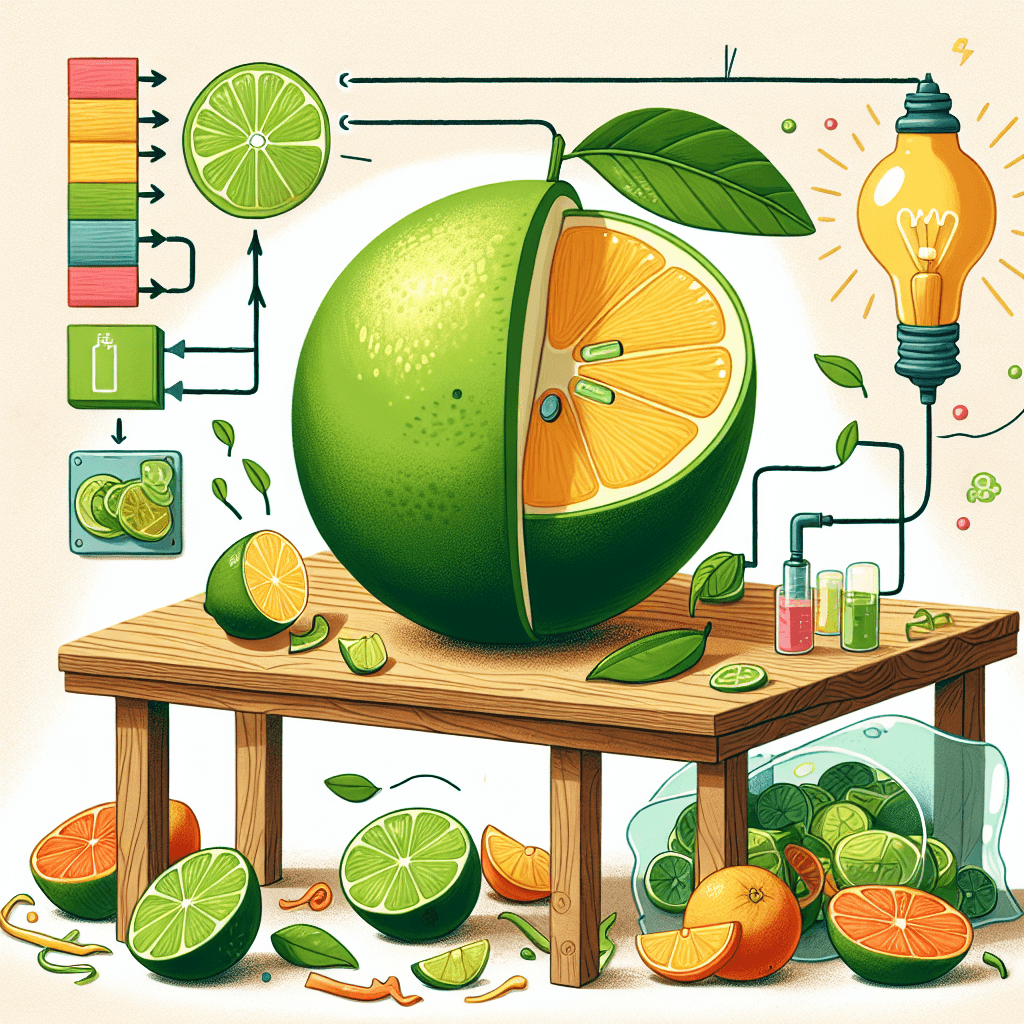
Lime Power: Generating Electricity from Citrus Waste
Inquiry Framework
Question Framework
Driving Question
The overarching question that guides the entire project.How can we harness the power of lime to create sustainable electricity while minimizing environmental impact?Essential Questions
Supporting questions that break down major concepts.- How can we use natural resources like lime to generate electricity?
- What are the environmental impacts of using lime as a source of energy?
- How does a lime-based battery work, and what are its limitations?
- What are the potential applications of lime-generated electricity in sustainable energy solutions?
Standards & Learning Goals
Learning Goals
By the end of this project, students will be able to:- Understand and apply the principles of energy transformation through the design of a lime battery.
- Evaluate the environmental impact of using bio-resources like lime for energy generation.
- Design and construct a working lime-based battery that demonstrates sustainable electricity generation.
- Explore real-world applications and implications of lime-generated electricity in sustainable energy solutions.
Next Generation Science Standards
Entry Events
Events that will be used to introduce the project to studentsStranded Bus Emergency
A snowstorm strands the student and a small group on a school bus with no heat or communication. The bus driver’s phone dies. The student uses leftover lunch items (lime), some copper wire from a phone charger, and a zinc keychain piece to power a small LED as a distress signal.Portfolio Activities
Portfolio Activities
These activities progressively build towards your learning goals, with each submission contributing to the student's final portfolio.Electrochemical Reaction Research
Students will research the basic principles of electrochemical reactions and the components needed to build a simple battery using lime as an electrolyte. They will explore the roles of electrodes, electrolytes, and oxidation-reduction reactions in generating electricity.Steps
Here is some basic scaffolding to help students complete the activity.Final Product
What students will submit as the final product of the activityA detailed research report outlining the electrochemical principles behind lime batteries, including diagrams of the battery setup and explanations of the chemical reactions involved.Alignment
How this activity aligns with the learning objectives & standardsAligns with NGSS.HS-PS3-3 by requiring students to design and build a device (lime battery) to convert chemical energy into electrical energy.Lime Battery Construction
Students will construct a basic lime battery using readily available materials (lime, zinc, copper, wires) based on their research. They will measure the voltage and current produced by the battery and document the construction process.Steps
Here is some basic scaffolding to help students complete the activity.Final Product
What students will submit as the final product of the activityA functional lime battery, along with a detailed logbook documenting the construction process, materials used, and initial voltage and current measurements.Alignment
How this activity aligns with the learning objectives & standardsAddresses NGSS.HS-PS3-3 as students build and refine a lime battery, focusing on energy conversion.Energy Transformation Modeling and Design Refinement
Students will create a model (physical or digital) illustrating the energy transformations occurring within the lime battery. They will analyze the factors affecting the battery's performance and identify potential improvements.Steps
Here is some basic scaffolding to help students complete the activity.Final Product
What students will submit as the final product of the activityAn annotated model (physical or digital) of the lime battery, showing energy transformations, and a report discussing factors affecting battery performance and potential improvements.Alignment
How this activity aligns with the learning objectives & standardsCorresponds to NGSS.HS-PS3-2 by requiring students to model energy transformations within the lime battery system.Lime Power Science Fair Poster
Students will explore and present real-world applications of lime-generated electricity, focusing on its potential in sustainable energy solutions and comparing it with other renewable energy sources. The presentation will be in the form of a science fair poster.Steps
Here is some basic scaffolding to help students complete the activity.Final Product
What students will submit as the final product of the activityA science fair poster showcasing real-world applications of lime-generated electricity, comparing its advantages and disadvantages with other renewable energy sources.Alignment
How this activity aligns with the learning objectives & standardsRelates to NGSS.HS-ESS3-4 by exploring real-world applications of lime-generated electricity in sustainable energy solutions.Rubric & Reflection
Portfolio Rubric
Grading criteria for assessing the overall project portfolioLime Battery Project Rubric
Electrochemical Research
Assessment of the quality of research and explanation of electrochemical reactions within lime batteries.Research Quality
Accuracy of electrochemical principles and completeness of research on lime batteries.
Exemplary
4 PointsDemonstrates comprehensive and accurate understanding of electrochemical principles with detailed research on lime batteries, including advanced concepts.
Proficient
3 PointsDemonstrates thorough and mostly accurate understanding of electrochemical principles with complete research on lime batteries.
Developing
2 PointsShows basic understanding of electrochemical principles with partially complete research on lime batteries.
Beginning
1 PointsShows limited understanding of electrochemical principles with incomplete or inaccurate research on lime batteries.
Diagram and Explanation
Clarity and detail of the diagram of the lime battery setup and explanation of chemical reactions.
Exemplary
4 PointsDiagram is exceptionally clear, detailed, and insightful, with thorough explanations of chemical reactions at each electrode.
Proficient
3 PointsDiagram is clear and detailed, with accurate explanations of chemical reactions at each electrode.
Developing
2 PointsDiagram is somewhat clear and contains basic explanations of chemical reactions at each electrode.
Beginning
1 PointsDiagram is unclear or incomplete, with limited or inaccurate explanations of chemical reactions.
Lime Battery Construction
Assessment of the construction and documentation of the lime battery.Battery Functionality
Functionality and completeness of the constructed lime battery.
Exemplary
4 PointsLime battery functions exceptionally well and demonstrates innovative design elements; all components are fully integrated and optimized.
Proficient
3 PointsLime battery functions well and includes all necessary components, demonstrating a clear understanding of the construction process.
Developing
2 PointsLime battery functions partially but may be missing some components or have assembly issues.
Beginning
1 PointsLime battery does not function or is missing essential components.
Logbook Documentation
Detail and accuracy of the logbook documenting the construction process and measurements.
Exemplary
4 PointsLogbook is exceptionally detailed, accurate, and insightful, providing comprehensive data and reflections on the construction process and measurements.
Proficient
3 PointsLogbook is detailed and accurate, providing clear documentation of the construction process, materials used, and initial voltage/current measurements.
Developing
2 PointsLogbook provides some details but may be missing information or lack accuracy in measurements.
Beginning
1 PointsLogbook is incomplete, lacking essential details about the construction process or measurements.
Energy Transformation
Evaluation of the model created to represent energy transformations within the lime battery.Model Accuracy
Clarity and accuracy of the model representing the components of the lime battery.
Exemplary
4 PointsModel is exceptionally clear, accurate, and insightful, demonstrating advanced understanding of the battery components and their interactions.
Proficient
3 PointsModel is clear and accurate, effectively representing the components of the lime battery.
Developing
2 PointsModel is somewhat clear but may contain inaccuracies or lack detail in representing the battery components.
Beginning
1 PointsModel is unclear, inaccurate, or incomplete, failing to represent the battery components effectively.
Energy Flow and Analysis
Effectiveness in illustrating the flow of energy within the battery and analysis of factors affecting performance.
Exemplary
4 PointsIllustrates energy flow comprehensively and provides an insightful analysis of factors affecting battery performance, including innovative improvements.
Proficient
3 PointsEffectively illustrates energy flow and provides a thorough analysis of factors affecting battery performance with suggested improvements.
Developing
2 PointsIllustrates energy flow adequately but provides a basic analysis of factors affecting battery performance with limited improvements.
Beginning
1 PointsFails to illustrate energy flow effectively and provides minimal analysis of factors affecting battery performance.
Real-World Applications
Assessment of the presentation showcasing real-world applications of lime-generated electricity and its comparison to other renewable energy sources.Application Research
Comprehensiveness of research on real-world applications of lime-generated electricity.
Exemplary
4 PointsResearch is exceptionally comprehensive and demonstrates an in-depth understanding of real-world applications, including innovative and forward-thinking solutions.
Proficient
3 PointsResearch is comprehensive and demonstrates a clear understanding of real-world applications of lime-generated electricity.
Developing
2 PointsResearch is adequate but may lack depth in exploring real-world applications.
Beginning
1 PointsResearch is minimal and lacks understanding of real-world applications of lime-generated electricity.
Presentation Quality
Clarity and insightfulness of the presentation comparing lime-generated electricity with other renewable energy sources.
Exemplary
4 PointsPresentation is exceptionally clear, insightful, and persuasive, offering a nuanced comparison with other renewable energy sources and demonstrating leadership.
Proficient
3 PointsPresentation is clear, insightful, and compares lime-generated electricity effectively with other renewable energy sources.
Developing
2 PointsPresentation is adequate but may lack clarity or depth in comparing energy sources.
Beginning
1 PointsPresentation is unclear, lacks insight, and fails to compare energy sources effectively.