
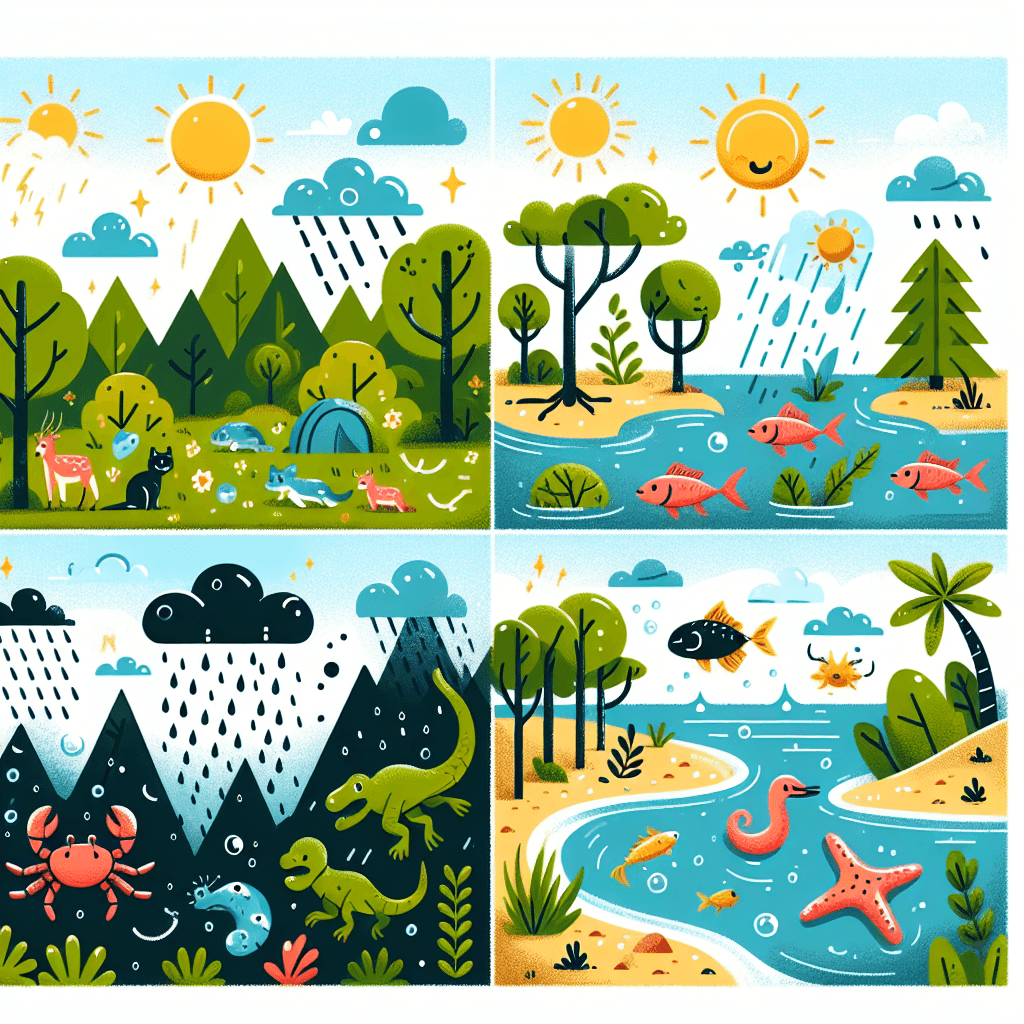
Living and Non-Living Worlds: Habitats and Weather
Inquiry Framework
Question Framework
Driving Question
The overarching question that guides the entire project.How can we observe and classify the world around us by understanding what makes something living or non-living, where different organisms live, and how weather influences their survival?Essential Questions
Supporting questions that break down major concepts.- What are the basic characteristics that distinguish living organisms from non-living things?
- How do different habitats support various forms of life?
- What are some common weather patterns and how do they affect living organisms?
Standards & Learning Goals
Learning Goals
By the end of this project, students will be able to:- Students will identify and describe the basic characteristics that distinguish living organisms from non-living things.
- Students will explore and explain how different habitats support various forms of life.
- Students will identify and describe common weather patterns and explain how they affect living organisms.
- Students will develop skills in observing and classifying organisms and materials based on their properties.
Next Generation Science Standards
Entry Events
Events that will be used to introduce the project to studentsVirtual Habitat Safari
Through virtual reality headsets, students are transported to different habitats – from lush rainforests to arid deserts. They explore and identify the different organisms within these settings, sparking interest in how weather and environment impact living organisms. This interactive experience allows them to develop a deeper understanding through exploration and observation.Portfolio Activities
Portfolio Activities
These activities progressively build towards your learning goals, with each submission contributing to the student's final portfolio.Living vs. Non-Living Detective
Students investigate the characteristics that differentiate living organisms from non-living things through hands-on exploration and observation.Steps
Here is some basic scaffolding to help students complete the activity.Final Product
What students will submit as the final product of the activityA chart categorizing objects as living or non-living with listed characteristics.Alignment
How this activity aligns with the learning objectives & standardsSupports 2-LS4-1 by guiding students to identify characteristics of living organisms.Habitat Model Making
Students create models of different habitats to understand and explore how these environments support various forms of life.Steps
Here is some basic scaffolding to help students complete the activity.Final Product
What students will submit as the final product of the activityA three-dimensional habitat model complete with labeled features and organisms.Alignment
How this activity aligns with the learning objectives & standardsAligns with 2-LS4-1 by focusing on life diversity in different habitats.Rubric & Reflection
Portfolio Rubric
Grading criteria for assessing the overall project portfolioLiving and Non-Living: Habitats and Weather Effects
Understanding Living vs Non-Living
Evaluates students' ability to differentiate between living and non-living things based on observable characteristics.Identification of Characteristics
Ability to identify and describe characteristics that distinguish living organisms from non-living things.
Exemplary
4 PointsConsistently identifies and describes multiple characteristics distinguishing living from non-living things with accuracy and detail.
Proficient
3 PointsIdentifies and describes several key characteristics distinguishing living from non-living things with reasonable accuracy.
Developing
2 PointsIdentifies some characteristics of living and non-living things, albeit inconsistently and with partial accuracy.
Beginning
1 PointsStruggles to identify characteristics of living vs non-living things, showing limited understanding.
Classification Skills
Skill in sorting objects into 'living' and 'non-living' categories based on observation.
Exemplary
4 PointsEfficiently and accurately sorts a variety of objects into correct categories with detailed justifications.
Proficient
3 PointsAccurately sorts most objects into correct categories with partial justifications.
Developing
2 PointsSorts objects with some accuracy but struggles to justify choices consistently.
Beginning
1 PointsStruggles to sort objects correctly, providing minimal justification.
Understanding Habitats and Diversity
Assesses understanding of different habitats and how they support diverse forms of life.Habitat Features Identification
Ability to identify key features of selected habitats.
Exemplary
4 PointsIdentifies and describes detailed and accurate features of selected habitats with compelling explanations of how these features support diverse life.
Proficient
3 PointsIdentifies and describes accurate features of selected habitats with explanations of how these features support life.
Developing
2 PointsIdentifies some features of habitats but provides limited explanations about life support.
Beginning
1 PointsStruggles to identify features of habitats and provide explanations.
Model Construction and Presentation
Quality of habitat model construction and the ability to present and explain model details.
Exemplary
4 PointsConstructs a detailed, accurate model and presents findings with clarity, depth, and enthusiasm.
Proficient
3 PointsConstructs a clear model and presents findings with adequate detail and clarity.
Developing
2 PointsConstructs a model with minimal detail and struggles to present findings clearly.
Beginning
1 PointsStruggles to construct a coherent model and provide a clear presentation.
Understanding Weather Effects
Evaluates understanding of weather patterns and their effects on living organisms and habitats.Weather Pattern Identification
Ability to identify and describe common weather patterns.
Exemplary
4 PointsAccurately identifies and describes multiple weather patterns with comprehensive explanations of their effects.
Proficient
3 PointsIdentifies and describes several weather patterns with reasonable explanations of their effects.
Developing
2 PointsIdentifies some weather patterns with limited explanations of their effects.
Beginning
1 PointsStruggles to identify weather patterns and provide explanations of their effects.