
Inquiry Framework
Question Framework
Driving Question
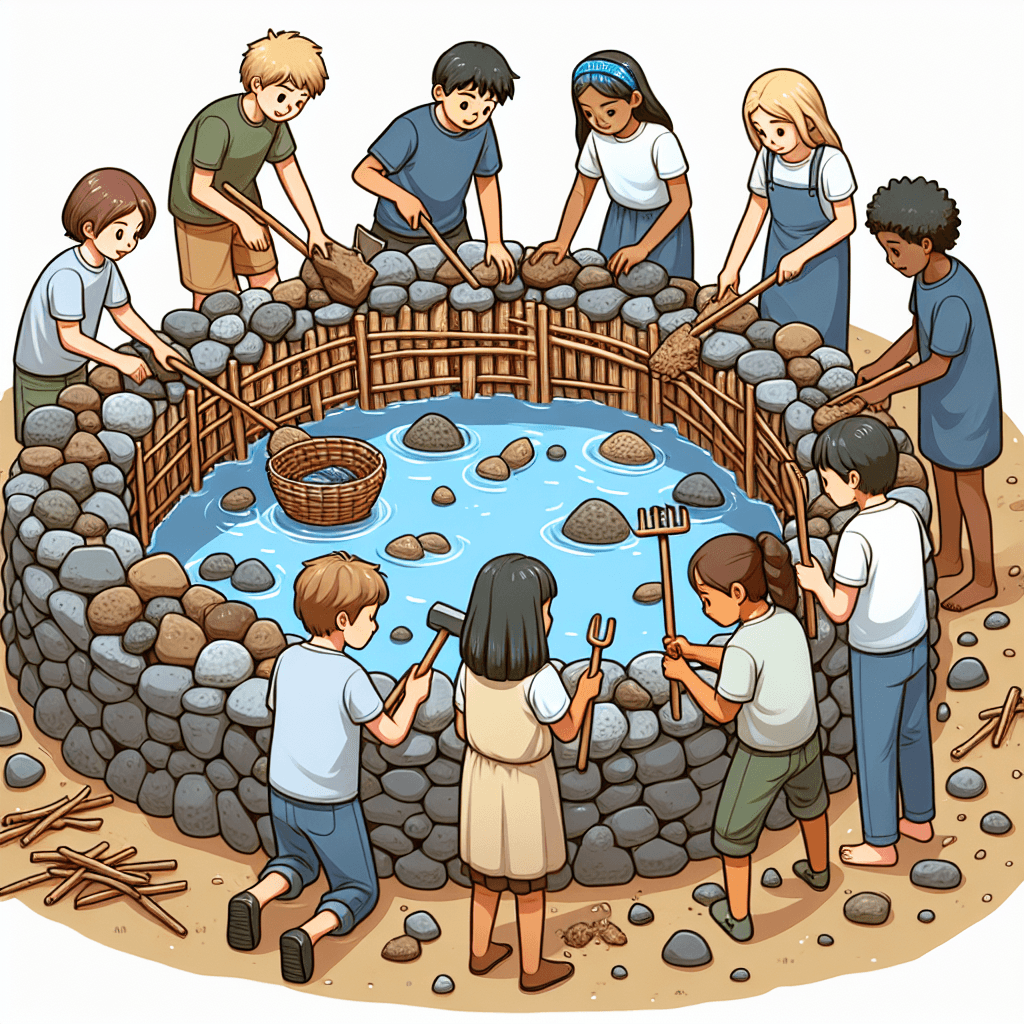
The overarching question that guides the entire project.How can we design and build a scale model of a traditional Hawaiian fishpond (loko iʻa) that effectively manages water flow and demonstrates the properties of strong wall construction using natural materials?Essential Questions
Supporting questions that break down major concepts.- What makes a strong wall?
- How does water pressure affect the wall?
- How can we control water flow in and out of the pond?
- What natural materials are best for building a fishpond wall?
- How do traditional Hawaiian fishponds work?
Standards & Learning Goals
Learning Goals
By the end of this project, students will be able to:- Understand the basic structure and function of a traditional Hawaiian fishpond (loko iʻa).
- Design and construct a scale model of a kuapā (pond wall) using natural materials.
- Apply knowledge of material properties to build a strong and water-resistant structure.
- Incorporate a functioning mākāhā (sluice gate) to manage water flow in the model fishpond.
- Test and evaluate the effectiveness of the kuapā in holding water and controlling water flow.
- Collaborate in teams, assigning roles such as builder, tester, and recorder to accomplish project goals.
- Use visual aids and vocabulary related to loko iʻa to support understanding and communication.
- Explain the importance of loko iʻa in traditional Hawaiian culture and sustainability.
- Record and present findings of the build and test.
- Understand the relationship between water pressure and wall stability.
- Learn about the properties of different materials.
- Apply the engineering design process to solve a problem.
- Use mathematical skills to measure and construct the model.
- Develop communication skills by discussing the project and findings.
- Foster creativity by finding unique solutions to construction challenges.
- Develop art and design skills by designing the physical appearance of the loko iʻa.
- Learn about traditional Hawaiian building techniques.
Entry Events
Events that will be used to introduce the project to studentsThe Fisherman's Plea
A local fisherman arrives in class with a broken section of a miniature kuapā (fishpond wall). He explains that the fish are escaping and asks for the students' help to redesign and rebuild it. This sets the stage for them to learn about traditional Hawaiian fishponds and engineering principles.Portfolio Activities
Portfolio Activities
These activities progressively build towards your learning goals, with each submission contributing to the student's final portfolio.Kuapā Design Brainstorm
Students will brainstorm and sketch initial designs for their kuapā, considering the materials available and the function of the wall.Steps
Here is some basic scaffolding to help students complete the activity.Final Product
What students will submit as the final product of the activityInitial design sketches of the kuapā, labeled with materials and dimensions.Alignment
How this activity aligns with the learning objectives & standardsLearning Goal: Design and construct a scale model of a kuapā (pond wall) using natural materials.Material Properties Lab
Students will test different materials for water resistance and strength, recording their findings to inform their building choices.Steps
Here is some basic scaffolding to help students complete the activity.Final Product
What students will submit as the final product of the activityA material testing log with observations and conclusions about the properties of different materials.Alignment
How this activity aligns with the learning objectives & standardsLearning Goal: Apply knowledge of material properties to build a strong and water-resistant structure.Kuapā Construction Crew
Students will construct the kuapā based on their designs, using the tested materials and ensuring it can hold water.Steps
Here is some basic scaffolding to help students complete the activity.Final Product
What students will submit as the final product of the activityA completed kuapā model that can hold water without significant leakage.Alignment
How this activity aligns with the learning objectives & standardsLearning Goal: Design and construct a scale model of a kuapā (pond wall) using natural materials.Mākāhā Mechanics
Students will integrate a mākāhā into their kuapā design, enabling controlled water flow in and out of the model fishpond.Steps
Here is some basic scaffolding to help students complete the activity.Final Product
What students will submit as the final product of the activityA functioning mākāhā integrated into the kuapā model, allowing for controlled water flow.Alignment
How this activity aligns with the learning objectives & standardsLearning Goal: Incorporate a functioning mākāhā (sluice gate) to manage water flow in the model fishpond.Loko Iʻa Performance Test
Students will test the completed loko iʻa model by filling it with water and observing its performance, making adjustments as needed.Steps
Here is some basic scaffolding to help students complete the activity.Final Product
What students will submit as the final product of the activityA tested and evaluated loko iʻa model with a functioning kuapā and mākāhā, along with a written evaluation of its performance.Alignment
How this activity aligns with the learning objectives & standardsLearning Goal: Test and evaluate the effectiveness of the kuapā in holding water and controlling water flow.Rubric & Reflection
Portfolio Rubric
Grading criteria for assessing the overall project portfolioLoko Iʻa Structure Challenge Rubric
Kuapā Design Brainstorm
This category assesses the quality and thoughtfulness of the initial kuapā design brainstorm, focusing on design clarity, structural integrity, and material selection.Design Clarity and Detail
This criterion assesses the clarity, detail, and thoughtfulness of the initial kuapā design sketches, including labeled materials and dimensions.
Exemplary
4 PointsThe design sketches are exceptionally detailed, clearly labeled with precise dimensions and materials, and demonstrate innovative solutions to structural challenges.
Proficient
3 PointsThe design sketches are detailed, labeled with dimensions and materials, and demonstrate a good understanding of structural requirements.
Developing
2 PointsThe design sketches are present but lack detail, with some materials and dimensions labeled, and demonstrate a basic understanding of structural requirements.
Beginning
1 PointsThe design sketches are incomplete, lack labels, and demonstrate minimal understanding of structural requirements.
Structural Integrity Considerations
This criterion assesses the consideration of stability and water resistance in the kuapā design.
Exemplary
4 PointsThe design demonstrates an innovative approach to ensuring stability and water resistance, going beyond the basic requirements with unique solutions.
Proficient
3 PointsThe design demonstrates a clear understanding of stability and water resistance principles.
Developing
2 PointsThe design shows some consideration for stability and water resistance, but understanding may be limited.
Beginning
1 PointsThe design shows little to no consideration for stability and water resistance.
Material Selection Rationale
This criterion assesses the thoughtfulness and feasibility of the materials chosen for the kuapā, based on their properties.
Exemplary
4 PointsMaterials chosen are exceptionally well-suited for the kuapā, demonstrating a deep understanding of their properties and how they contribute to the structure's success.
Proficient
3 PointsMaterials chosen are appropriate for the kuapā and demonstrate a good understanding of their properties.
Developing
2 PointsSome materials chosen may not be ideal for the kuapā, indicating a limited understanding of their properties.
Beginning
1 PointsMaterials chosen are unsuitable for the kuapā, demonstrating a lack of understanding of their properties.
Material Properties Lab
This category assesses the material properties lab, focusing on the thoroughness of the testing log, the quality of the testing methods, and the application of testing results to inform material choices.Material Testing Log Accuracy and Detail
This criterion assesses the thoroughness and accuracy of the material testing log, including detailed observations and conclusions about water resistance and strength.
Exemplary
4 PointsThe material testing log is exceptionally thorough, with precise observations, accurate conclusions, and innovative testing methods.
Proficient
3 PointsThe material testing log is thorough, with clear observations and accurate conclusions.
Developing
2 PointsThe material testing log is present but lacks detail, with some observations and conclusions missing or unclear.
Beginning
1 PointsThe material testing log is incomplete, with minimal observations and inaccurate conclusions.
Testing Methodology Quality
This criterion assesses the quality of the methods used to test the materials for water resistance and strength.
Exemplary
4 PointsTesting methods are innovative, highly effective, and demonstrate a sophisticated understanding of material properties.
Proficient
3 PointsTesting methods are effective and appropriate for determining water resistance and strength.
Developing
2 PointsTesting methods are basic and may not accurately determine water resistance and strength.
Beginning
1 PointsTesting methods are inadequate or not used effectively.
Application of Testing Results
This criterion assesses how well the findings from the material testing log are used to inform the choice of materials for the kuapā construction.
Exemplary
4 PointsMaterial choices are exceptionally well-justified based on the testing results, demonstrating a deep understanding of material properties.
Proficient
3 PointsMaterial choices are clearly justified based on the testing results.
Developing
2 PointsMaterial choices are partially justified or not clearly linked to the testing results.
Beginning
1 PointsMaterial choices are not justified by the testing results.
Kuapā Construction Crew
This category assesses the kuapā construction, focusing on structural stability, adherence to the initial design, and overall craftsmanship.Structural Stability and Water Retention
This criterion assesses the stability and water-holding capacity of the completed kuapā model.
Exemplary
4 PointsThe kuapā model is exceptionally stable, demonstrates superior water-holding capacity, and incorporates innovative design elements.
Proficient
3 PointsThe kuapā model is stable and holds water effectively without significant leakage.
Developing
2 PointsThe kuapā model has some stability issues or leaks, but generally holds water.
Beginning
1 PointsThe kuapā model is unstable and leaks significantly or cannot hold water.
Adherence to Design
This criterion assesses the degree to which the kuapā construction adheres to the initial design sketches.
Exemplary
4 PointsThe kuapā construction closely follows the initial design sketches, with modifications made to improve functionality and design.
Proficient
3 PointsThe kuapā construction largely follows the initial design sketches.
Developing
2 PointsThe kuapā construction deviates somewhat from the initial design sketches.
Beginning
1 PointsThe kuapā construction bears little resemblance to the initial design sketches.
Craftsmanship and Detail
This criterion assesses the overall craftsmanship and attention to detail in the kuapā construction.
Exemplary
4 PointsThe kuapā demonstrates exceptional craftsmanship, with meticulous attention to detail and a high level of finish.
Proficient
3 PointsThe kuapā demonstrates good craftsmanship and attention to detail.
Developing
2 PointsThe kuapā demonstrates basic craftsmanship with some attention to detail.
Beginning
1 PointsThe kuapā demonstrates poor craftsmanship with little attention to detail.
Mākāhā Mechanics
This category assesses the mākāhā design and integration, focusing on water flow control effectiveness, integration quality, and mechanism durability.Water Flow Control Effectiveness
This criterion assesses the effectiveness of the mākāhā design in controlling water flow in and out of the loko iʻa model.
Exemplary
4 PointsThe mākāhā design is exceptionally effective and innovative, allowing for precise and controlled water flow in both directions.
Proficient
3 PointsThe mākāhā design effectively controls water flow in and out of the loko iʻa model.
Developing
2 PointsThe mākāhā design has some functionality but may not fully control water flow or may leak.
Beginning
1 PointsThe mākāhā design is ineffective and does not control water flow.
Integration Quality
This criterion assesses the seamlessness of the mākāhā integration into the kuapā structure.
Exemplary
4 PointsThe mākāhā is seamlessly integrated into the kuapā structure, enhancing both functionality and aesthetics.
Proficient
3 PointsThe mākāhā is well-integrated into the kuapā structure.
Developing
2 PointsThe mākāhā is integrated into the kuapā structure, but the integration is not seamless.
Beginning
1 PointsThe mākāhā is poorly integrated into the kuapā structure.
Mechanism Durability and Reliability
This criterion assesses the durability and reliability of the mākāhā mechanism.
Exemplary
4 PointsThe mākāhā mechanism is exceptionally durable and reliable, with smooth and consistent operation.
Proficient
3 PointsThe mākāhā mechanism is durable and operates reliably.
Developing
2 PointsThe mākāhā mechanism functions but may be fragile or unreliable.
Beginning
1 PointsThe mākāhā mechanism is flimsy and easily broken.
Loko Iʻa Performance Test
This category assesses the performance testing of the loko iʻa model, focusing on the thoroughness of the evaluation, the effectiveness of the adjustments made, and the overall model performance.Evaluation Thoroughness and Accuracy
This criterion assesses the thoroughness and accuracy of the loko iʻa model performance evaluation.
Exemplary
4 PointsThe performance evaluation is exceptionally thorough, providing detailed insights into all aspects of the model's functionality and performance, and including innovative improvement suggestions.
Proficient
3 PointsThe performance evaluation is thorough and provides clear insights into the model's functionality and performance.
Developing
2 PointsThe performance evaluation is present but lacks detail, with some observations or conclusions missing.
Beginning
1 PointsThe performance evaluation is incomplete and lacks essential observations or conclusions.
Improvement Effectiveness
This criterion assesses the quality and effectiveness of the adjustments made to improve the model's functionality based on the performance test.
Exemplary
4 PointsAdjustments are exceptionally effective and demonstrate innovative problem-solving skills, significantly improving the model's functionality.
Proficient
3 PointsAdjustments are effective and improve the model's functionality.
Developing
2 PointsSome adjustments are made, but their effectiveness is limited.
Beginning
1 PointsNo significant adjustments are made, or adjustments are ineffective.
Overall Model Performance
This criterion assesses the overall performance of the loko iʻa model, considering the kuapā's water-holding capacity and the mākāhā's water flow control.
Exemplary
4 PointsThe loko iʻa model demonstrates exceptional performance, with a completely watertight kuapā and precise mākāhā control, reflecting a deep understanding of the system.
Proficient
3 PointsThe loko iʻa model performs well, with a kuapā that effectively holds water and a mākāhā that controls water flow.
Developing
2 PointsThe loko iʻa model has some performance issues, such as minor leaks in the kuapā or difficulty controlling water flow with the mākāhā.
Beginning
1 PointsThe loko iʻa model performs poorly, with significant leaks in the kuapā and an ineffective mākāhā.