
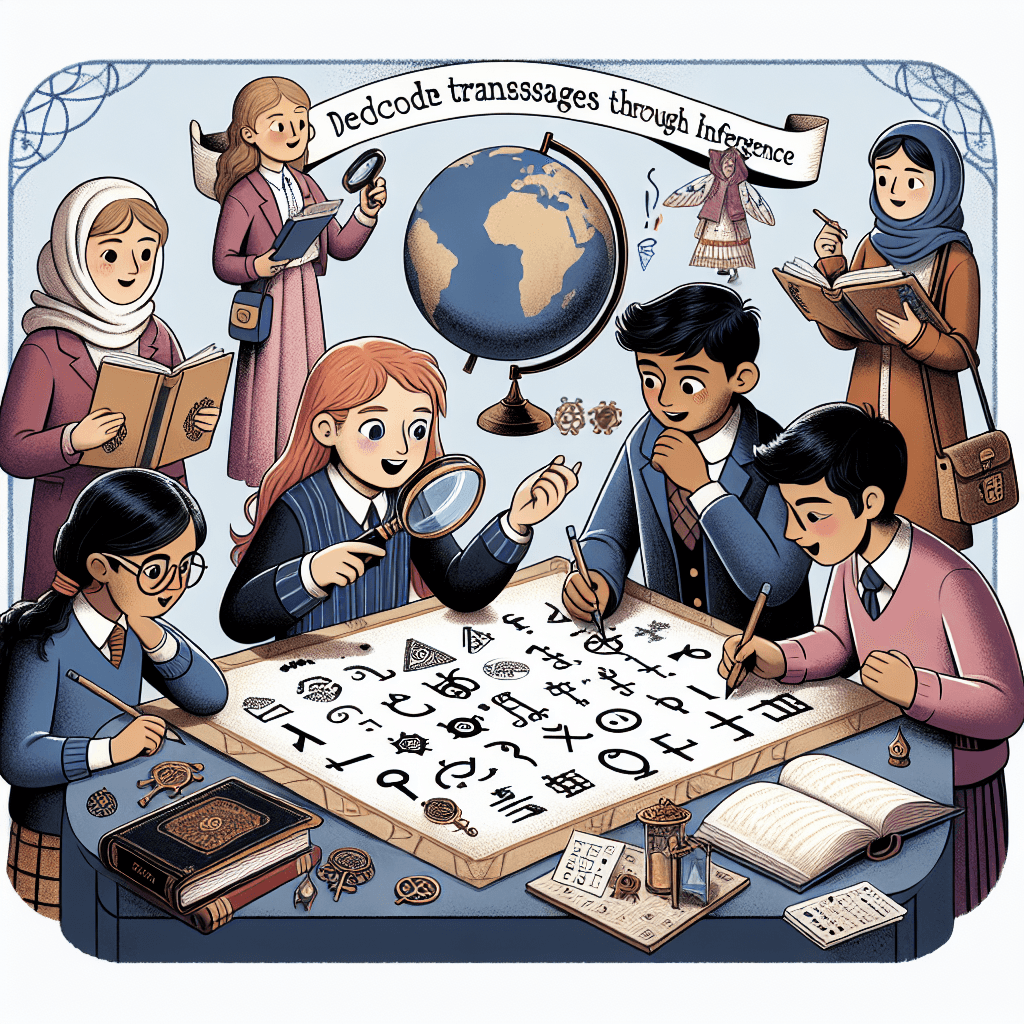
Lost in Translation: Decode Messages Through Inference
Inquiry Framework
Question Framework
Driving Question
The overarching question that guides the entire project.How can we effectively decode messages by using inference strategies to understand context and uncover clues within a text?Essential Questions
Supporting questions that break down major concepts.- What strategies can we use to make inferences from a text?
- How can understanding the context help us decode messages?
- Why are clues in the text important for making inferences?
- How does making inferences enhance our understanding of a story?
Standards & Learning Goals
Learning Goals
By the end of this project, students will be able to:- Students will develop the ability to use context clues to make inferences from a text.
- Students will learn to identify textual evidence that supports their inferences.
- Students will enhance their critical thinking skills by analyzing text for clues and drawing logical conclusions.
- Students will improve their comprehension by understanding the role of inferences in interpreting a text.
- Students will be able to articulate their inferencing process and conclusions effectively.
Common Core Standards
Entry Events
Events that will be used to introduce the project to studentsMystery Envelope Challenge
Upon entering the classroom, students find envelopes on their desks, each containing a mysterious, coded message about a stolen artifact. Their task is to decode the message to reveal the 'who, what, where, and when' of the artifact's recovery operation. This will not only spark their curiosity but also connect directly to the core goals of inferencing in texts.Portfolio Activities
Portfolio Activities
These activities progressively build towards your learning goals, with each submission contributing to the student's final portfolio.Inference Collaboration Corner
This activity enhances inference skills through collaboration, where students work in groups to discuss different perspectives and inferencing strategies on a more complex coded message.Steps
Here is some basic scaffolding to help students complete the activity.Final Product
What students will submit as the final product of the activityA group summary and presentation of the decoded message, highlighting the collaborative inferencing process.Alignment
How this activity aligns with the learning objectives & standardsMeets CCSS.ELA-LITERACY.SL.4.1 by engaging students in collaborative discussions that build on shared ideas.Inference Showcase
To demonstrate their overall learning, students will create a portfolio showcasing their inferencing journey throughout the project, highlighting decoded messages and the steps taken to reach their conclusions.Steps
Here is some basic scaffolding to help students complete the activity.Final Product
What students will submit as the final product of the activityA comprehensive portfolio showcasing students' inferencing ability and a reflective narrative of their learning process.Alignment
How this activity aligns with the learning objectives & standardsReinforces CCSS.ELA-LITERACY.RL.4.1 and CCSS.ELA-LITERACY.RL.4.4 by combining text inferences with vocabulary comprehension, while also supporting CCSS.ELA-LITERACY.SL.4.1 through reflective presentations.Message Decoding Detective
In this activity, students will become detectives tasked with decoding their first coded message from the mystery envelopes using inferencing skills. The goal is to identify the key elements of the message (who, what, where, when) by making inferences from the text provided.Steps
Here is some basic scaffolding to help students complete the activity.Final Product
What students will submit as the final product of the activityA paragraph summarizing the decoded message using inferences.Alignment
How this activity aligns with the learning objectives & standardsAligns with CCSS.ELA-LITERACY.RL.4.1 by requiring students to refer to details and examples in a text to make inferences.Context Clue Navigator
Students will dive into the deeper practice of using context clues to infer meanings of unknown words and phrases within their coded messages. This activity focuses on understanding vocabulary in context, a critical aspect of decoding and comprehension.Steps
Here is some basic scaffolding to help students complete the activity.Final Product
What students will submit as the final product of the activityAn illustrated message that shows understanding of keywords and phrases through visual representation.Alignment
How this activity aligns with the learning objectives & standardsAddresses CCSS.ELA-LITERACY.RL.4.4 by determining the meaning of words and phrases using context.Rubric & Reflection
Portfolio Rubric
Grading criteria for assessing the overall project portfolioInference and Decoding Skills Assessment Rubric
Inferencing Skills
Measures the student's ability to make logical inferences from text, supported by evidence.Logical Inferences
Evaluates how well students make logical inferences from a text using context clues.
Exemplary
4 PointsMakes highly logical and insightful inferences consistently, with strong supporting evidence from the text.
Proficient
3 PointsMakes logical inferences frequently, with clear supporting evidence from the text.
Developing
2 PointsMakes some logical inferences, but often lacks sufficient supporting evidence.
Beginning
1 PointsStruggles to make logical inferences or provide supporting evidence.
Use of Context Clues
Assesses how effectively students use context clues to understand and decode messages.
Exemplary
4 PointsUses context clues adeptly to accurately decode messages and clarify meanings.
Proficient
3 PointsFrequently uses context clues effectively to decode messages and clarify meanings.
Developing
2 PointsAttempts to use context clues but with mixed effectiveness.
Beginning
1 PointsRarely uses context clues effectively to decode messages or clarify meanings.
Collaborative Communication
Assesses the student's ability to effectively engage in collaborative discussions while sharing inferences and decoding processes.Expressing Ideas
Evaluates the student's clarity and cohesion in sharing their inferences and ideas during discussions.
Exemplary
4 PointsExpresses ideas clearly and persuasively during discussions, consistently building on previous ideas.
Proficient
3 PointsExpresses ideas clearly during discussions and builds on previous ideas.
Developing
2 PointsShares ideas but lacks clarity or connection to previous ideas.
Beginning
1 PointsStruggles to express ideas clearly during discussions.
Active Listening
Measures the student's ability to actively listen and incorporate others' ideas in their understanding.
Exemplary
4 PointsConsistently demonstrates active listening, incorporating others' ideas into their understanding effectively.
Proficient
3 PointsShows active listening and incorporates others' ideas into their understanding.
Developing
2 PointsListens to others but rarely incorporates their ideas effectively.
Beginning
1 PointsStruggles with active listening and incorporation of others' ideas.
Artifact Presentation
Assesses the quality and coherence of the final presentations of their decoded messages and inferencing processes.Clarity of Presentation
Evaluates how clearly students present their decoded messages and inferences.
Exemplary
4 PointsPresentation is exceptionally clear, engaging, and logically structured.
Proficient
3 PointsPresentation is clear and well-structured.
Developing
2 PointsPresentation is somewhat clear but lacks structure.
Beginning
1 PointsPresentation lacks clarity and structure.
Depth of Analysis
Assesses the depth and thoroughness with which students analyze and present their inferencing process.
Exemplary
4 PointsProvides a comprehensive analysis of the inferencing process, with detailed examples and reflections.
Proficient
3 PointsProvides an analysis of the inferencing process with examples and reflections.
Developing
2 PointsAttempts to analyze the inferencing process but lacks depth and detail.
Beginning
1 PointsMinimal analysis of the inferencing process is presented.