
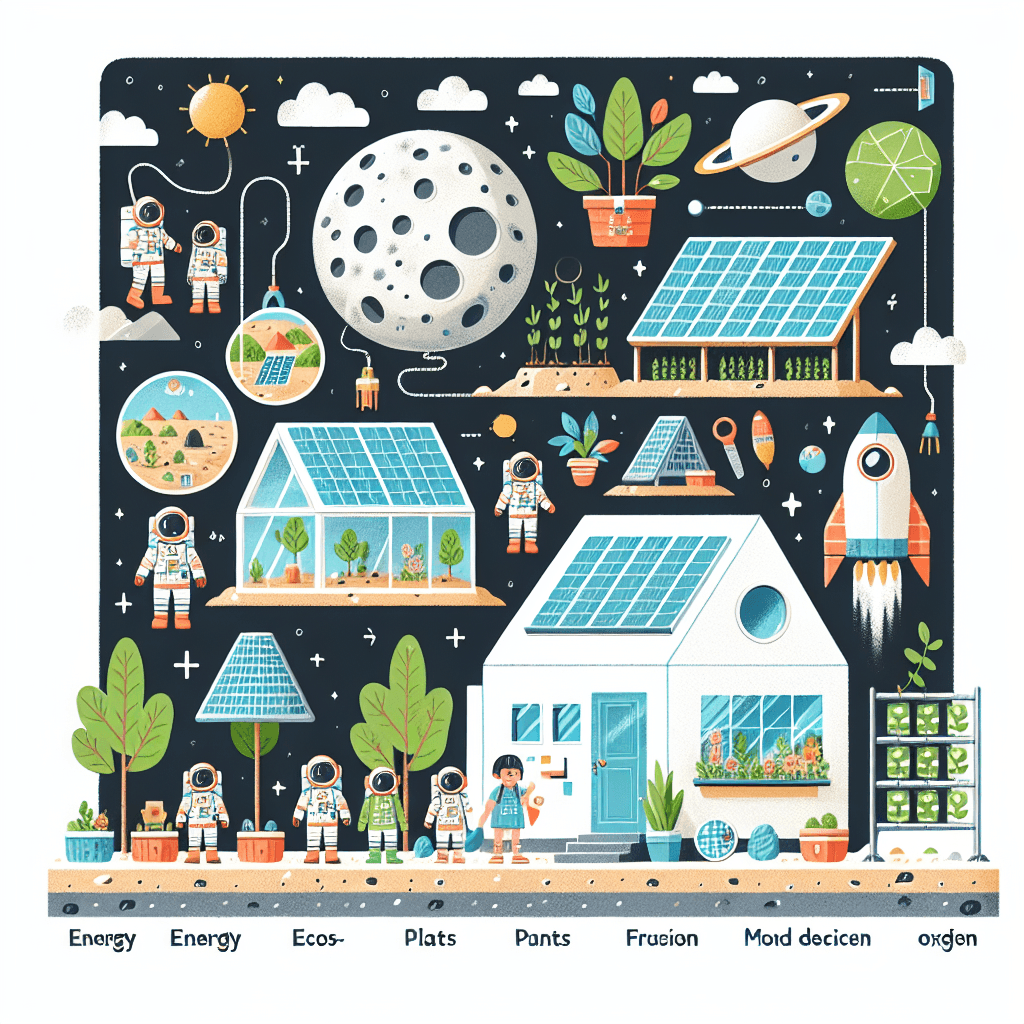
Lunar Oasis: Designing a Sustainable Lunar Habitat
Inquiry Framework
Question Framework
Driving Question
The overarching question that guides the entire project.How can we design a lunar habitat that provides long-term sustainability for astronauts while addressing the challenges and impacts of space exploration?Essential Questions
Supporting questions that break down major concepts.- How can we create a self-sustaining habitat on the Moon?
- What are the essential resources (air, water, food, energy) needed for human survival on the Moon, and how can we obtain/create them?
- How can technology help astronauts meet their basic needs in space?
- What are the environmental challenges of living on the Moon, and how can we overcome them?
- What are the positive and negative impacts of space research and exploration?
Standards & Learning Goals
Learning Goals
By the end of this project, students will be able to:- Students will be able to design a sustainable lunar habitat model that incorporates solutions for obtaining and managing essential resources.
- Students will be able to explain how technological advancements enable astronauts to meet their basic needs in space, providing specific examples.
- Students will be able to analyze the positive and negative impacts of space research programs, using evidence to support their claims.
- Students will be able to identify Canadian contributions to space science and technology.
- Students will be able to describe past and present space research programs and their contributions to scientific knowledge.
- Students will be able to identify technologies used in space to study Earth and improve communication.
- Students will be able to evaluate the environmental challenges of living on the Moon and propose solutions to overcome them
Alberta Program of Studies
Entry Events
Events that will be used to introduce the project to studentsLunar Town Hall Debate: Balancing Needs
Stage a mock 'town hall' debate where students represent different stakeholders in a lunar settlement (scientists, engineers, business owners, lunar inhabitants). Each group presents their priorities and concerns regarding resource allocation and sustainability. This activity fosters critical thinking, collaboration, and an understanding of the complex trade-offs involved in creating a functional lunar oasis.Portfolio Activities
Portfolio Activities
These activities progressively build towards your learning goals, with each submission contributing to the student's final portfolio.Needs in Space Technology Showcase
Students will research and create a presentation detailing technologies that provide astronauts with basic needs like air, water, food, and temperature control.Steps
Here is some basic scaffolding to help students complete the activity.Final Product
What students will submit as the final product of the activityA detailed presentation (PowerPoint, poster, or video) showcasing essential technologies for astronaut survival with labeled diagrams.Alignment
How this activity aligns with the learning objectives & standardsGLO: B1, B2, D1, D6: Focuses on identifying necessary technologies for astronaut survival.Learning Goal: Students will be able to explain how technological advancements enable astronauts to meet their basic needs in space, providing specific examples.Canadian Space Pioneers
Students will research and create a short biography about a Canadian who has significantly contributed to space science or technology.Steps
Here is some basic scaffolding to help students complete the activity.Final Product
What students will submit as the final product of the activityA one-page biography or a short video highlighting a Canadian's contribution to space exploration.Alignment
How this activity aligns with the learning objectives & standards6-4-03: Focuses on Canadian contributions to space. Learning Goal: Students will be able to identify Canadian contributions to space science and technology.Space Research Program Deep Dive
Students will investigate and compare two space research programs (e.g., Apollo and the International Space Station) and their contributions to scientific knowledge.Steps
Here is some basic scaffolding to help students complete the activity.Final Product
What students will submit as the final product of the activityA comparative report or presentation analyzing two space research programs, including their objectives, methods, and scientific outcomes.Alignment
How this activity aligns with the learning objectives & standards6-4-04: Focuses on investigating space research programs. Learning Goal: Students will be able to describe past and present space research programs and their contributions to scientific knowledge.The Space Exploration Impact Report
Students will create a balanced argument outlining the positive and negative impacts of space research, supporting each point with evidence.Steps
Here is some basic scaffolding to help students complete the activity.Final Product
What students will submit as the final product of the activityA persuasive essay or debate presentation outlining the pros and cons of space research with supporting evidence.Alignment
How this activity aligns with the learning objectives & standards6-4-05: Focuses on describing the positive and negative impacts arising from space research programs.Learning Goal: Students will be able to analyze the positive and negative impacts of space research programs, using evidence to support their claims.Earth From Space: Tech in Orbit
Students will create an infographic showcasing technological devices in space used to study Earth and improve communication.Steps
Here is some basic scaffolding to help students complete the activity.Final Product
What students will submit as the final product of the activityAn infographic illustrating space-based technologies used for Earth observation and communication (e.g., satellites, telescopes).Alignment
How this activity aligns with the learning objectives & standards6-4-06: Focuses on identifying space technologies that help humans learn about Earth. Learning Goal: Students will be able to identify technologies used in space to study Earth and improve communication.Rubric & Reflection
Portfolio Rubric
Grading criteria for assessing the overall project portfolioLunar Oasis Habitat Portfolio Rubric
Technology Showcase
Assessment of research, visual representation, and presentation skills related to technologies for astronaut survival.Research Accuracy
Accuracy and completeness of researched information on astronaut needs and supporting technologies.
Exemplary
4 PointsDemonstrates comprehensive and accurate research, including detailed explanations of multiple technologies and their functions. Information is thoroughly supported by evidence and examples.
Proficient
3 PointsDemonstrates accurate research, including clear explanations of technologies and their functions. Information is supported by evidence and examples.
Developing
2 PointsDemonstrates some research, but explanations may be incomplete or contain minor inaccuracies. Evidence and examples are limited.
Beginning
1 PointsDemonstrates minimal research with significant inaccuracies or omissions. Lacks supporting evidence and examples.
Visual Representation
Clarity and effectiveness of diagrams or visuals in illustrating how technologies work.
Exemplary
4 PointsDiagrams/visuals are exceptionally clear, detailed, and effectively illustrate the workings of each technology in an innovative manner. Enhances overall understanding.
Proficient
3 PointsDiagrams/visuals are clear, detailed, and effectively illustrate the workings of each technology. Supports understanding.
Developing
2 PointsDiagrams/visuals are present but may lack detail or clarity, making it difficult to understand the workings of the technologies. Partially supports understanding.
Beginning
1 PointsDiagrams/visuals are minimal, unclear, or missing, failing to illustrate the workings of the technologies. Does not support understanding.
Presentation Quality
Quality and clarity of the presentation in explaining each technology and its importance.
Exemplary
4 PointsPresentation is exceptionally well-organized, engaging, and clearly explains each technology and its importance with sophistication and insight. Captures audience attention and demonstrates leadership.
Proficient
3 PointsPresentation is well-organized and clearly explains each technology and its importance. Holds audience attention.
Developing
2 PointsPresentation is somewhat organized, but explanations may be unclear or incomplete. Struggles to maintain audience attention.
Beginning
1 PointsPresentation is disorganized, unclear, and fails to adequately explain the technologies or their importance. Loses audience attention.
Space Pioneer Biography
Assessment of research, writing, and presentation skills related to Canadian contributions to space science.Research Depth
Depth and accuracy of research on the chosen Canadian's background, achievements, and contributions to space science or technology.
Exemplary
4 PointsDemonstrates exceptionally thorough and accurate research, providing comprehensive details about the Canadian's background, achievements, and contributions. Includes unique insights.
Proficient
3 PointsDemonstrates thorough and accurate research, providing clear details about the Canadian's background, achievements, and contributions.
Developing
2 PointsDemonstrates some research, but details may be incomplete or contain minor inaccuracies regarding the Canadian's background, achievements, or contributions.
Beginning
1 PointsDemonstrates minimal research with significant inaccuracies or omissions regarding the Canadian's background, achievements, and contributions.
Presentation Clarity
Quality and clarity of the biography or video script, including effective use of visuals (photos, illustrations).
Exemplary
4 PointsBiography/video script is exceptionally well-written, engaging, and uses visuals innovatively to enhance the presentation. Demonstrates outstanding creativity and communication skills.
Proficient
3 PointsBiography/video script is well-written, clear, and uses visuals effectively to enhance the presentation. Demonstrates strong communication skills.
Developing
2 PointsBiography/video script is adequate but may lack clarity or engagement. Visuals are limited or not well-integrated. Demonstrates basic communication skills.
Beginning
1 PointsBiography/video script is poorly written, unclear, and lacks effective use of visuals. Demonstrates weak communication skills.
Impact and Effectiveness
Overall impact and effectiveness of the biography or video in highlighting the Canadian's contribution to space exploration.
Exemplary
4 PointsBiography/video is exceptionally impactful and effectively highlights the Canadian's contribution to space exploration, leaving a lasting impression. Shows leadership in recognizing contributions.
Proficient
3 PointsBiography/video is impactful and effectively highlights the Canadian's contribution to space exploration. Makes a clear impression.
Developing
2 PointsBiography/video is somewhat impactful but may not fully highlight the Canadian's contribution to space exploration. Makes a limited impression.
Beginning
1 PointsBiography/video is not impactful and fails to adequately highlight the Canadian's contribution to space exploration. Fails to make an impression.
Program Comparison
Assessment of research, analytical, and presentation skills related to space research programs.Research Thoroughness
Thoroughness of research into the objectives, methods, and results of each selected space research program.
Exemplary
4 PointsDemonstrates exceptionally thorough research, providing comprehensive and insightful details about the objectives, methods, and results of each program. Shows advanced understanding.
Proficient
3 PointsDemonstrates thorough research, providing clear and detailed information about the objectives, methods, and results of each program. Shows complete understanding.
Developing
2 PointsDemonstrates some research, but details may be incomplete or lack depth regarding the objectives, methods, or results of each program. Shows partial understanding.
Beginning
1 PointsDemonstrates minimal research with significant omissions or inaccuracies regarding the objectives, methods, and results of each program. Shows limited understanding.
Comparative Analysis
Quality of the comparison and contrast between the programs, focusing on their contributions to scientific knowledge.
Exemplary
4 PointsComparison/contrast is exceptionally insightful and effectively analyzes the programs' contributions to scientific knowledge with nuanced understanding and sophisticated critical thinking.
Proficient
3 PointsComparison/contrast is clear and effectively analyzes the programs' contributions to scientific knowledge with clear and effective critical thinking.
Developing
2 PointsComparison/contrast is present but may lack depth or clarity in analyzing the programs' contributions to scientific knowledge with basic critical thinking.
Beginning
1 PointsComparison/contrast is minimal or missing, failing to adequately analyze the programs' contributions to scientific knowledge with minimal critical thinking.
Presentation Organization
Clarity and organization of the written report or presentation in presenting the research findings.
Exemplary
4 PointsReport/presentation is exceptionally well-organized, clear, and engaging, presenting the research findings in a compelling and sophisticated manner. Shows leadership in presentation skills.
Proficient
3 PointsReport/presentation is well-organized, clear, and presents the research findings effectively. Shows confident presentation skills.
Developing
2 PointsReport/presentation is adequately organized but may lack clarity or engagement in presenting the research findings. Shows basic presentation skills.
Beginning
1 PointsReport/presentation is poorly organized, unclear, and fails to adequately present the research findings. Shows weak presentation skills.
Space Impact Analysis
Assessment of analytical, research, and argumentative skills related to the impacts of space exploration.Impact Exploration
Scope and depth of the exploration of positive and negative impacts of space research.
Exemplary
4 PointsExploration of impacts is exceptionally comprehensive and insightful, demonstrating a deep understanding of both positive and negative aspects. Incorporates innovative ideas and solutions.
Proficient
3 PointsExploration of impacts is comprehensive and detailed, demonstrating a clear understanding of both positive and negative aspects. Provides solid insights.
Developing
2 PointsExploration of impacts is adequate but may lack depth or detail in either positive or negative aspects. Shows basic understanding.
Beginning
1 PointsExploration of impacts is minimal and lacks depth in both positive and negative aspects. Shows limited understanding.
Evidence Strength
Strength of evidence and support for each identified positive and negative impact.
Exemplary
4 PointsProvides exceptionally strong and compelling evidence to support each identified impact, demonstrating thorough research and sophisticated analysis. Shows excellent critical thinking.
Proficient
3 PointsProvides strong evidence to support each identified impact, demonstrating thorough research and clear analysis. Shows effective critical thinking.
Developing
2 PointsProvides some evidence to support each identified impact, but the evidence may be weak or incomplete. Shows basic critical thinking.
Beginning
1 PointsProvides minimal or no evidence to support each identified impact. Shows limited critical thinking.
Argument Balance
Balance and persuasiveness of the argument, acknowledging both sides of the issue effectively.
Exemplary
4 PointsArgument is exceptionally balanced, persuasive, and demonstrates a nuanced understanding of both sides of the issue. Presents insights beyond the obvious and invites deep reflection.
Proficient
3 PointsArgument is well-balanced, persuasive, and acknowledges both sides of the issue effectively. Presents a clear and convincing case.
Developing
2 PointsArgument shows some balance but may favor one side of the issue. Persuasiveness is limited. Acknowledges both sides.
Beginning
1 PointsArgument lacks balance and fails to adequately acknowledge both sides of the issue. Persuasiveness is weak. Struggles to see multiple perspectives.
Earth Observation Technologies
Assessment of research, design, and presentation skills related to space technologies for Earth observation.Technology Research
Accuracy and depth of research on space technologies used for Earth observation and communication.
Exemplary
4 PointsDemonstrates exceptionally comprehensive and accurate research, including detailed explanations of multiple technologies and their functions for earth observation. Information is thoroughly supported by evidence and examples.
Proficient
3 PointsDemonstrates accurate research, including clear explanations of technologies and their functions. Information is supported by evidence and examples.
Developing
2 PointsDemonstrates some research, but explanations may be incomplete or contain minor inaccuracies. Evidence and examples are limited.
Beginning
1 PointsDemonstrates minimal research with significant inaccuracies or omissions. Lacks supporting evidence and examples.
Infographic Design
Clarity and effectiveness of the infographic design in visually representing each technology and its function.
Exemplary
4 PointsInfographic is exceptionally clear, visually appealing, and effectively illustrates the workings of each technology in an innovative and easily understandable manner. Enhances overall understanding significantly.
Proficient
3 PointsInfographic is clear, visually appealing, and effectively illustrates the workings of each technology. Supports understanding.
Developing
2 PointsInfographic is present but may lack detail or clarity, making it difficult to understand the workings of the technologies. Partially supports understanding.
Beginning
1 PointsInfographic is minimal, unclear, or missing, failing to illustrate the workings of the technologies. Does not support understanding.
Presentation Quality
Quality of the presentation in explaining each technology and its benefits for understanding Earth and improving communication.
Exemplary
4 PointsPresentation is exceptionally well-organized, engaging, and clearly explains each technology and its benefits with sophistication and insight. Captures audience attention and demonstrates leadership.
Proficient
3 PointsPresentation is well-organized and clearly explains each technology and its benefits. Holds audience attention.
Developing
2 PointsPresentation is somewhat organized, but explanations may be unclear or incomplete. Struggles to maintain audience attention.
Beginning
1 PointsPresentation is disorganized, unclear, and fails to adequately explain the technologies or their benefits. Loses audience attention.