
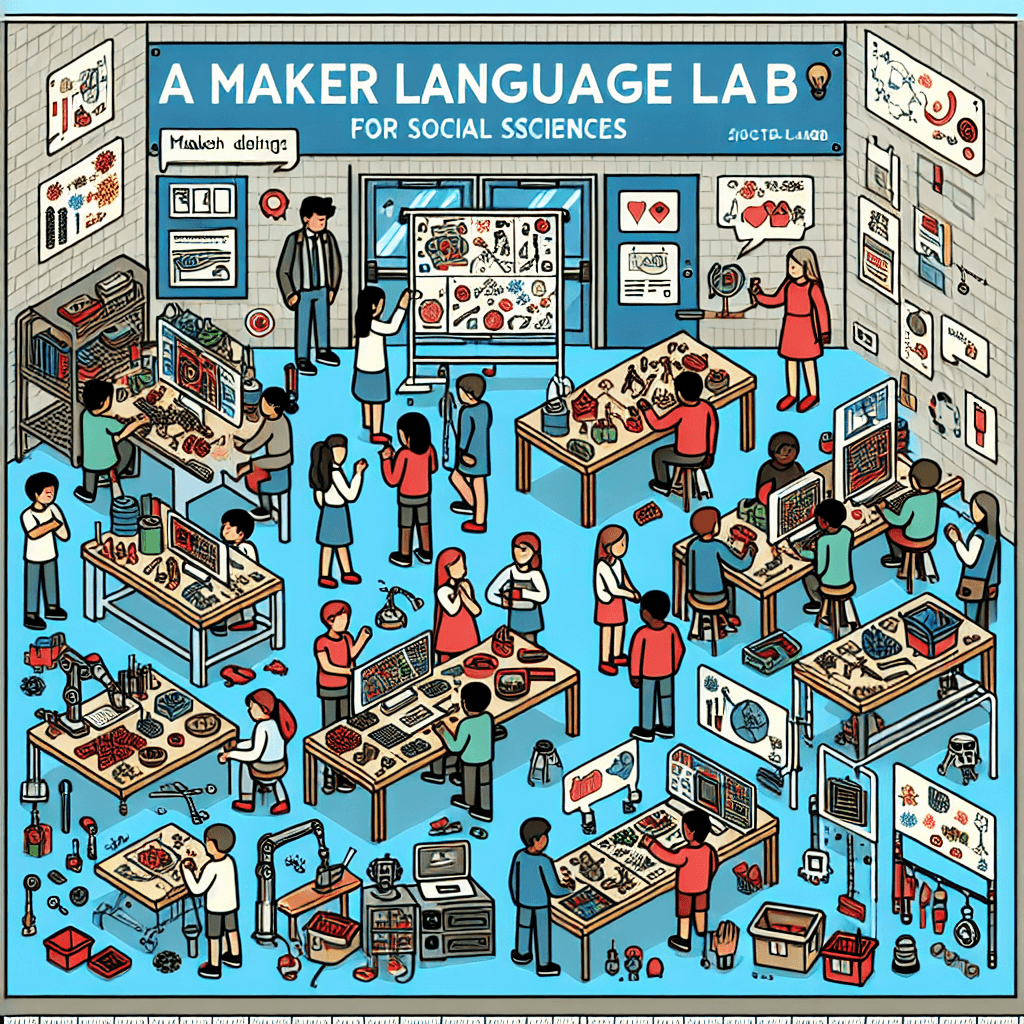
Making Meaning: A Maker Language Lab for Social Sciences
Inquiry Framework
Question Framework
Driving Question
The overarching question that guides the entire project.How can we, as critical makers, design and prototype a solution to a specific systemic inequality that redefines individual agency while navigating the ethical, psychological, and social complexities of decentralized production?Essential Questions
Supporting questions that break down major concepts.- How does the transition from 'consumer' to 'maker' redefine individual agency and social identity in the 21st century?
- In what ways do makerspaces challenge or reinforce existing social hierarchies and power structures?
- What are the psychological impacts of the 'fail-forward' iterative process on learner resilience and cognitive problem-solving?
- How does 'critical making' serve as a philosophical tool for deconstructing the relationship between humans and technology?
- What ethical responsibilities arise when decentralized production (making) bypasses traditional industrial and regulatory frameworks?
- How can the democratization of tools through maker culture address systemic inequalities in local and global communities?
Standards & Learning Goals
Learning Goals
By the end of this project, students will be able to:- Analyze how the transition from 'consumer' to 'maker' influences individual agency and social identity through the lens of sociological theory.
- Evaluate the ethical implications of decentralized production and how it challenges or bypasses traditional industrial and regulatory frameworks.
- Apply the 'fail-forward' iterative design process to develop a physical or digital prototype that addresses a specific systemic inequality.
- Critique the role of makerspaces in challenging or reinforcing existing social hierarchies and power structures within local communities.
- Synthesize psychological principles of resilience and cognitive problem-solving to document personal growth during the prototyping phase.
- Design a 'Critical Maker Manifesto' that articulates the philosophical relationship between humans, technology, and social justice.
American Sociological Association (ASA) Undergraduate Learning Goals
American Psychological Association (APA) Guidelines for the Undergraduate Psychology Major
AAC&U VALUE Rubrics (Ethical Reasoning)
AAC&U VALUE Rubrics (Critical Thinking)
AAC&U VALUE Rubrics (Civic Engagement)
Entry Events
Events that will be used to introduce the project to studentsThe Archaeology of the Future
Students enter a room transformed into a 'fossil record' of 2050, where everyday objects have been modified by DIY maker culture to survive a social collapse. Stations rotate students through analyzing these artifacts via a sociological lens (class structures), a philosophical lens (the ethics of survival), and a maker lens (deconstructing the 'language' of the modifications).The Cognitive Maker-Box Challenge
Using the flipped classroom model, students arrive having watched a video on 'Cognitive Biases in Design' and are greeted by a 'Black Box' project that reacts differently to different psychological triggers. They must rotate through stations to 'hack' the box’s behavior, exploring how maker language can physically manifest psychological theories of human-computer interaction.The Semantic Hack: A Living Manifesto
The classroom is set up as a 'Living Manifesto' where the walls are covered in unfinished philosophical prompts about the 'Right to Repair' and the 'Democratization of Production.' Students rotate through stations where they must use maker tools to physically carve, 3D print, or laser-etch their rebuttals, blending the semiotics of maker language with classical social theory.The Campus 'Wicked Problem' Sprint
Students are presented with a 'wicked problem' affecting their local campus community and must rotate through stations to map out a solution using the 'Maker Mindset.' Each station focuses on a different discipline: the Sociology of the space, the Psychology of the users, and the Philosophy of the proposed intervention, ending with a rapid-prototype 'maker' sketch.The Ethical Re-Maker Lab
In this station-rotation event, students interact with a 'Failed Invention Gallery'—objects that were technically brilliant but socially or ethically disastrous. They are tasked with using the 'language of making' to redesign one artifact so that it aligns with a specific psychological or philosophical framework they studied in the flipped prep-work.Portfolio Activities
Portfolio Activities
These activities progressively build towards your learning goals, with each submission contributing to the student's final portfolio.The Semiotic Deconstruction: Decoding Maker Agency
In this flipped classroom activity, students engage with the 'Archaeology of the Future' entry event. Before class, they watch a curated video series on the 'Sociology of Objects' and the 'Right to Repair' movement. In class, they rotate through stations to deconstruct 'fossilized' artifacts of 2050. They must identify how these objects represent either social hierarchy or decentralized agency. The goal is to understand the 'language' of making as a form of social resistance and a tool for redefining the self in a post-consumerist world.Steps
Here is some basic scaffolding to help students complete the activity.Final Product
What students will submit as the final product of the activityA 'Semiotic Map' of a chosen artifact that identifies its original consumerist purpose, its modified maker-purpose, and the social power structure it challenges or reinforces.Alignment
How this activity aligns with the learning objectives & standardsAligns with ASA-1.3 (Analyze the influence of social structures on individual and group behavior) and AACU-CT-02 (Critical Thinking). It directly addresses the learning goal of analyzing how the transition from 'consumer' to 'maker' influences social identity.The Radical Repair Manifesto: Ethics in Action
Building on the social identity work, students move into the 'Living Manifesto' phase. They explore the 'Ethical Re-Maker Lab' stations, where they interact with 'Failed Inventions.' Students must apply different ethical frameworks (e.g., Utilitarianism, Ethics of Care, Virtue Ethics) to evaluate why these inventions failed socially or ethically. They will then use maker tools to physically etch or print their own ethical stances onto a collective 'Critical Maker Manifesto' board, addressing the 'wicked problem' of systemic inequality.Steps
Here is some basic scaffolding to help students complete the activity.Final Product
What students will submit as the final product of the activityA 'Physical Ethical Statement' (3D printed, laser-etched, or hand-carved) that will be integrated into a large-scale classroom Living Manifesto.Alignment
How this activity aligns with the learning objectives & standardsAligns with AACU-ER-01 (Ethical Reasoning) and AACU-CT-02 (Critical Thinking). This activity meets the learning goal of evaluating the ethical implications of decentralized production and its bypass of traditional frameworks.Failing Forward: The Cognitive Resilience Lab
This activity focuses on the 'Cognitive Maker-Box' challenge. Students explore the psychological impact of the 'fail-forward' process. After watching a video on 'The Psychology of Grit and Cognitive Biases,' students must attempt to 'hack' a reactive 'Black Box' that uses sensors to trigger different psychological responses (frustration, reward, curiosity). Students must document their cognitive processes and emotional reactions as they fail and iterate, applying psychological theories to their own problem-solving behavior.Steps
Here is some basic scaffolding to help students complete the activity.Final Product
What students will submit as the final product of the activityA 'Cognitive Iteration Log' that documents at least three 'failures,' the psychological response to those failures, and the cognitive shift that led to a successful hack of the box.Alignment
How this activity aligns with the learning objectives & standardsAligns with APA-3.2 (Apply psychological principles to personal, social, and organizational issues). It fulfills the learning goal of synthesizing psychological principles of resilience and cognitive problem-solving.Systemic Disruptors: Prototyping Social Change
In the final phase, students apply everything they have learned—sociological agency, ethical frameworks, and psychological resilience—to the 'Campus Wicked Problem Sprint.' Students identify a specific systemic inequality on campus (e.g., accessibility issues, food insecurity, or digital divides). They rotate through 'Discipline Desks' (Sociology, Psychology, Philosophy) to refine their solution before building a 'Social Disruptor' prototype. The prototype must use 'Maker Language' to communicate its social purpose and ethical foundation.Steps
Here is some basic scaffolding to help students complete the activity.Final Product
What students will submit as the final product of the activityA 'Critical Maker Prototype' (physical or high-fidelity digital) accompanied by a 'Social Impact Pitch' that explains how the design addresses a systemic inequality.Alignment
How this activity aligns with the learning objectives & standardsAligns with AACU-CE-03 (Civic Engagement) and ASA-1.3. This activity serves as the culmination of the project, meeting the learning goal of applying the iterative design process to address systemic inequality.Rubric & Reflection
Portfolio Rubric
Grading criteria for assessing the overall project portfolioCritical Maker & Social Disruptor Portfolio Rubric
Sociological Analysis & Semiotics
Evaluates the student's ability to apply sociological theory and semiotic analysis to the artifacts and practices of maker culture.Sociological Deconstruction of Agency
The ability to analyze how the transition from consumer to maker influences individual agency and social identity, using specific sociological terms and semiotic mapping.
Exemplary
4 PointsProvides a sophisticated deconstruction of maker agency, expertly using semiotic mapping to connect physical modifications to complex power structures and social resistance. Demonstrates a deep understanding of alienation vs. autonomy.
Proficient
3 PointsThoroughly analyzes how maker activities shift identity from consumer to creator. Uses sociological terminology correctly to explain the relationship between modified artifacts and social agency.
Developing
2 PointsIdentifies basic shifts in identity but the analysis of 'maker language' is inconsistent. Sociological terms are used but may lack depth or clear application to the artifact.
Beginning
1 PointsOffers a superficial description of artifacts with little to no connection to sociological theory or the concept of agency. Semiotic mapping is incomplete or misunderstood.
Ethics & Philosophy of Making
Assesses the application of ethical frameworks and philosophical inquiry to the democratization of technology and production.Ethical Reasoning in Decentralized Production
The ability to assess ethical values in decentralized production, recognizing the implications of bypassing traditional frameworks and applying philosophical lenses to social justice issues.
Exemplary
4 PointsSynthesizes multiple ethical frameworks (e.g., Utilitarianism, Ethics of Care) to provide a nuanced critique of decentralized production. The physical manifesto contribution is a powerful, theoretically-grounded rebuttal.
Proficient
3 PointsClearly evaluates ethical implications of maker culture using at least one philosophical framework. The physical manifesto contribution aligns well with the stated ethical stance.
Developing
2 PointsIdentifies ethical issues in the 'Failed Invention Gallery' but applies philosophical frameworks inconsistently. The manifesto contribution is present but lacks a strong theoretical link.
Beginning
1 PointsDemonstrates minimal awareness of ethical complexities. Struggles to connect philosophical concepts to the act of making or the 'Right to Repair.'
Psychological Principles & Metacognition
Evaluates the student's ability to monitor and analyze their own cognitive processes and emotional resilience within the design cycle.Metacognitive Resilience & Cognitive Hacking
Applying psychological principles of resilience, grit, and cognitive bias to the iterative 'fail-forward' maker process.
Exemplary
4 PointsProvides an exceptional synthesis of psychological theory and personal practice. Accurately categorizes cognitive roadblocks and demonstrates advanced metacognitive monitoring during the 'Black Box' challenge.
Proficient
3 PointsEffectively documents the 'fail-forward' process, using APA terminology to describe cognitive responses and problem-solving strategies during the iteration phase.
Developing
2 PointsDescribes the experience of failure and hacking, but the application of psychological principles like 'functional fixedness' or 'grit' is emerging or incomplete.
Beginning
1 PointsProvides a simple narrative of the activity without reflecting on the cognitive or psychological processes involved in overcoming frustration or failure.
Iterative Design & Systemic Disruptors
Measures the technical and conceptual quality of the final prototype and its potential to address real-world systemic issues.Critical Making for Social Change
The ability to design and build a physical or digital prototype that addresses a systemic inequality, where the 'Maker Language' (form, material, function) intentionally communicates a social purpose.
Exemplary
4 PointsProduces an innovative, high-fidelity prototype that masterfully integrates 'Maker Language' to disrupt a systemic inequality. The 'Social Impact Pitch' is compelling and deeply rooted in critical theory.
Proficient
3 PointsDevelops a functional prototype that clearly addresses a campus 'wicked problem.' The design choices reflect an intentional effort to communicate social and ethical values.
Developing
2 PointsCreates a basic prototype that identifies a systemic issue, but the connection between the 'Maker Language' used and the intended social impact is weak or unclear.
Beginning
1 PointsThe prototype is incomplete or fails to address a systemic inequality. There is little evidence of applying the iterative design process or critical making principles.