
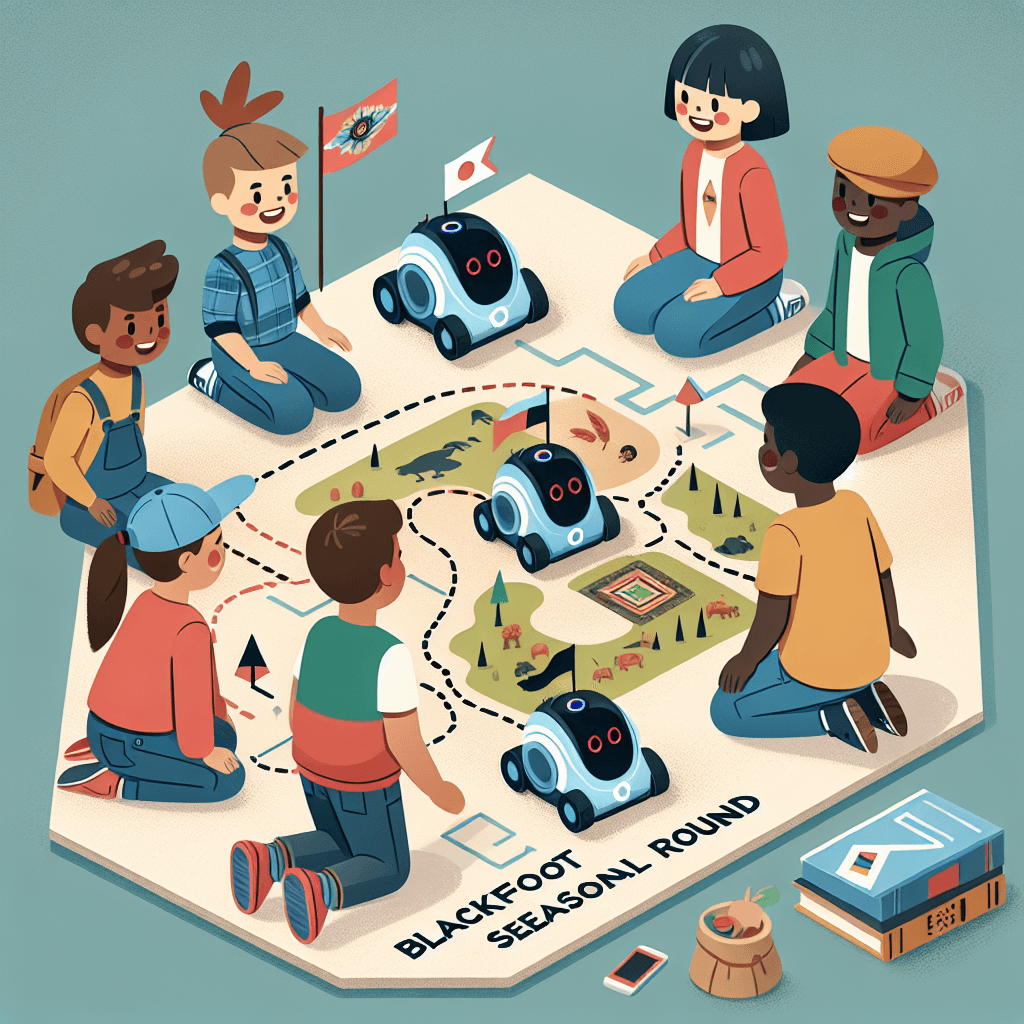
Mapping the Blackfoot Seasonal Round with Ozobots
Inquiry Framework
Question Framework
Driving Question
The overarching question that guides the entire project.How can we use coding and measurement to tell the story of the Niitsitapi (Blackfoot) seasonal round and show how their traditional journey across the land reflects their history and culture?Essential Questions
Supporting questions that break down major concepts.- How do the oral traditions and seasonal rounds of the Niitsitapi (Blackfoot) people reflect their unique culture and relationship with the land?
- How can we use measurement and place value math to accurately represent the long-distance travels of the Blackfoot people in the 1800s?
- How do we measure and compare both straight and curved paths on a map using standard units (cm, m)?
- How can we use coding and sequencing to represent the story of a journey through time and geography?
- How can we organize and present our research in a logical sequence that shows respect for traditional shared knowledge?
Standards & Learning Goals
Learning Goals
By the end of this project, students will be able to:- Research and describe the historical and cultural significance of the Niitsitapi (Blackfoot) seasonal round using primary and digital resources.
- Accurately measure both straight and curved paths on a physical map using metric units (centimetres and metres).
- Apply three-digit addition and regrouping strategies to calculate the total distance traveled during a seasonal cycle.
- Program an Ozobot to navigate a mapped sequence of historical stops, demonstrating logical sequencing and coding skills.
- Organize and present an oral report that explains the Niitsitapi journey, showing respect for traditional shared knowledge and oral traditions.
Alberta Social Studies Program of Studies
Alberta Mathematics Curriculum
Alberta English Language Arts and Literature
Entry Events
Events that will be used to introduce the project to studentsThe Case of the Missing Markers
Students receive a weathered 'Winter Count' hide (reproduction) with missing symbols and a frantic digital message from a museum curator. The curator explains that a 'digital scout' (an Ozobot) has been sent back in time via a simulation but is lost because the ancient seasonal markers have faded, requiring students to reconstruct the journey to save the community's history.The Moccasin vs. The Microchip
The teacher transforms the classroom into a 'Time Portal' where students find a 19th-century moccasin next to a high-tech Ozobot. Students are challenged to determine if this tiny robot could actually survive the hundreds of kilometers traveled by the Niitsitapi in a single year, sparking a debate on distance, endurance, and the precision of traditional navigation.Portfolio Activities
Portfolio Activities
These activities progressively build towards your learning goals, with each submission contributing to the student's final portfolio.Digital Scout’s Field Journal
Before mapping, students must become 'Digital Scouts.' Using the Glenbow Museum's 'Niitsitapiisinni: The Blackfoot Way' online resource, students will explore the four seasons of the Blackfoot seasonal round. They will identify where the people moved during each season, why they moved there (e.g., hunting buffalo, gathering berries), and one traditional story or oral tradition associated with that time of year.Steps
Here is some basic scaffolding to help students complete the activity.Final Product
What students will submit as the final product of the activityA 'Digital Scout’s Research Log' containing notes on the four seasons, sketches of traditional dwellings or tools used, and a brief summary of one oral tradition.Alignment
How this activity aligns with the learning objectives & standardsAligns with Social Studies (SS-FN-01) by identifying the specific history and culture of the Niitsitapi (Blackfoot) people. It also meets ELA-3.1 (Investigate oral traditions) by researching stories of cultural significance passed through generations.Cartography of the Seasons
Students will translate their research into a large-scale physical map. This isn't just a drawing; it’s a data representation of a journey. Students must design a path that includes straight lines (for travel across flat plains) and curved lines (for navigating river valleys or foothills), ensuring the map reflects the actual geography researched in Activity 1.Steps
Here is some basic scaffolding to help students complete the activity.Final Product
What students will submit as the final product of the activityA large-scale 'Seasonal Journey Map' featuring at least four distinct stops, labeled with Niitsitapi names, and connected by a mix of straight and curved paths.Alignment
How this activity aligns with the learning objectives & standardsAligns with MATH-3.2 (Measure lengths of straight lines and curves) and MATH-DATA-3.1 (Examine First Nations representations of data). This activity transforms historical data into a visual, measurable representation.The Great Distance Calculation
Now, students will calculate the 'Great Distance.' They will use rulers to measure the straight paths and string to measure the curved paths on their maps in centimeters. To make it realistic, the teacher will provide a scale (e.g., 1 cm on the map = 25 km in the 1800s). Students will then use 3-digit addition and regrouping to find the total distance of the entire yearly cycle.Steps
Here is some basic scaffolding to help students complete the activity.Final Product
What students will submit as the final product of the activityA 'Distance Data Sheet' showing the measurements of each leg of the journey and the multi-digit addition equations used to find the total distance.Alignment
How this activity aligns with the learning objectives & standardsAligns with MATH-3.1 (Relate strategies for 2-digit to 3-digit addition/subtraction and model regrouping) and MATH-3.2 (Measuring with cm and m). This connects physical measurement to abstract arithmetic.Coding the Ancestral Path
Students will 'program' the history of the journey. Using Ozobots, students will use color codes (OzoCodes) to guide the bot through the map. The coding must be logical: for example, using 'Slow' codes during the winter months in the mountains and 'Fast' codes for traveling across the plains in the summer. The bot must pause at each stop to represent a settlement.Steps
Here is some basic scaffolding to help students complete the activity.Final Product
What students will submit as the final product of the activityA fully coded Ozobot-ready map that successfully navigates the seasonal round from start to finish without intervention.Alignment
How this activity aligns with the learning objectives & standardsAligns with ELA-3.2 (Group relevant ideas/information in a logical sequence) and fulfills the project's technological requirement of coding to represent a journey.Voices of the Land: A Presentation of Journey
In the final activity, students present their maps and Ozobot simulations to the class. They will act as 'Keepers of the Story,' explaining the cultural significance of the Niitsitapi seasonal round, the math behind the distance, and how the Ozobot's movements represent the historical reality of the 1800s.Steps
Here is some basic scaffolding to help students complete the activity.Final Product
What students will submit as the final product of the activityA 2-3 minute oral presentation delivered while the Ozobot navigates the map, accompanied by a 'Respectful Listener' reflection.Alignment
How this activity aligns with the learning objectives & standardsAligns with ELA-3.1 (Discuss how oral stories show respect) and ELA-3.2 (Compose and share a short speech; participate as a respectful audience member). This synthesizes all learning into a formal presentation.Rubric & Reflection
Portfolio Rubric
Grading criteria for assessing the overall project portfolioVoices of the Land: Niitsitapi Seasonal Round Portfolio Rubric
Historical & Cultural Understanding
Evaluates the student's ability to research, understand, and respect the Niitsitapi (Blackfoot) history, culture, and relationship with the land.Seasonal Round Research Accuracy
Accuracy and depth of research regarding the Niitsitapi (Blackfoot) people's movement and activities across the four seasons.
Exemplary
4 PointsDemonstrates a sophisticated understanding of the seasonal round; research is comprehensive, accurately identifying specific locations and complex activities for all four seasons with historical nuance.
Proficient
3 PointsDemonstrates a thorough understanding of the seasonal round; accurately identifies geographic locations and primary activities for each of the four seasons.
Developing
2 PointsShows emerging understanding; identifies some seasons and activities correctly, but research may be incomplete or contain minor inaccuracies in location or purpose.
Beginning
1 PointsShows initial understanding; research is incomplete, missing multiple seasons or primary activities, or contains significant historical inaccuracies.
Oral Traditions & Cultural Respect
Integration of traditional stories and oral traditions to show respect for Niitsitapi cultural knowledge.
Exemplary
4 PointsSummarizes an oral tradition with exceptional insight, clearly connecting the story's values to the historical context of the seasonal round.
Proficient
3 PointsProvides a clear summary of an oral tradition and correctly identifies its cultural significance or connection to a specific time of year.
Developing
2 PointsProvides a basic summary of a story but lacks a clear connection to the cultural values or the seasonal context.
Beginning
1 PointsSummary is missing, or the chosen story lacks relevance to Niitsitapi oral traditions or shared knowledge.
Mathematical Application & Calculation
Assesses the application of measurement skills and multi-digit arithmetic within the context of the historical journey.Metric Measurement Precision
Precision in measuring both straight and curved travel paths using metric units (centimetres).
Exemplary
4 PointsAll measurements are highly precise; demonstrates an advanced ability to use tools (string/rulers) to measure complex curves without error.
Proficient
3 PointsMeasurements of both straight and curved lines are accurate within a reasonable margin of error; correctly uses standard units (cm).
Developing
2 PointsMeasurements show emerging accuracy; may struggle with the precision of curved lines or inconsistent use of metric units.
Beginning
1 PointsMeasurements are frequently inaccurate or missing; shows significant difficulty using measurement tools for both straight and curved lines.
Addition & Regrouping Strategy
Execution of 3-digit addition strategies, including the accurate use of regrouping (carrying).
Exemplary
4 PointsCalculates total distance with 100% accuracy; demonstrates sophisticated mastery of regrouping across multiple place values (ones, tens, hundreds).
Proficient
3 PointsCorrectly applies 3-digit addition strategies and models regrouping accurately to find the total distance.
Developing
2 PointsShows inconsistent application of addition strategies; may make errors in regrouping or place value alignment.
Beginning
1 PointsStruggles with 3-digit addition; regrouping is not modeled or is consistently incorrect, leading to inaccurate totals.
Coding & Technical Representation
Evaluates the use of technology and visual design to represent historical data and logical sequences.Coding Logic & Sequencing
Logical arrangement of OzoCodes and path design to represent historical movement and terrain.
Exemplary
4 PointsCoding is innovative and highly logical; uses a wide variety of codes (speed, turns, spins) to creatively represent environmental challenges and historical stops.
Proficient
3 PointsCoding is logical and functional; uses appropriate OzoCodes to simulate speed changes and stops at designated seasonal locations.
Developing
2 PointsCoding is partially functional; some codes may be placed incorrectly or the sequence does not always reflect the intended historical movement.
Beginning
1 PointsCoding is missing or non-functional; the bot cannot navigate the map or the codes have no relation to the seasonal story.
Visual Data Representation (Mapping)
Integration of geographic features and cultural symbols into a data-rich map representation.
Exemplary
4 PointsProduces an outstanding map that blends technical accuracy with artistic 'Winter Count' symbols, creating a sophisticated visual story.
Proficient
3 PointsMap clearly represents the four stops and travel paths using appropriate symbols and labels to tell a coherent story of the data.
Developing
2 PointsMap shows emerging organization but may be missing key labels, symbols, or clear differentiation between geographic features.
Beginning
1 PointsMap is incomplete or disorganized; fails to represent the data of the seasonal round in a recognizable way.
Communication & Community Engagement
Assesses the student's ability to communicate their learning and interact respectfully within a learning community.Oral Communication & Synthesis
Delivery of an oral report that synthesizes research, math, and coding in a logical sequence.
Exemplary
4 PointsPresentation is exceptionally engaging and articulate; information is synthesized seamlessly with the Ozobot simulation to provide a deep narrative experience.
Proficient
3 PointsDelivers a clear, well-organized oral report that explains the research, distance calculations, and coding choices in a logical order.
Developing
2 PointsPresentation is audible but lacks organization; ideas are presented in a disjointed sequence or key components (math/culture) are omitted.
Beginning
1 PointsOral report is incomplete, difficult to hear, or lacks a logical sequence; fails to explain the connection between the map and the culture.
Respectful Participation & Listening
Demonstration of respectful audience behaviors and engagement with peers' cultural knowledge.
Exemplary
4 PointsExhibits leadership in the audience; provides insightful reflections on peers' work and demonstrates profound respect for all shared knowledge.
Proficient
3 PointsParticipates as a respectful audience member; records clear evidence of learning from peers' presentations.
Developing
2 PointsParticipates inconsistently; may need reminders to stay focused or provides only surface-level reflections on peers' work.
Beginning
1 PointsStruggles to remain a respectful audience member; provides no evidence of listening or learning from other presentations.