
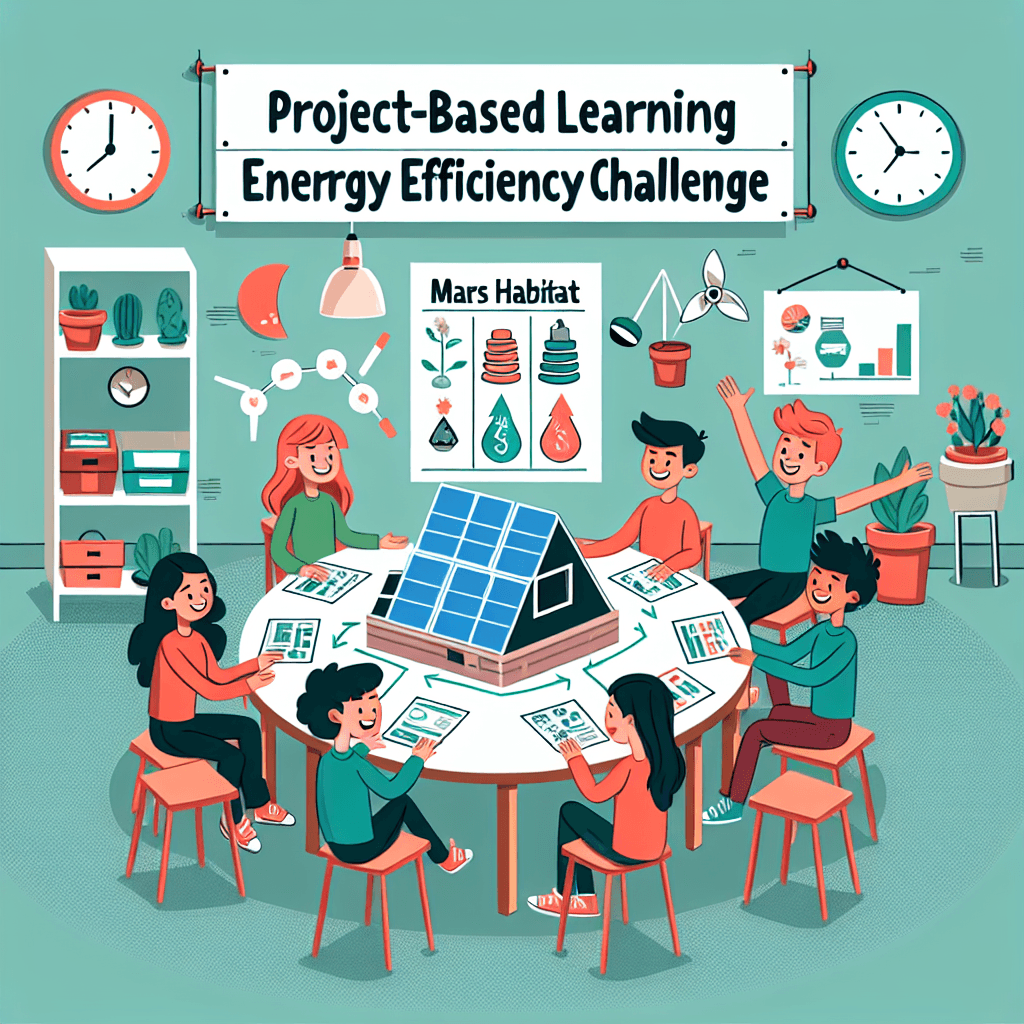
Mars Habitat Energy Efficiency Challenge
Inquiry Framework
Question Framework
Driving Question
The overarching question that guides the entire project.How can we design an innovative Mars habitat that integrates energy efficiency and technological innovations while addressing the environmental differences between Earth and Mars, using insights from physics, chemistry, biology, and math to create sustainable life support systems?Essential Questions
Supporting questions that break down major concepts.- What are the key factors in designing a sustainable habitat on Mars?
- How can principles of energy efficiency be incorporated into habitat design?
- What technological innovations are necessary to support human life on Mars?
- How do Earth's environmental systems differ from Mars, and how does that impact habitat design?
- In what ways do math and physics inform the architecture and operation of a Mars habitat?
- How can chemistry and biology be used to create self-sustaining life support systems in a Mars habitat?
- What role does English play in communicating complex scientific and technical ideas effectively?
Standards & Learning Goals
Learning Goals
By the end of this project, students will be able to:- Students will analyze the environmental differences between Earth and Mars to determine necessary adjustments in habitat design.
- Students will collaborate to design a functional model of a Mars habitat that incorporates energy-efficient technologies.
- Learners will apply principles from physics and math to optimize the architectural and operational elements of the Mars habitat.
- Participants will evaluate potential technological innovations and their applicability to supporting human life on Mars.
- Students will synthesize information from research and experiments to create a compelling presentation on their habitat design.
- Learners will demonstrate their ability to communicate complex scientific and technical information clearly and effectively.
Next Generation Science Standards
Common Core Standards
Entry Events
Events that will be used to introduce the project to studentsMars Escape Room
Turn the classroom into a Mars surface with an escape room challenge. Students solve science, math, and engineering challenges to 'escape' the simulated harsh conditions of the Martian environment, sparking curiosity about innovative design requirements for a Mars habitat.Mars Conference Simulation
Host a mock international space conference where students present their preliminary ideas for Mars habitats. Students participate as delegates from various fields (engineers, biologists, etc.), offering a multidisciplinary perspective on habitat challenges.Virtual Reality Mars
Utilize VR technology to provide a virtual tour of the Martian surface, followed by a brainstorming session on habitat requirements. This immersive experience makes the harsh realities of Mars tangible, prompting creative problem-solving discussion.Portfolio Activities
Portfolio Activities
These activities progressively build towards your learning goals, with each submission contributing to the student's final portfolio.Mars Habitat Concept Map
Students create a concept map to visually organize their knowledge and ideas about Mars habitat requirements. This activity encourages students to brainstorm and connect concepts from various disciplines that influence the habitat design, such as energy efficiency, technological innovations, and environmental differences between Earth and Mars.Steps
Here is some basic scaffolding to help students complete the activity.Final Product
What students will submit as the final product of the activityA concept map that visually organizes and connects ideas related to Mars habitat design.Alignment
How this activity aligns with the learning objectives & standardsAligns with HS-ETS1-1 by specifying criteria and constraints for Mars habitats.Resource Analysis Showcase
In this activity, students perform an in-depth analysis of available resources on Mars and Earth to understand the challenges and opportunities in habitat construction and sustainability. This task also focuses on the differences in environmental conditions and how they affect human life support systems.Steps
Here is some basic scaffolding to help students complete the activity.Final Product
What students will submit as the final product of the activityA multimedia presentation analyzing resource usage and challenges in Mars habitat construction.Alignment
How this activity aligns with the learning objectives & standardsAligns with CCSS.ELA-LITERACY.W.9-10.7 by conducting research and synthesizing information.Energy Efficiency Design Lab
Students engage in a design lab focused on creating energy-efficient systems for a Mars habitat. Through modeling and simulations, they explore how to apply principles of physics and energy conservation to optimize habitat functions.Steps
Here is some basic scaffolding to help students complete the activity.Final Product
What students will submit as the final product of the activityPrototypes or models of energy-efficient systems for the Mars habitat.Alignment
How this activity aligns with the learning objectives & standardsAligns with HS-ESS3-4 by evaluating technological solutions to support sustainable human life.Mathematical Modeling Workshop
Students participate in workshops to apply mathematics to model and define quantities for habitat design on Mars. This incorporates calculations and geometric considerations essential for creating technical specifications.Steps
Here is some basic scaffolding to help students complete the activity.Final Product
What students will submit as the final product of the activityDetailed mathematical models and calculations supporting Mars habitat specifications.Alignment
How this activity aligns with the learning objectives & standardsAligns with CCSS.MATH.CONTENT.HSN-Q.A.2 by defining quantities for descriptive modeling.Biological Systems Exploration
This activity invites students to design biological systems that support life in the Mars habitat, focusing on self-sustaining processes. They explore photosynthesis, cellular respiration, and closed-loop systems to maintain life support.Steps
Here is some basic scaffolding to help students complete the activity.Final Product
What students will submit as the final product of the activityA detailed model of a biological life support system suitable for a Mars habitat.Alignment
How this activity aligns with the learning objectives & standardsAligns with HS-LS2-5 by illustrating the flow of energy and cycling of matter.Technical Communication Challenge
In this activity, students focus on their ability to effectively communicate complex scientific and technical ideas. They refine their presentations and written outputs to ensure clarity, precision, and engagement with the intended audience.Steps
Here is some basic scaffolding to help students complete the activity.Final Product
What students will submit as the final product of the activityA polished scientific paper or presentation showcasing the Mars habitat design.Alignment
How this activity aligns with the learning objectives & standardsAligns with CCSS.ELA-LITERACY.W.9-10.7 by demonstrating clear and effective communication of scientific ideas.Rubric & Reflection
Portfolio Rubric
Grading criteria for assessing the overall project portfolioMars Habitat Innovation Assessment Rubric
Conceptual Understanding and Innovation
Evaluates the student's grasp of habitat design concepts and their innovative application.Energy Efficiency Application
Assesses the integration of energy-efficient technologies in the habitat design.
Exemplary
4 PointsDemonstrates a sophisticated understanding and innovative application of energy-efficient technologies, integrating multiple systems to optimize habitat energy use.
Proficient
3 PointsDisplays a thorough understanding and appropriate application of energy-efficient technologies, with successful integration into habitat design.
Developing
2 PointsShows emerging understanding of energy-efficient technologies, with inconsistent application and integration into habitat design.
Beginning
1 PointsExhibits minimal understanding of energy-efficient technologies and struggles with application in habitat design.
Technological Innovation
Measures the application of innovative technology solutions in the habitat design.
Exemplary
4 PointsApplies cutting-edge technological innovations to solve complex habitat challenges, showing creativity and leadership.
Proficient
3 PointsEffectively applies suitable technological solutions, demonstrating a clear understanding of their impact on habitat design.
Developing
2 PointsApplies technological solutions sporadically, with a basic understanding and limited innovation shown.
Beginning
1 PointsStruggles to apply technological solutions, showing minimal understanding and innovation.
Interdisciplinary Integration and Analysis
Assesses the ability to integrate and analyze concepts across multiple disciplines.Interdisciplinary Connections
Evaluates how well the student connects concepts from physics, chemistry, biology, and math.
Exemplary
4 PointsDemonstrates exceptional integration and synthesis of cross-disciplinary concepts, creating a cohesive and insightful habitat design.
Proficient
3 PointsMakes clear and effective connections between disciplines, contributing to a well-rounded habitat design.
Developing
2 PointsAttempts to connect concepts across disciplines with partial success, leading to a somewhat integrated design.
Beginning
1 PointsShows initial attempts to connect cross-disciplinary concepts with limited success and understanding.
Communication and Presentation
Evaluates the clarity and effectiveness of communicating scientific and technical ideas.Technical Communication
Assesses the clarity and coherence in presenting the Mars habitat design.
Exemplary
4 PointsPresents information with exceptional clarity, coherence, and engagement, demonstrating advanced communication skills.
Proficient
3 PointsCommunicates ideas clearly and effectively, with minor areas for improvement in coherence or engagement.
Developing
2 PointsCommunicates basic ideas with some clarity, but presentation lacks coherence and depth.
Beginning
1 PointsStruggles to present ideas clearly, with significant issues in clarity, coherence, and engagement.