
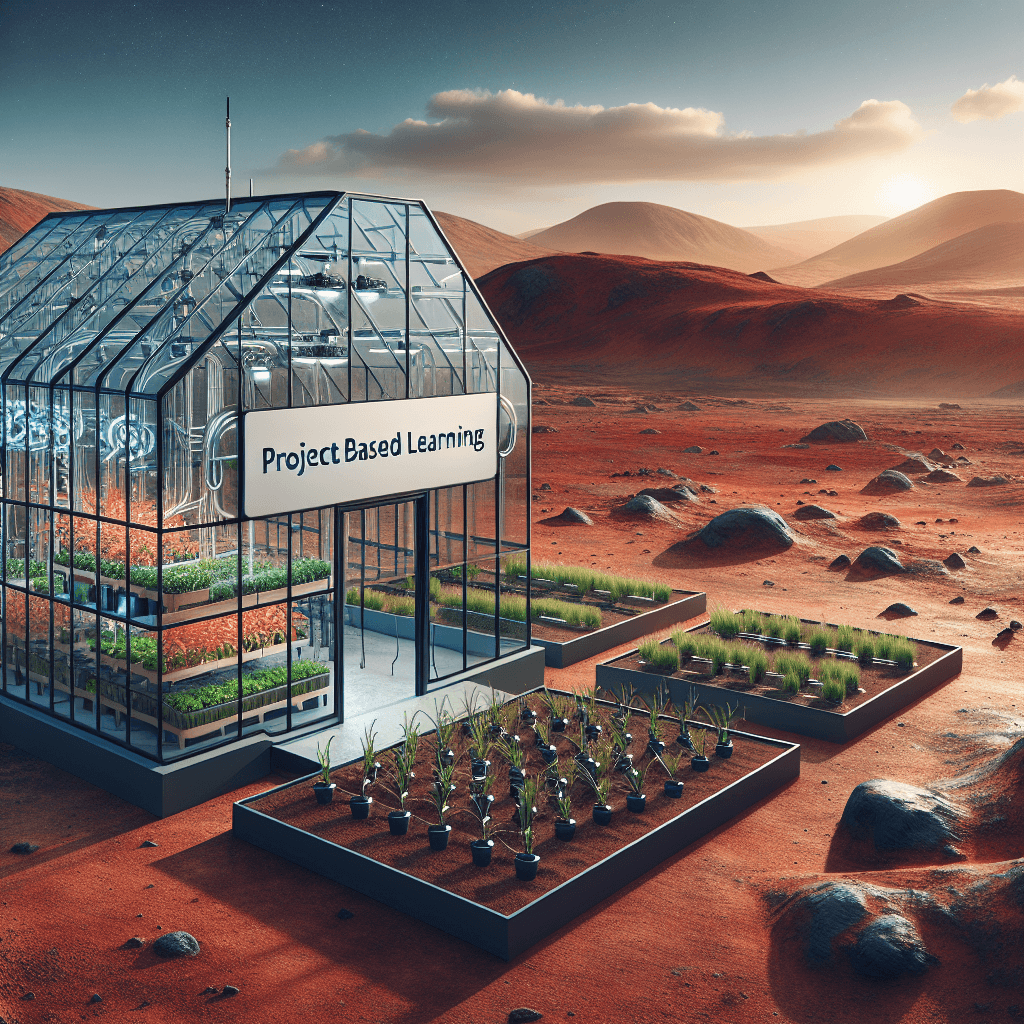
Martian Harvest: Designing Sustainable Greenhouses for the Red Planet
Inquiry Framework
Question Framework
Driving Question
The overarching question that guides the entire project.How can we, as mission engineers, design and defend the ultimate self-sustaining Martian greenhouse by analyzing data from various prototypes to ensure plants effectively cycle matter and energy for human survival?Essential Questions
Supporting questions that break down major concepts.- How do plants transform energy and matter to create a life-support system in an extreme environment?
- What are the biological 'must-haves' for a plant to survive on Mars, and how does photosynthesis provide them?
- How can we use data from multiple design trials to engineer a 'perfect' greenhouse solution?
- What specific design features (like material, light source, or air filtration) are most critical for a self-sustaining system?
- How do we communicate a complex scientific argument to prove that our greenhouse design is the most viable for a Martian colony?
Standards & Learning Goals
Learning Goals
By the end of this project, students will be able to:- Analyze data from greenhouse design prototypes to identify the most effective features for oxygen production and plant health.
- Construct a detailed scientific explanation of how photosynthesis cycles matter and flows energy within a self-sustaining system.
- Synthesize individual design characteristics (light, filtration, materials) into a single, optimized greenhouse model for the Martian environment.
- Develop and present a evidence-based argument to defend the viability of a specific greenhouse design for human survival on Mars.
Next Generation Science Standards (NGSS)
Common Core State Standards (ELA/Literacy)
Entry Events
Events that will be used to introduce the project to studentsThe Interplanetary Design Summit
Students are invited to a 'Lunar vs. Martian' Design Summit where they are shown data from a successful Moon greenhouse and a failing Mars greenhouse. They must identify why a design that works on the Moon (closer to Earth's light/energy) fails on Mars, forcing them to re-evaluate the role of light intensity in photosynthesis and engineering adaptation.Portfolio Activities
Portfolio Activities
These activities progressively build towards your learning goals, with each submission contributing to the student's final portfolio.The Data Detective's Dossier: Analyzing Prototype Trials
In this activity, students become 'Data Detectives.' They are provided with three distinct greenhouse prototype datasets (e.g., Design A: High-tech LED/Hydroponic, Design B: Natural Light/Regolith Soil, Design C: Low-energy/Aeroponic). Students must analyze performance data regarding oxygen yield, plant growth rate, and energy consumption to determine which features are viable for Mars and which are not.Steps
Here is some basic scaffolding to help students complete the activity.Final Product
What students will submit as the final product of the activityA 'Prototype Performance Matrix' (a detailed comparison table) with a color-coded analysis of the strengths and weaknesses of each design.Alignment
How this activity aligns with the learning objectives & standardsAligns with MS-ETS1-3 by requiring students to analyze data sets from different design solutions to identify which features performed best under specific constraints.The Martian Mastermind: Engineering the Hybrid Blueprint
Armed with their data analysis, students will now synthesize their findings into a single 'Master Blueprint.' This is the engineering phase where they pick and choose the most efficient components (light, water, air filtration, and growth medium) to create a new, hybrid design that solves the failures identified in the Lunar vs. Martian summit.Steps
Here is some basic scaffolding to help students complete the activity.Final Product
What students will submit as the final product of the activityA detailed, annotated Technical Blueprint of the 'Ultimate Martian Greenhouse' showing the integrated features and explaining why they were chosen.Alignment
How this activity aligns with the learning objectives & standardsAligns with MS-ETS1-3, focusing on combining the best characteristics of multiple designs into a new, superior solution to meet the criteria for success.The Mission Brief: Defending the Design with Evidence
Now that the design is complete, students must write a formal proposal to the 'Mars Colony Board.' This activity focuses on the 'English' component of the project, where students use their scientific data and photosynthesis knowledge to build a persuasive argument. They must defend why their specific combination of features is the most likely to succeed where others failed.Steps
Here is some basic scaffolding to help students complete the activity.Final Product
What students will submit as the final product of the activityA 'Mission Viability Report' (Argumentative Essay) that uses a Claim-Evidence-Reasoning (CER) structure to defend the design.Alignment
How this activity aligns with the learning objectives & standardsAligns with CCSS.ELA-LITERACY.WHST.6-8.1 by requiring students to write a formal argument supported by scientific evidence and data.The Bio-Mechanics Audit: Mapping the Martian Life Cycle
Before designing a greenhouse, students must understand the 'biological engine' that powers it. In this activity, students act as Bio-Engineers to map out the process of photosynthesis specifically within the context of a sealed Martian habitat. They will investigate how energy from light is converted into chemical energy and how matter (carbon, hydrogen, oxygen) cycles through the plant to create food and breathable air for astronauts.Steps
Here is some basic scaffolding to help students complete the activity.Final Product
What students will submit as the final product of the activityAn 'Energy & Matter Flowchart' that illustrates the inputs and outputs of a plant system on Mars, including a written summary explaining how this cycle maintains a self-sustaining environment.Alignment
How this activity aligns with the learning objectives & standardsDirectly aligns with MS-LS1-6, as students must trace the flow of energy (sunlight) and matter (CO2, water, glucose, O2) to explain how a greenhouse functions as a life-support system.Rubric & Reflection
Portfolio Rubric
Grading criteria for assessing the overall project portfolioMartian Greenhouse Mission: Engineering & Life Science Rubric
Biological Systems & Energy Flow
Evaluates the student's mastery of MS-LS1-6, focusing on the biological processes that power the greenhouse.Scientific Explanation: Photosynthesis & Life Support
The ability to construct a scientific explanation for how photosynthesis cycles matter and flows energy, specifically adapted for the Martian environment.
Exemplary
4 PointsProvides a sophisticated explanation of photosynthesis; accurately traces the flow of energy and cycling of atoms (C, H, O) with specific focus on Martian constraints (light intensity). Explains the interdependence of the cycle for human survival with zero errors.
Proficient
3 PointsProvides a thorough explanation of photosynthesis; correctly identifies inputs (CO2, water, light) and outputs (glucose, oxygen). Explains how these support a self-sustaining system on Mars with minor inaccuracies.
Developing
2 PointsShows an emerging understanding of photosynthesis; identifies most inputs and outputs but struggles to explain the flow of energy or the specific cycling of matter in a sealed system.
Beginning
1 PointsShows initial understanding; identifies that plants need light and water but fails to explain the process of photosynthesis or its role in life support accurately.
Engineering Design & Data Interpretation
Evaluates the student's mastery of MS-ETS1-3, focusing on the engineering cycle and data-driven decision making.Data Analysis & Feature Selection
The ability to analyze performance data from multiple prototypes to identify successes, failures, and optimal features for a new design solution.
Exemplary
4 PointsDemonstrates sophisticated data analysis; identifies nuanced trade-offs (e.g., energy vs. oxygen yield) across all prototypes. Justifies feature selection with precise data points from the 'Dossier.'
Proficient
3 PointsDemonstrates thorough data analysis; identifies clear successes and failures for each design. Selects the 'winning features' based on provided evidence to meet success criteria.
Developing
2 PointsShows emerging analysis; identifies some strengths and weaknesses but choices for the final design are inconsistently supported by the provided data.
Beginning
1 PointsStruggles with data application; identifies very few features or fails to use the data charts to inform design choices. Requires significant support.
Design Synthesis & Technical Communication
Evaluates the ability to combine characteristics into a new solution, as required by the engineering standards.Technical Synthesis & Blueprinting
The ability to synthesize selected features into a cohesive, annotated blueprint that addresses specific Martian environmental challenges.
Exemplary
4 PointsProduces an outstanding blueprint; all components are logically integrated and labeled with highly detailed 'Engineering Justifications' that address radiation, light, and atmosphere. The design is innovative and fully viable.
Proficient
3 PointsProduces a quality blueprint; labels all major components and includes justifications for how the design addresses Martian challenges. The hybrid solution is cohesive and functional.
Developing
2 PointsProduces a blueprint of varying quality; labels are present but justifications are brief or lack scientific depth. The integration of different prototype features is only partially successful.
Beginning
1 PointsProduces an incomplete or unorganized blueprint; lacks clear labels or justifications. The design does not realistically address the constraints of the Martian environment.
Scientific Argumentation & Advocacy
Evaluates mastery of WHST.6-8.1 and SL.6.4, focusing on the ability to defend scientific claims.Evidence-Based Argumentation (CER)
The ability to write a persuasive argument using the Claim-Evidence-Reasoning (CER) structure, defending the design choices with scientific data.
Exemplary
4 PointsWrites a sophisticated argument; claim is precise, evidence is quantitative and specific, and reasoning deeply connects engineering choices to biological needs. Masterfully addresses a complex counter-argument.
Proficient
3 PointsWrites an effective argument; uses a clear CER structure. Supports the claim with relevant data from trials and provides a logical connection to photosynthesis. Includes a valid counter-argument.
Developing
2 PointsWrites an argument with a basic CER structure; claim is present but evidence is general rather than specific. Reasoning is present but may not fully bridge the gap between the data and the science.
Beginning
1 PointsProduces an incomplete argument; lacks a clear claim or fails to provide evidence from the activities. Reasoning is missing or illogical. Does not address counter-arguments.