
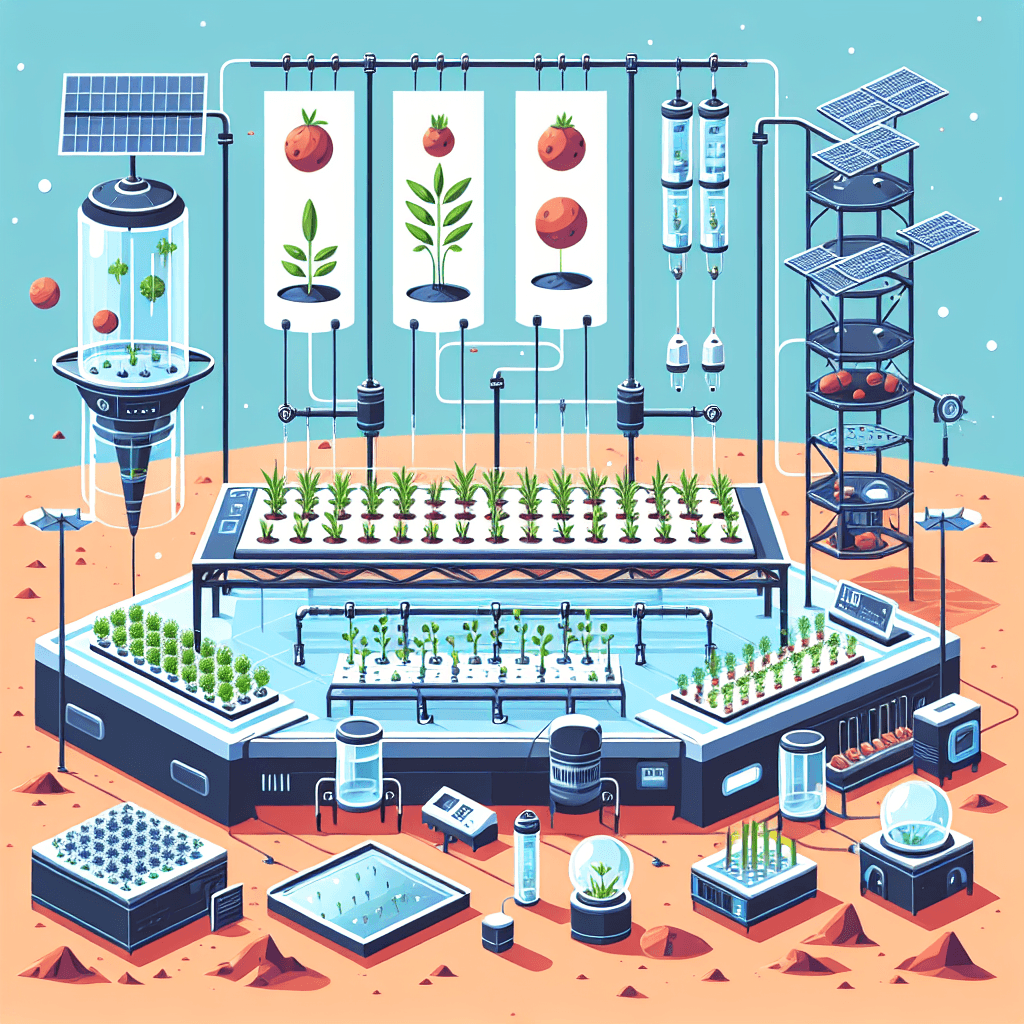
Inquiry Framework
Question Framework
Driving Question
The overarching question that guides the entire project.How can we design a sustainable hydroponic farm on Mars to overcome the challenges of Martian conditions and provide food for a human habitat, while considering resource availability, ethical implications, and the essential factors for plant growth?Essential Questions
Supporting questions that break down major concepts.- What are the essential environmental factors for plant growth on Earth?
- How do hydroponic systems work and what are their benefits?
- What challenges would Martian conditions pose to plant growth, and how can hydroponics address these?
- What resources are available on Mars that could be used in a hydroponic system?
- How can we design a sustainable and efficient hydroponic farm for Mars, considering energy, water, and waste management?
- What ethical considerations should be taken into account when planning a Martian habitat and farm?
Standards & Learning Goals
Learning Goals
By the end of this project, students will be able to:- Students will be able to identify the essential environmental factors for plant growth and explain how hydroponic systems can address the challenges of growing plants in Martian conditions.
NGSS
Entry Events
Events that will be used to introduce the project to studentsEmergency on Mars
Imagine you're on the first human mission to Mars. The hydroponic farm malfunctions, and you're facing food shortages. Your challenge is to redesign the farm to ensure food security for the entire crew.SpaceX Challenge
You're a lead scientist for SpaceX, tasked with creating a sustainable farming system for a Martian colony. Design a hydroponic farm that addresses the challenges of Martian soil, atmosphere, and resource limitations.Portfolio Activities
Portfolio Activities
These activities progressively build towards your learning goals, with each submission contributing to the student's final portfolio.Earth vs. Mars: A Plant's Perspective
Students will research and document the essential environmental factors required for plant growth on Earth, comparing and contrasting these with the conditions on Mars. They will identify key differences and challenges, focusing on how hydroponic systems can offer solutions.Steps
Here is some basic scaffolding to help students complete the activity.Final Product
What students will submit as the final product of the activityA comparative analysis report detailing Earth's plant growth conditions versus Mars, highlighting the challenges and potential solutions offered by hydroponics.Alignment
How this activity aligns with the learning objectives & standardsMS-LS2-3, addressing matter and energy flow in a closed-loop system.Martian Hydroponics 101: Building a Closed-Loop System
Students will design a basic hydroponic system suitable for growing a specific type of plant on Mars. They will consider factors such as nutrient solutions, lighting, water circulation, and waste management within a closed-loop system.Steps
Here is some basic scaffolding to help students complete the activity.Final Product
What students will submit as the final product of the activityA blueprint and explanatory document outlining their hydroponic system design, including justifications for their choices based on scientific principles.Alignment
How this activity aligns with the learning objectives & standardsMS-LS2-4, examining how a stable ecosystem can be created in the challenging and changing conditions of Mars.Mission Sustainability: Resource Management on Mars
Students will delve deeper into the sustainability aspect of their Martian farm, exploring methods for resource management, energy efficiency, and waste recycling within the hydroponic system.Steps
Here is some basic scaffolding to help students complete the activity.Final Product
What students will submit as the final product of the activityA detailed sustainability plan outlining strategies for resource management, energy efficiency, and waste recycling in their Martian hydroponic farm.Alignment
How this activity aligns with the learning objectives & standardsMS-LS1-3, supporting the understanding of systems and subsystems.Red Planet Ethics: Responsible Exploration of Mars
Students will explore the ethical implications of establishing a human habitat and farm on Mars, considering potential impacts on the Martian environment and the responsibility of humans in space exploration.Steps
Here is some basic scaffolding to help students complete the activity.Final Product
What students will submit as the final product of the activityA presentation or report discussing the ethical considerations, including potential impacts and responsible exploration practices.Alignment
How this activity aligns with the learning objectives & standardsMS-LS2-3, focusing on energy flow and nutrient cycling.Rubric & Reflection
Portfolio Rubric
Grading criteria for assessing the overall project portfolioMartian Hydroponic Farming Assessment Rubric
Scientific Understanding
Assesses the depth of understanding related to plant growth factors, environmental conditions on Mars, and how hydroponics can address these challenges.Comparison Analysis
Evaluation of the student's ability to compare and contrast Earth's and Mars' conditions for plant growth.
Exemplary
4 PointsThoroughly and insightfully compares Earth's and Mars' conditions with multiple insightful differences identified and well-articulated understanding of challenges.
Proficient
3 PointsComprehensively compares Earth's and Mars' conditions with clear identification of primary differences and challenges.
Developing
2 PointsAttempts to compare Earth's and Mars' conditions, with some differences identified but lacks depth and clear articulation of challenges.
Beginning
1 PointsMinimal comparison with limited differences identified; lacks articulation of challenges.
Hydroponic Systems Understanding
Assesses the student's ability to explain how hydroponic systems overcome Martian challenges.
Exemplary
4 PointsProvides a nuanced explanation of hydroponic systems with advanced understanding of how they address specific Martian challenges with scientific support.
Proficient
3 PointsClearly explains hydroponic systems and how they address major Martian challenges with supporting details.
Developing
2 PointsExplains hydroponic systems with basic linkage to some Martian challenges, but lacks detail.
Beginning
1 PointsMinimal explanation of hydroponic systems with little connection to Martian challenges.
Design Justification
Evaluates the student's ability to justify design choices scientifically for their hydroponic system.
Exemplary
4 PointsDevelops compelling justifications for all design choices, grounded in scientific principles with strong evidence and critical analysis.
Proficient
3 PointsProvides sound justifications for design choices with relevant scientific grounding and evidence.
Developing
2 PointsAttempts to justify design choices with some scientific rationale but lacks depth and comprehensive evidence.
Beginning
1 PointsMinimal or unsupported justifications for design choices; lacks scientific basis.
Sustainability and Ethics
Assesses students’ awareness of sustainability practices and ethical considerations in the context of Martian exploration.Sustainability Plan
Quality of strategies developed for resource management, energy efficiency, and waste recycling on Mars.
Exemplary
4 PointsCrafts a highly detailed and innovative sustainability plan with all strategies thoroughly justified using scientific reasoning.
Proficient
3 PointsDevelops a comprehensive sustainability plan with well-justified strategies and scientific reasoning.
Developing
2 PointsPresents a basic sustainability plan with partially justified strategies; scientific reasoning is limited.
Beginning
1 PointsOffers minimal or inadequate sustainability plan with unsupported strategies.
Ethical Considerations
Evaluates the depth of ethical reflection regarding human impact and planetary protection on Mars.
Exemplary
4 PointsProvides a profound reflection on ethical considerations with comprehensive guidelines fully supported by detailed evidence and examples.
Proficient
3 PointsOffers a thorough reflection on ethical considerations with well-supported guidelines and evidence.
Developing
2 PointsProvides a basic reflection on ethical issues with some guidelines; lacks comprehensive support.
Beginning
1 PointsMinimal consideration and reflection on ethical issues; guidelines unclear or unsupported.