
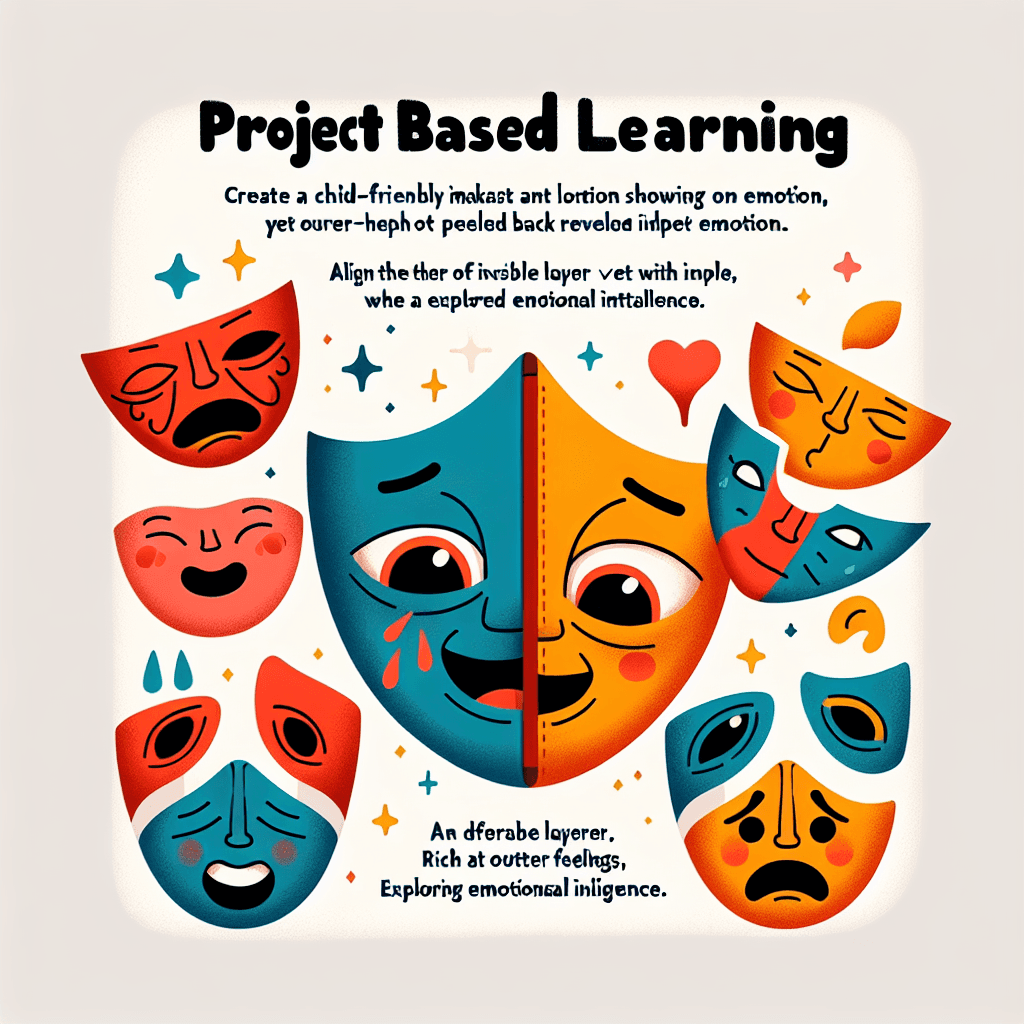
Masks of Emotion: Pinduli-Inspired Inner and Outer Feelings
Inquiry Framework
Question Framework
Driving Question
The overarching question that guides the entire project.How can we design masks to express a range of emotions, inspired by Pinduli, to better understand and respect both our own inner feelings and those of others?Essential Questions
Supporting questions that break down major concepts.- How can masks be used to show different feelings?
- How does Pinduli's story help us understand our own feelings?
- How do our inner feelings sometimes differ from what we show outside?
- Why is it important to understand and respect the feelings of others?
Standards & Learning Goals
Learning Goals
By the end of this project, students will be able to:- Students will be able to identify and describe a range of emotions.
- Students will be able to create a mask that reflects both inner and outer feelings.
- Students will be able to connect the story of Pinduli to their own emotional experiences.
- Students will be able to collaborate with peers to design and create masks.
- Students will be able to explain how masks can be used to express emotions.
- Students will be able to demonstrate respect for their own feelings and the feelings of others.
- Students will be able to compare and contrast inner and outer feelings.
- Students will be able to understand why it is important to respect the feelings of others.
- Students will be able to apply knowledge from Pinduli's story to understand their own emotions.
- Students will be able to design masks to express emotions.
- Students will be able to understand and respect their own inner feelings and those of others.
- Students will be able to better understand their own feelings and the feelings of others through mask design.
- Students will be able to use masks to show different feelings.
- Students will be able to use collaboration to create masks
Entry Events
Events that will be used to introduce the project to studentsEmotion Charades
'Emotion Charades': Students act out emotions without speaking, and the class guesses. This connects to the project by immediately engaging students with identifying and expressing feelings, mirroring Pinduli's journey of understanding her emotions. It sparks inquiry into non-verbal communication and the challenge of representing inner feelings outwardly.Portfolio Activities
Portfolio Activities
These activities progressively build towards your learning goals, with each submission contributing to the student's final portfolio.Emotion Brainstorm
Students will begin by brainstorming a list of emotions and discussing situations that might cause those emotions. They will then choose three emotions to focus on for the next activity.Steps
Here is some basic scaffolding to help students complete the activity.Final Product
What students will submit as the final product of the activityA list of emotions with brief descriptions of associated situations.Alignment
How this activity aligns with the learning objectives & standardsAligns with the learning goal: Students will be able to identify and describe a range of emotions.Design Refinement & Emotion Selection
Students will refine their mask designs based on peer feedback. They'll choose one emotion to focus on for the final mask creation, combining inner and outer expressions.Steps
Here is some basic scaffolding to help students complete the activity.Final Product
What students will submit as the final product of the activityA finalized mask design and a short written reflection on the design choices and peer feedback.Alignment
How this activity aligns with the learning objectives & standardsAligns with the learning goals: Students will be able to design masks to express emotions; Students will be able to collaborate with peers to design and create masks.Mask Creation: Expressing Feelings Visually
Students will create their final mask using craft materials. They will focus on visually representing both the inner feeling and the outward expression of their chosen emotion.Steps
Here is some basic scaffolding to help students complete the activity.Final Product
What students will submit as the final product of the activityA completed mask that visually represents both the inner feeling and outward expression of a chosen emotion.Alignment
How this activity aligns with the learning objectives & standardsAligns with the learning goals: Students will be able to create a mask that reflects both inner and outer feelings; Students will be able to explain how masks can be used to express emotions.Mask Presentation & Reflection
Students will present their masks to the class, explaining their design choices and how the mask represents both inner and outer feelings. They will also discuss how the activity helped them connect with Pinduli's story and understand their own emotions.Steps
Here is some basic scaffolding to help students complete the activity.Final Product
What students will submit as the final product of the activityA presentation of the completed mask, explaining the design choices, the represented emotion, and personal reflections on the project.Alignment
How this activity aligns with the learning objectives & standardsAligns with the learning goals: Students will be able to connect the story of Pinduli to their own emotional experiences; Students will be able to demonstrate respect for their own feelings and the feelings of others.Rubric & Reflection
Portfolio Rubric
Grading criteria for assessing the overall project portfolioMasks of Emotion Rubric
Understanding Emotions
This category assesses the student's ability to identify and describe a range of emotions and their associated situations.Emotion Identification
How well the student identified and described a variety of emotions.
Exemplary
4 PointsThe student accurately identifies and describes a wide range of emotions with detailed explanations of associated situations, demonstrating a sophisticated understanding of emotional nuances.
Proficient
3 PointsThe student accurately identifies and describes several emotions with clear explanations of associated situations, demonstrating a thorough understanding of emotional concepts.
Developing
2 PointsThe student identifies and describes a few basic emotions with limited explanations of associated situations, demonstrating an emerging understanding of emotions.
Beginning
1 PointsThe student struggles to identify and describe emotions, providing minimal or inaccurate explanations of associated situations, demonstrating a beginning understanding of emotions.
Expressing Emotions Visually
This category assesses the student's ability to design and refine their mask to effectively express the chosen emotion, combining inner and outer feelings, and their effective use of peer feedback.Mask Design & Refinement
How effectively the student designed and refined their mask based on feedback to express the chosen emotion, combining inner and outer feelings.
Exemplary
4 PointsThe student innovatively designs and refines a mask that masterfully expresses the chosen emotion, seamlessly integrating inner and outer feelings based on insightful feedback, resulting in a highly original and impactful design.
Proficient
3 PointsThe student effectively designs and refines a mask that clearly expresses the chosen emotion, successfully combining inner and outer feelings based on peer feedback, resulting in a well-executed and thoughtful design.
Developing
2 PointsThe student designs a mask that shows an attempt to express the chosen emotion, partially combining inner and outer feelings with some consideration of peer feedback, resulting in a design that is developing in its expression.
Beginning
1 PointsThe student struggles to design a mask that expresses the chosen emotion, with limited connection between inner and outer feelings and minimal incorporation of peer feedback, resulting in a design that is beginning in its expression.
Use of Feedback
How well the student incorporated peer feedback into their final mask design and reflection.
Exemplary
4 PointsThe student demonstrates exceptional integration of peer feedback, resulting in a final design that reflects deep consideration and innovative incorporation of suggestions, accompanied by a reflective piece that showcases sophisticated understanding of the feedback's impact.
Proficient
3 PointsThe student demonstrates effective integration of peer feedback, resulting in a final design that clearly reflects thoughtful incorporation of suggestions, accompanied by a reflective piece that showcases a clear understanding of the feedback's impact.
Developing
2 PointsThe student demonstrates partial integration of peer feedback, resulting in a final design that shows some consideration of suggestions, accompanied by a reflective piece that indicates a basic understanding of the feedback's impact.
Beginning
1 PointsThe student demonstrates limited integration of peer feedback, resulting in a final design that shows minimal consideration of suggestions, accompanied by a reflective piece that indicates a beginning understanding of the feedback's impact.
Mask Creation & Craftsmanship
This category assesses the student's ability to use craft materials to visually represent both the inner feeling and outward expression of their chosen emotion in their mask.Visual Representation
How effectively the student used craft materials to visually represent both the inner feeling and the outward expression of their chosen emotion in the mask.
Exemplary
4 PointsThe student skillfully uses craft materials in an innovative way to create a mask that powerfully and subtly conveys both the inner feeling and outward expression of the chosen emotion, demonstrating advanced understanding of visual communication.
Proficient
3 PointsThe student effectively uses craft materials to create a mask that clearly conveys both the inner feeling and outward expression of the chosen emotion, demonstrating a thorough understanding of visual communication.
Developing
2 PointsThe student uses craft materials to create a mask that attempts to convey both the inner feeling and outward expression of the chosen emotion, demonstrating an emerging understanding of visual communication.
Beginning
1 PointsThe student struggles to use craft materials to create a mask that conveys the inner feeling and outward expression of the chosen emotion, demonstrating a beginning understanding of visual communication.
Connecting & Communicating Emotions
This category assesses the student's ability to present their mask, explain their design choices, connect the activity to Pinduli's story and their own emotional experiences, and demonstrate respectful communication during presentations.Presentation & Reflection
How well the student presented their mask, explained their design choices, and connected the activity to Pinduli's story and their own emotional experiences.
Exemplary
4 PointsThe student delivers an exceptionally insightful presentation, articulating design choices with sophistication, drawing profound connections between the activity, Pinduli's story, and their own emotional experiences, demonstrating a high level of self-awareness and critical thinking.
Proficient
3 PointsThe student delivers a clear and thoughtful presentation, explaining design choices effectively, drawing clear connections between the activity, Pinduli's story, and their own emotional experiences, demonstrating self-awareness and critical thinking.
Developing
2 PointsThe student delivers a basic presentation, explaining some design choices, drawing limited connections between the activity, Pinduli's story, and their own emotional experiences, demonstrating some self-awareness and critical thinking.
Beginning
1 PointsThe student delivers an incomplete presentation, struggling to explain design choices or draw connections between the activity, Pinduli's story, and their own emotional experiences, demonstrating a beginning level of self-awareness and critical thinking.
Respectful Communication
How respectfully the student offered and received feedback during presentations.
Exemplary
4 PointsThe student consistently offers insightful and constructive feedback to peers while gracefully receiving feedback on their own work, demonstrating exceptional interpersonal skills and a strong commitment to collaborative growth.
Proficient
3 PointsThe student offers respectful and constructive feedback to peers while openly receiving feedback on their own work, demonstrating strong interpersonal skills and a commitment to collaborative growth.
Developing
2 PointsThe student sometimes offers respectful feedback to peers while occasionally receiving feedback on their own work, demonstrating developing interpersonal skills and a basic commitment to collaborative growth.
Beginning
1 PointsThe student struggles to offer respectful feedback to peers and/or has difficulty receiving feedback on their own work, demonstrating beginning interpersonal skills and a limited commitment to collaborative growth.