
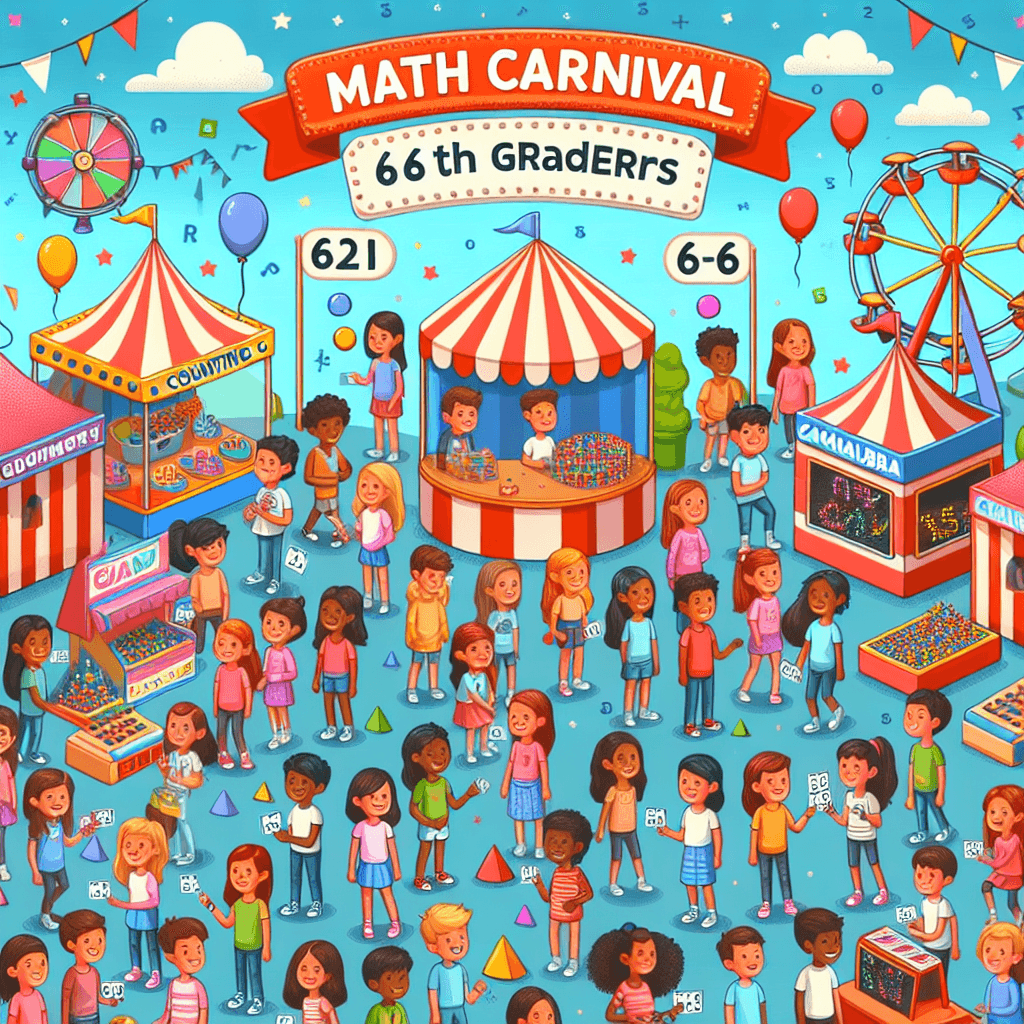
Math Carnival: Interactive Games for 6th Graders
Inquiry Framework
Question Framework
Driving Question
The overarching question that guides the entire project.How can we design and run a Math Carnival that successfully integrates mathematical concepts like probability, geometry, data analysis, and financial literacy to engage and educate participants?Essential Questions
Supporting questions that break down major concepts.- What mathematical concepts can create engaging and educational carnival games?
- How can probability influence the outcome of carnival games?
- In what ways can geometry and measurement be used to design carnival attractions?
- What role does data analysis play in understanding and improving carnival games?
- How can financial literacy be integrated into planning and running a carnival?
Standards & Learning Goals
Learning Goals
By the end of this project, students will be able to:- Students will understand and apply ratio concepts to design fair and balanced carnival games.
- Students will compute fractions and division to handle financial aspects of running a carnival.
- Students will formulate statistical questions and analyze data to improve game design and effectiveness.
- Students will use geometric principles to design the layout and structure of carnival attractions.
- Students will calculate probabilities to ensure games are fun and challenging for participants.
Kentucky Academic Standards for Mathematics
Entry Events
Events that will be used to introduce the project to studentsThe Math Magician's Conundrum
Introduce a video of a magician who uses math to perform amazing tricks at his carnival. Students will then be tasked with unraveling the secrets behind the tricks and adapting them into fair games that illustrate math concepts.Mystery Math Riddles
Unveil a room filled with mysterious math riddles and puzzles. Students must solve these riddles to reveal the theme of their 'Math Carnival Funhouse'. This event taps into their natural curiosity and sets the stage for designing their own unique carnival games.Portfolio Activities
Portfolio Activities
These activities progressively build towards your learning goals, with each submission contributing to the student's final portfolio.Ratio Ringleader Challenge
Students will develop and apply their understanding of ratio concepts to design fair and balanced carnival games. This activity emphasizes the use of ratios in game design to ensure an equitable and enjoyable experience for all participants.Steps
Here is some basic scaffolding to help students complete the activity.Final Product
What students will submit as the final product of the activityA presentation detailing three carnival game designs that utilize ratio concepts to ensure fairness.Alignment
How this activity aligns with the learning objectives & standardsAligns with Kentucky Standard M-6.1 (Understand ratio concepts and use ratio reasoning to solve problems).Fraction Financier: Carnival Cash
Students will apply their knowledge of fractions and division to manage the financial elements of their carnival games. Through this activity, students will learn to calculate costs, potential gains, and set equitable entry fees using fraction operations.Steps
Here is some basic scaffolding to help students complete the activity.Final Product
What students will submit as the final product of the activityA comprehensive financial report outlining costs, entry fees, and projected profits for the carnival games using fraction and division principles.Alignment
How this activity aligns with the learning objectives & standardsAligns with Kentucky Standard M-6.2 (Interpret and compute quotients of fractions, and solve word problems involving division of fractions by fractions).Statistical Sleuth
Explore statistical questions by designing a data collection method and analyzing data to improve game mechanics. Students will delve into statistics to better understand game performance and participant engagement.Steps
Here is some basic scaffolding to help students complete the activity.Final Product
What students will submit as the final product of the activityA data analysis report that includes statistical questions, data collected from test runs, insights, and recommended game improvements.Alignment
How this activity aligns with the learning objectives & standardsAligns with Kentucky Standard M-6.3 (Understand the concept of a statistical question as one that anticipates variability in data related to the question and accounts for it in the answers).Geometric Game Planners
Students utilize geometric concepts to design the layout of carnival attractions, focusing on measurement of area and volume for planning efficient and appealing game booth spaces.Steps
Here is some basic scaffolding to help students complete the activity.Final Product
What students will submit as the final product of the activityA detailed and dimensionally accurate carnival layout map, optimized for space and flow using geometric principles.Alignment
How this activity aligns with the learning objectives & standardsAligns with Kentucky Standard M-6.4 (Solve real-world and mathematical problems involving area, surface area, and volume).Probability Party Planners
Students will dive into the world of probability, learning how to calculate probabilities to ensure carnival games are both fun and challenging, while remaining fair.Steps
Here is some basic scaffolding to help students complete the activity.Final Product
What students will submit as the final product of the activityAn adjusted carnival game instruction sheet that includes calculated probabilities and rationales for ensuring fairness and excitement.Alignment
How this activity aligns with the learning objectives & standardsAligns with Kentucky Standard M-6.5 (Understand and calculate probabilities of simple events to solve problems).Rubric & Reflection
Portfolio Rubric
Grading criteria for assessing the overall project portfolioMath Carnival Funhouse Rubric
Ratio and Proportions Application
Assessment of students' ability to apply ratio and proportion concepts in designing fair carnival games.Conceptual Understanding of Ratios
Evaluates the depth of understanding and application of ratio concepts in game design.
Exemplary
4 PointsDemonstrates comprehensive understanding of ratios, evident in innovative and fair game designs with clear explanations.
Proficient
3 PointsShows solid understanding of ratios, resulting in fair game designs with minimal guidance required.
Developing
2 PointsDisplays basic understanding of ratios with limited application and inconsistent game fairness.
Beginning
1 PointsStruggles to understand and apply ratio concepts, leading to imbalanced games.
Financial Literacy and Fraction Application
Evaluation of students' proficiency in using fractions for budgeting and financial planning of carnival games.Fraction Operations for Budgeting
Assesses the ability to use fractions in calculating costs, revenues, and profits for the games.
Exemplary
4 PointsExhibits advanced proficiency in using fractions to accurately compute comprehensive budgets with justified entry fees and profits.
Proficient
3 PointsUtilizes fractions effectively for budgeting and profit calculations with correct entries.
Developing
2 PointsApplies fractions inconsistently, leading to occasional errors in budget or profit calculations.
Beginning
1 PointsDemonstrates minimal ability in using fractions, resulting in flawed budgets and financial plans.
Statistical Analysis in Game Design
Assesses the use of statistical questions and data analysis to improve game design.Data Collection and Analysis
Evaluates the formulation of statistical questions and the effectiveness of data analysis in deriving game improvements.
Exemplary
4 PointsCrafts insightful statistical questions and performs detailed analyses to significantly enhance game designs with strong evidence provided.
Proficient
3 PointsFormulates relevant statistical questions and conducts sound analyses to support game improvements.
Developing
2 PointsDevelops basic statistical questions with limited analysis leading to modest game enhancements.
Beginning
1 PointsStruggles with creating statistical questions and lacks substantial data analysis.
Geometric Concepts in Layout Design
Assessment of students' application of geometric principles in crafting efficient and appealing carnival layouts.Geometry in Space Planning
Evaluates the use of geometric concepts in determining the layout and spatial design of the carnival.
Exemplary
4 PointsDemonstrates mastery in using geometry to create detailed and space-efficient layouts with optimal flow.
Proficient
3 PointsApplies geometric principles effectively to produce functional and well-organized layouts.
Developing
2 PointsDisplays basic application of geometry with some layout inefficiencies noted.
Beginning
1 PointsStruggles with using geometric concepts, resulting in poorly planned layouts.
Probability in Game Fairness
Evaluation of students' ability to apply probability concepts to ensure fairness and engagement in games.Probability Calculations and Adjustments
Assesses the understanding and application of probability concepts to balance game outcomes.
Exemplary
4 PointsExhibits outstanding skill in calculating probabilities and making insightful adjustments for fairness and excitement.
Proficient
3 PointsCalculates probabilities accurately and makes logical adjustments to game design.
Developing
2 PointsShows basic ability in probability calculations with some imbalances present.
Beginning
1 PointsStruggles with probability concepts, leading to unbalanced games.