
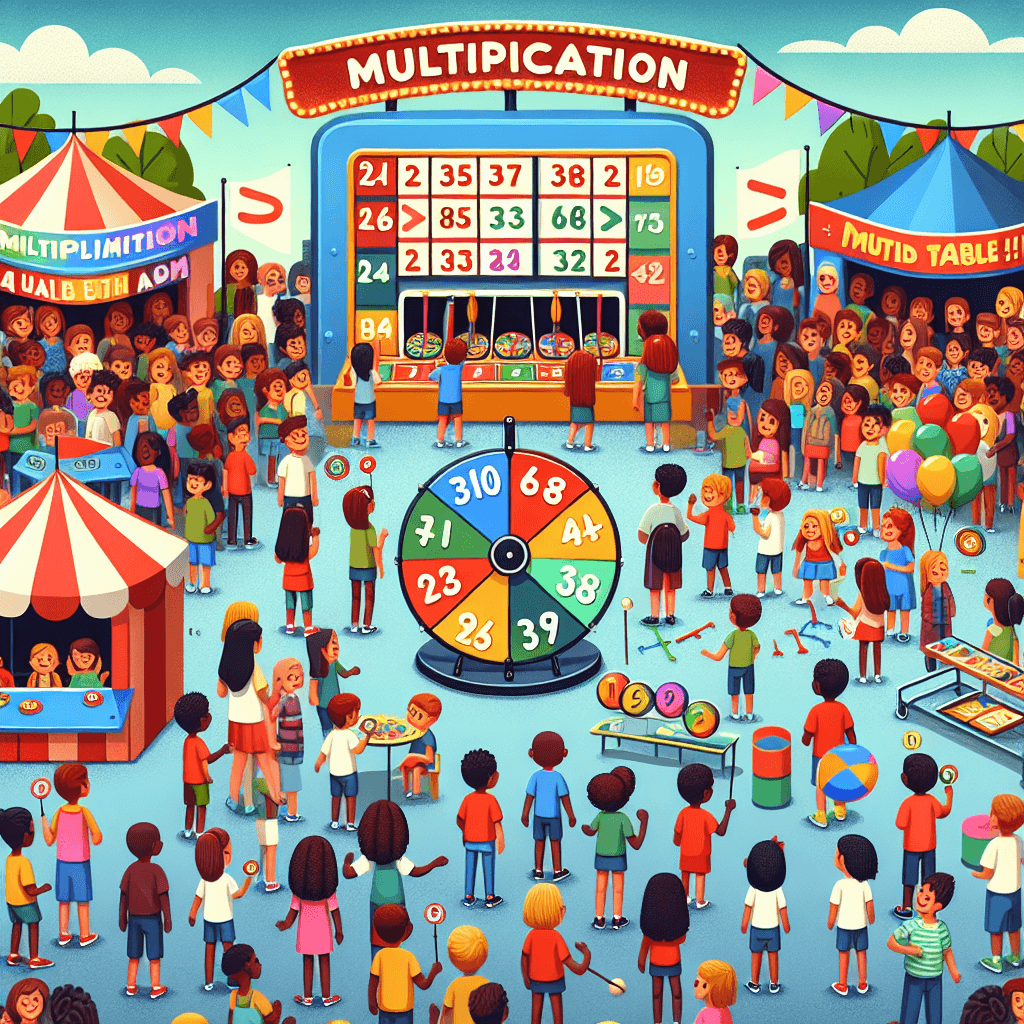
Math Carnival: Multiplication Games Extravaganza
Inquiry Framework
Question Framework
Driving Question
The overarching question that guides the entire project.How can we design and run engaging carnival games that use 2-digit multiplication to help us understand and apply multiplication concepts effectively in real-world scenarios?Essential Questions
Supporting questions that break down major concepts.- How can multiplication be used in real-world scenarios, such as in a carnival?
- What strategies can we use to multiply two-digit numbers effectively?
- In what ways can games enhance our understanding of mathematical concepts, like multiplication?
- How can we design a fun and educational carnival game that involves multiplication?
- What are the properties of multiplication that can help simplify complex problems?
Standards & Learning Goals
Learning Goals
By the end of this project, students will be able to:- Students will understand and apply strategies for multiplying two-digit numbers using place value and the properties of operations.
- Students will design and run engaging carnival games that incorporate two-digit multiplication to demonstrate their understanding of the concept.
- Students will strengthen their problem-solving abilities by creating and testing games that use real-world applications of multiplication.
- Students will learn to illustrate and explain multiplication calculations by using equations, arrays, or area models.
- Students will engage in collaborative group work to design educational games, enhancing their communication and teamwork skills.
Common Core Standards
Entry Events
Events that will be used to introduce the project to studentsCarnival Launch Day with a Mysterious Guest
Invite a magician who specializes in math tricks to put on a show where all tricks are based on 2-digit multiplication. After the show, challenge students to uncover the secrets behind the magician's tricks, sparking their interest in the project goals of designing similar engaging carnival games.Virtual Tour of World's Best Math Carnivals
Take students on a virtual field trip to the best math-themed carnivals around the world. During the tour, they will hear from game designers about the math behind their games, piquing curiosity about creating their own 2-digit multiplication games.Portfolio Activities
Portfolio Activities
These activities progressively build towards your learning goals, with each submission contributing to the student's final portfolio.Multiplication Mastery Maps
Students create visual maps to explore and solidify understanding of two-digit multiplication strategies and properties.Steps
Here is some basic scaffolding to help students complete the activity.Final Product
What students will submit as the final product of the activityA visual map or infographic demonstrating the strategies and properties of two-digit multiplication.Alignment
How this activity aligns with the learning objectives & standardsAligns with 4.NBT.B.5 by helping students understand and apply strategies for multiplying two-digit numbers using place value and operation properties.Carnival Game Design Drafts
Students brainstorm and draft initial blueprints for their carnival games, ensuring the use of multiplication strategies learned.Steps
Here is some basic scaffolding to help students complete the activity.Final Product
What students will submit as the final product of the activityInitial game drafts with emphasis on 2-digit multiplication in scoring and mechanics.Alignment
How this activity aligns with the learning objectives & standardsSupports 4.OA.A.3, focusing on applying multiplication in real-life scenarios and enhancing problem-solving skills.Pitch Your Game
Students present their completed games to the class, emphasizing the mathematical concepts and strategies involved.Steps
Here is some basic scaffolding to help students complete the activity.Final Product
What students will submit as the final product of the activityA presentation showcasing the carnival game, highlighting how multiplication is integrated.Alignment
How this activity aligns with the learning objectives & standardsCombines all learning goals, with emphasis on illustrating, explaining multiplication calculations, and enhancing communication skills.Rubric & Reflection
Portfolio Rubric
Grading criteria for assessing the overall project portfolioMath Carnival: Multiplication Games Rubric
Mathematical Understanding
Assesses the ability to accurately apply and demonstrate two-digit multiplication strategies and properties in game design.Accuracy of Multiplication Strategies
Evaluates how well students apply two-digit multiplication strategies, such as area models, partial products, and standard algorithms.
Exemplary
4 PointsConsistently and accurately applies a variety of multiplication strategies with sophisticated understanding and no errors.
Proficient
3 PointsApplies multiplication strategies accurately with minor errors that do not affect overall understanding.
Developing
2 PointsApplies multiplication strategies with some errors and inconsistent understanding.
Beginning
1 PointsStruggles to apply multiplication strategies and demonstrates limited understanding.
Explanation and Illustration
Evaluates the ability to illustrate and explain multiplication calculations using equations, arrays, or area models.
Exemplary
4 PointsProvides comprehensive and clear illustrations and explanations of calculations using a range of methods.
Proficient
3 PointsProvides clear and mostly accurate illustrations and explanations using some methods.
Developing
2 PointsProvides incomplete or partially unclear illustrations and explanations.
Beginning
1 PointsProvides unclear or incorrect illustrations and explanations.
Game Design and Creativity
Assesses creativity in designing a carnival game that effectively integrates multiplication concepts.Integration of Multiplication Concepts
Evaluates how effectively multiplication is integrated into the game mechanics and scoring.
Exemplary
4 PointsElegantly integrates multiplication into a well-thought-out game with innovative mechanics.
Proficient
3 PointsEffectively integrates multiplication into the game with clear mechanics.
Developing
2 PointsIntegration of multiplication into the game shows some coherence but lacks depth.
Beginning
1 PointsStruggles to integrate multiplication into the game mechanics.
Creativity in Game Design
Evaluates the originality and creativity of the game concept and design.
Exemplary
4 PointsPresents an original and highly creative game concept that engages and educates effectively.
Proficient
3 PointsPresents a creative game concept that engages and educates.
Developing
2 PointsPresents a somewhat creative concept that lacks engagement or educational depth.
Beginning
1 PointsStruggles to present a creative or engaging game concept.
Collaboration and Communication
Assesses the ability to work collaboratively in groups and effectively present game ideas.Team Collaboration
Evaluates participation and contribution to group tasks and objectives.
Exemplary
4 PointsDemonstrates leadership and consistently contributes to team objectives with exceptional collaboration skills.
Proficient
3 PointsContributes effectively to team objectives with good collaboration skills.
Developing
2 PointsShows some participation in team activities, though unevenly.
Beginning
1 PointsStruggles to participate effectively in team activities and lacks collaboration skills.
Presentation Skills
Evaluates the clarity, engagement, and organization of the game presentation.
Exemplary
4 PointsDelivers a highly engaging, clear, and organized presentation with exceptional communication skills.
Proficient
3 PointsDelivers a clear and organized presentation with good communication skills.
Developing
2 PointsDelivers a presentation that is somewhat clear and organized with basic communication skills.
Beginning
1 PointsStruggles to deliver a clear and organized presentation, lacking communication skills.