
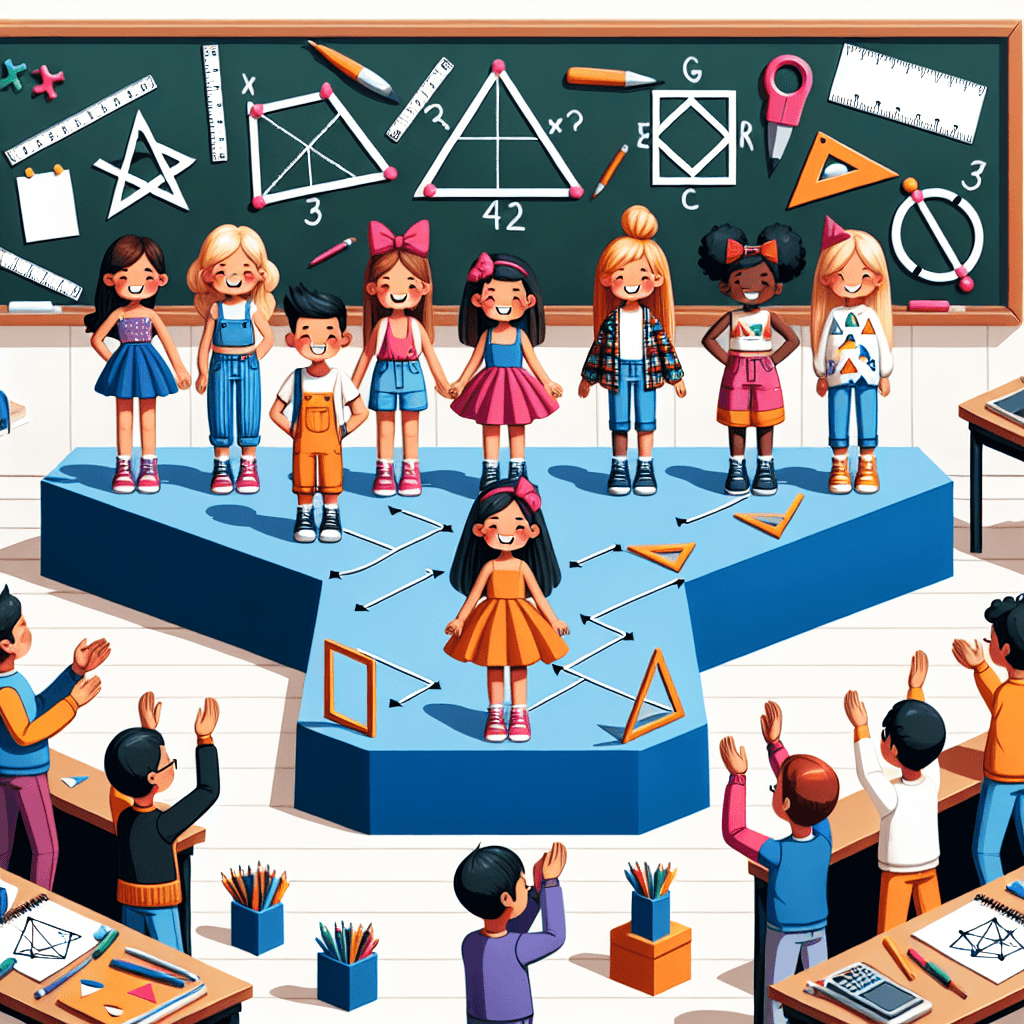
Math Fashion: Transformations on the Runway
Inquiry Framework
Question Framework
Driving Question
The overarching question that guides the entire project.How can we use geometric transformations to create innovative fashion designs for a runway show, and what impact do these transformations have on the patterns and aesthetics of our outfits?Essential Questions
Supporting questions that break down major concepts.- What are geometric transformations, and how can they be used to manipulate figures?
- How can we use rotations, reflections, and translations to create patterns and designs in fashion?
- In what ways do geometric transformations appear in real-world fashion design?
- How can a series of geometric transformations be sequenced to create a specified design effect?
- What tools and methods can be used to accurately perform and demonstrate geometric transformations?
Standards & Learning Goals
Learning Goals
By the end of this project, students will be able to:- Students will understand and apply geometric transformations including rotations, reflections, and translations.
- Students will be able to design and create fashion patterns using geometric transformations and document the sequence of transformations used.
- Students will explore the use of geometric transformations in real-world contexts, particularly in fashion design.
- Students will develop skills in using geometry tools such as graph paper and software to perform and visualize transformations.
Common Core Standards
Entry Events
Events that will be used to introduce the project to studentsTransformation Fashion Challenge
Launch a timed challenge where students transform basic clothing items using geometric transformations to create new fashion pieces. This hands-on activity motivates students to apply mathematical concepts creatively and see immediate results. Students are given a time period, and specific shapes, in which they have to make their clothing.Portfolio Activities
Portfolio Activities
These activities progressively build towards your learning goals, with each submission contributing to the student's final portfolio.Geometry Fashion Designer Sketch
Students start by designing basic fashion sketches incorporating geometric shapes like rectangles, parallelograms, and trapezoids. Through artistic sketching, students will conceptualize designs, identifying potential shapes and transformations.Steps
Here is some basic scaffolding to help students complete the activity.Final Product
What students will submit as the final product of the activityA detailed sketch of a fashion design using basic geometric shapes, labeled with their names.Alignment
How this activity aligns with the learning objectives & standardsAligns with CCSS.MATH.CONTENT.HSG.CO.A.3 as it requires identifying basic geometric shapes and preludes to their transformations.Transformation Technique Tryouts
Students practice the three fundamental transformations: rotations, reflections, and translations, on paper. By applying these transformations to their sketches, they learn how designs can be altered and evolve through geometric concepts.Steps
Here is some basic scaffolding to help students complete the activity.Final Product
What students will submit as the final product of the activitySet of transformation versions of an original sketch showing translations, reflections, and rotations.Alignment
How this activity aligns with the learning objectives & standardsConnects with CCSS.MATH.CONTENT.HSG.CO.A.5 by engaging students in drawing transformed figures through basic transformations.Fashion Transformation Series
In this activity, students will select a base design and apply a series of transformations to create a fashion transformation series, showcasing their understanding of sequencing and the effect on the design.Steps
Here is some basic scaffolding to help students complete the activity.Final Product
What students will submit as the final product of the activityA documented sequence of transformations showing the progressive changes to the design, displayed as a series of sketches.Alignment
How this activity aligns with the learning objectives & standardsSupports CCSS.MATH.CONTENT.HSG.CO.B.6 as students apply sequences of transformations and predict their design influence.Tech-Savvy Geometry Tailor
Students utilize geometry software to model transformations on their fashion designs digitally, allowing for precise visualization and manipulation through technology.Steps
Here is some basic scaffolding to help students complete the activity.Final Product
What students will submit as the final product of the activityDigitally transformed fashion designs showing various geometric manipulations.Alignment
How this activity aligns with the learning objectives & standardsAligns with CCSS.MATH.CONTENT.HSG.CO.A.5 and CCSS.MATH.CONTENT.HSG.CO.B.6 by integrating technology with geometric transformations.Runway Presentation Portfolio
Culmination of previous activities where students compile their transformation designs into a portfolio for a class 'runway' presentation, discussing their creative process and mathematical applications.Steps
Here is some basic scaffolding to help students complete the activity.Final Product
What students will submit as the final product of the activityA polished portfolio of fashion transformation designs along with an oral presentation.Alignment
How this activity aligns with the learning objectives & standardsHighlights CCSS.MATH.CONTENT.HSG.CO.B.8 by demonstrating the understanding of congruence and transformation sequences, and connects real-world applications to mathematical concepts.Rubric & Reflection
Portfolio Rubric
Grading criteria for assessing the overall project portfolioFashion Transformation Design Project Rubric
Understanding of Geometric Transformations
Evaluates the student's grasp on geometric transformations including rotations, reflections, and translations as applied in fashion design.Application of Rotations, Reflections, Translations
The extent to which the student accurately applies rotations, reflections, and translations in their designs.
Exemplary
4 PointsDemonstrates a sophisticated application of rotations, reflections, and translations, creating innovative and aesthetically appealing designs.
Proficient
3 PointsApplies rotations, reflections, and translations correctly and effectively in the design projects.
Developing
2 PointsShows an emerging understanding of geometric transformations, but with some inaccuracies in application.
Beginning
1 PointsDemonstrates a limited understanding of transformations with frequent inaccuracies.
Sequence of Transformations
Assessment of the student's ability to plan and execute a series of transformations logically and creatively.
Exemplary
4 PointsPrecisely sequences multiple transformations in a logical, creative series that clearly exemplifies advanced planning.
Proficient
3 PointsCorrectly sequences transformations in a well-organized manner for clear design evolution.
Developing
2 PointsAttempts to sequence transformations, but with some gaps in logic and planning.
Beginning
1 PointsStruggles to sequence transformations effectively, resulting in disorganized design transitions.
Technology Integration in Transformations
Measures the proficiency in using technology to perform and visualize transformations.
Exemplary
4 PointsSeamlessly integrates technology to enhance and precisely demonstrate transformations, resulting in high-quality digital designs.
Proficient
3 PointsEffectively uses technology to demonstrate transformations, resulting in well-executed digital representations.
Developing
2 PointsUses technology with some difficulty, leading to partially effective digital transformations.
Beginning
1 PointsLimited ability to use technology, resulting in underdeveloped digital transformations.
Creative Fashion Design Execution
Assesses the creativity and originality in the students' fashion design, integrating geometric concepts.Originality and Creativity
The originality of the fashion designs created using geometric transformations and the creativity shown in the final product.
Exemplary
4 PointsDemonstrates exceptional creativity and originality in designs that are both innovative and geometrically informed.
Proficient
3 PointsShows creativity and originality with designs that effectively incorporate geometric transformations.
Developing
2 PointsPresents designs with some creative elements, though may rely on common patterns or basic transformations.
Beginning
1 PointsDesigns show minimal creativity, predominantly inspired by basic templates or lacking geometrical integration.
Communication and Presentation of Design
Evaluates how well students communicate their design process, transformations applied, and mathematical understanding in their presentations.Clarity and Effectiveness of Presentation
The clarity and effectiveness of the oral presentation in explaining the design process and mathematical concepts used.
Exemplary
4 PointsPresents ideas with clarity and sophistication, fully explaining the mathematical concepts and design choices with confidence and insight.
Proficient
3 PointsCommunicates design process and mathematical concepts clearly and effectively with some insightful points.
Developing
2 PointsPresentation communicates basic ideas but lacks detail and full clarity in explaining mathematical concepts.
Beginning
1 PointsStruggles with communication, leaving many concepts unexplained or misunderstood.