
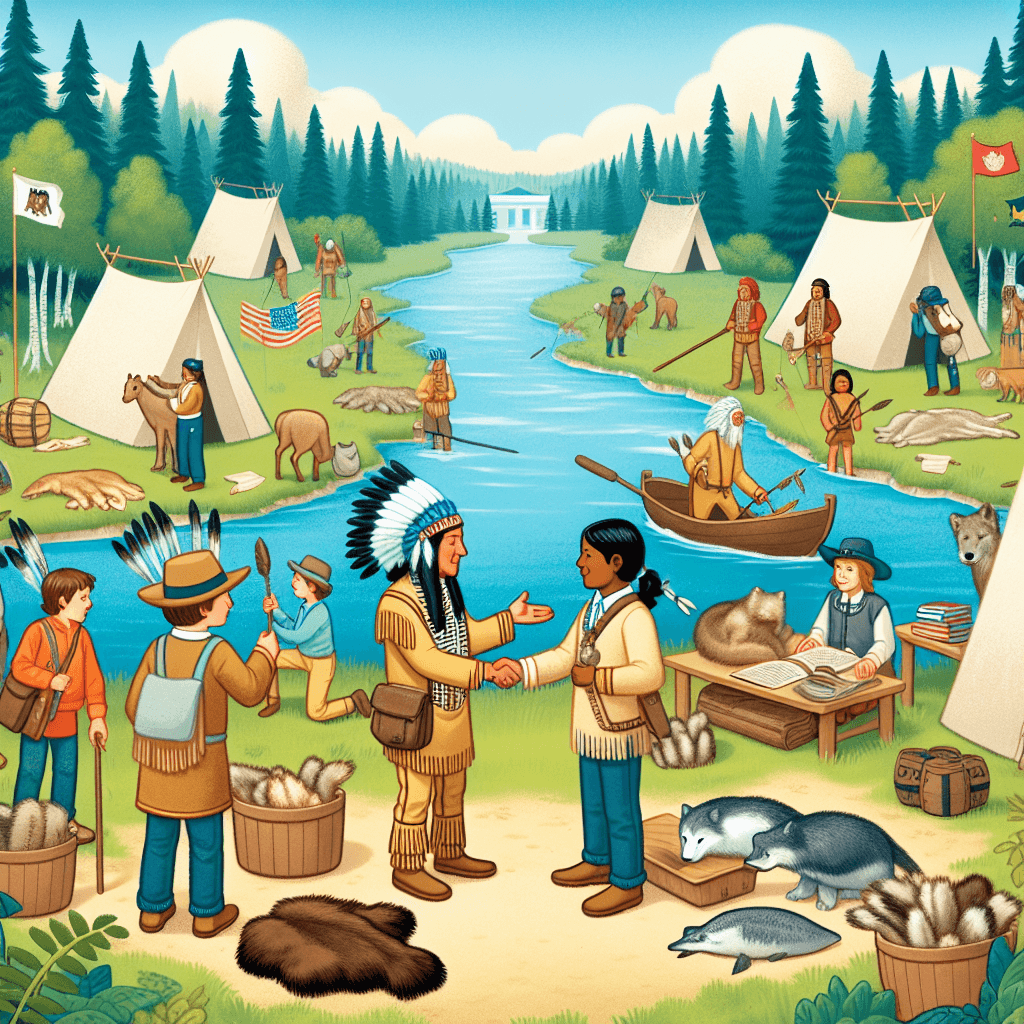
Michigan Fur Trade Exploration
Inquiry Framework
Question Framework
Driving Question
The overarching question that guides the entire project.How did geography, economy, and cultural interactions shape the development and impact of the fur trade in Michigan, and how can we understand the roles of different groups and the environmental changes that occurred during this period?Essential Questions
Supporting questions that break down major concepts.- How did the fur trade impact the economy and daily life in Michigan?
- What were the roles of different people and groups involved in the Michigan fur trade?
- How did geography influence the development of the fur trade in Michigan?
- Why was the fur trade important to cultural exchanges between Native Americans and European settlers?
- What were the environmental impacts of the fur trade in Michigan?
- How did the fur trade lead to changes in the relationships between Native Americans and European settlers?
Standards & Learning Goals
Learning Goals
By the end of this project, students will be able to:- Students will understand the economic impact of the fur trade on Michigan's development.
- Students will identify the roles and relationships between different cultural groups involved in the fur trade.
- Students will describe how geography influenced the fur trade routes and practices in Michigan.
- Students will explore the cultural exchanges and conflicts between Native Americans and European settlers during the fur trade.
- Students will assess the environmental changes brought by the fur trade in Michigan.
Michigan K-12 Social Studies Standards
Entry Events
Events that will be used to introduce the project to studentsTrading Post Marketplace Challenge
The classroom is transformed into a bustling trading post marketplace where students must create their own goods and trade them with classmates. This hands-on market simulation will highlight the concepts of trade and barter as experienced during the fur trade era.Portfolio Activities
Portfolio Activities
These activities progressively build towards your learning goals, with each submission contributing to the student's final portfolio.Fur Trade Explorer's Journal
Students will create a personal journal from the perspective of an explorer or settler during the Michigan fur trade era. This activity helps students empathize with historical figures, understand economic decisions, and grasp cultural interactions.Steps
Here is some basic scaffolding to help students complete the activity.Final Product
What students will submit as the final product of the activityA series of journal entries that reflect the economic, cultural, and geographical aspects of the Michigan fur trade from the character's perspective.Alignment
How this activity aligns with the learning objectives & standardsAligns with 3-H3.0.3 to describe the impact of exploration and trade on Native American tribes, and with 3-E1.0.1 to explain economic decisions during the fur trade.Geography Mapping Adventure
In this activity, students will create detailed maps showing the geographical features and trade routes vital to the Michigan fur trade. This will provide an understanding of how geography influenced the development and practices of the trade.Steps
Here is some basic scaffolding to help students complete the activity.Final Product
What students will submit as the final product of the activityA detailed map showcasing the geographical influences on the Michigan fur trade, complete with trade routes and natural resources.Alignment
How this activity aligns with the learning objectives & standardsAligns with 3-G4.0.1 by describing how geography affected the fur trade's development and execution in Michigan.Cultural Exchange Role Play
Students will participate in a role-play activity where they act as different cultural groups involved in the fur trade, engaging in trade negotiations and cultural exchanges. This highlights the diversity and interactions between groups.Steps
Here is some basic scaffolding to help students complete the activity.Final Product
What students will submit as the final product of the activityA role-play session that demonstrates understanding of cultural interactions and trade negotiations during the fur trade.Alignment
How this activity aligns with the learning objectives & standardsAligns with 3-H3.0.3 by highlighting cultural exchanges and 3-C2.0.2 by understanding decision-making within the fur trade.Eco Impact Investigation
In this activity, students explore the ecological effects of the fur trade in Michigan by examining environmental changes and understanding the importance of sustainable practices.Steps
Here is some basic scaffolding to help students complete the activity.Final Product
What students will submit as the final product of the activityA presentation or report highlighting the environmental impacts of the Michigan fur trade and proposing sustainable practices.Alignment
How this activity aligns with the learning objectives & standardsAligns with 3-H3.0.3 by examining the impact of fur trade activities on the environment and cultural interactions.Rubric & Reflection
Portfolio Rubric
Grading criteria for assessing the overall project portfolioMichigan Fur Trade Portfolio Rubric
Historical Empathy and Perspective
Evaluates the student's ability to empathize with historical figures and understand their roles and experiences in the Michigan fur trade through journal entries.Accuracy of Historical Context
Measures how accurately the student incorporates historically accurate details relevant to the Michigan fur trade era into their journal entries.
Exemplary
4 PointsIntegrates numerous accurate and detailed historical facts, showcasing a comprehensive understanding of the era and its context.
Proficient
3 PointsIncludes several accurate details, demonstrating a good understanding of the historical context.
Developing
2 PointsIncorporates some historical details but lacks depth or accuracy in some areas.
Beginning
1 PointsIncludes minimal historical context, with inaccuracies or vague descriptions.
Creative Expression and Insight
Evaluates the creativity and insightfulness of the student's portrayal of their chosen character's experiences and perspectives.
Exemplary
4 PointsDisplays exceptional creativity and insight, providing a vivid and engaging portrayal that invites empathy and understanding.
Proficient
3 PointsConsistently conveys clear and thoughtful insights, with creative elements that enhance the narrative.
Developing
2 PointsShows attempts at creative expression, but insights may be superficial or lacked engagement.
Beginning
1 PointsLimited creativity or insight, resulting in a flat or unengaging narrative.
Geographical Understanding
Assesses the student's map-making skills, understanding of Michigan's geography, and how geographic features influenced the fur trade.Map Accuracy and Detail
Reflects the accuracy and detail in the student's geographical map, including trade routes and key natural resources.
Exemplary
4 PointsMap is highly accurate and detailed, reflecting comprehensive geographical knowledge and careful attention to trade routes and resources.
Proficient
3 PointsMap accurately represents major features and resources, with evident organization and understanding.
Developing
2 PointsMap includes basic features but lacks detail or contains minor inaccuracies.
Beginning
1 PointsMap lacks accuracy, detail, or shows misunderstanding of key geographical elements.
Cultural Exchange and Decision-Making
Evaluates understanding of cultural interactions, negotiations, and decision-making within the fur trade context.Role-Playing Participation and Understanding
Assesses the student's engagement and understanding during the role-play activity, demonstrating comprehension of cultural exchanges and trade negotiations.
Exemplary
4 PointsExhibits outstanding participation and a deep understanding of cultural roles, exchanges, and negotiations.
Proficient
3 PointsConsistently participates with a clear understanding of roles and exchanges, actively engaging in negotiations.
Developing
2 PointsParticipates, but understanding of roles and exchanges is limited or inconsistent.
Beginning
1 PointsMinimal participation, with little understanding of cultural roles or exchanges.
Environmental Impact Analysis
Judges the quality of the student's investigation and presentation on the environmental impacts of the fur trade.Depth of Environmental Analysis
Evaluates the thoroughness and depth of the student's analysis and presentation on the environmental impacts.
Exemplary
4 PointsPresents a nuanced and comprehensive analysis with insightful conclusions and well-supported sustainable suggestions.
Proficient
3 PointsOffers a clear and detailed analysis with logical conclusions and appropriate recommendations.
Developing
2 PointsProvides a basic analysis, but lacks depth or contains unsupported conclusions.
Beginning
1 PointsAnalysis is superficial, with limited understanding or detail, and lacks viable recommendations.