
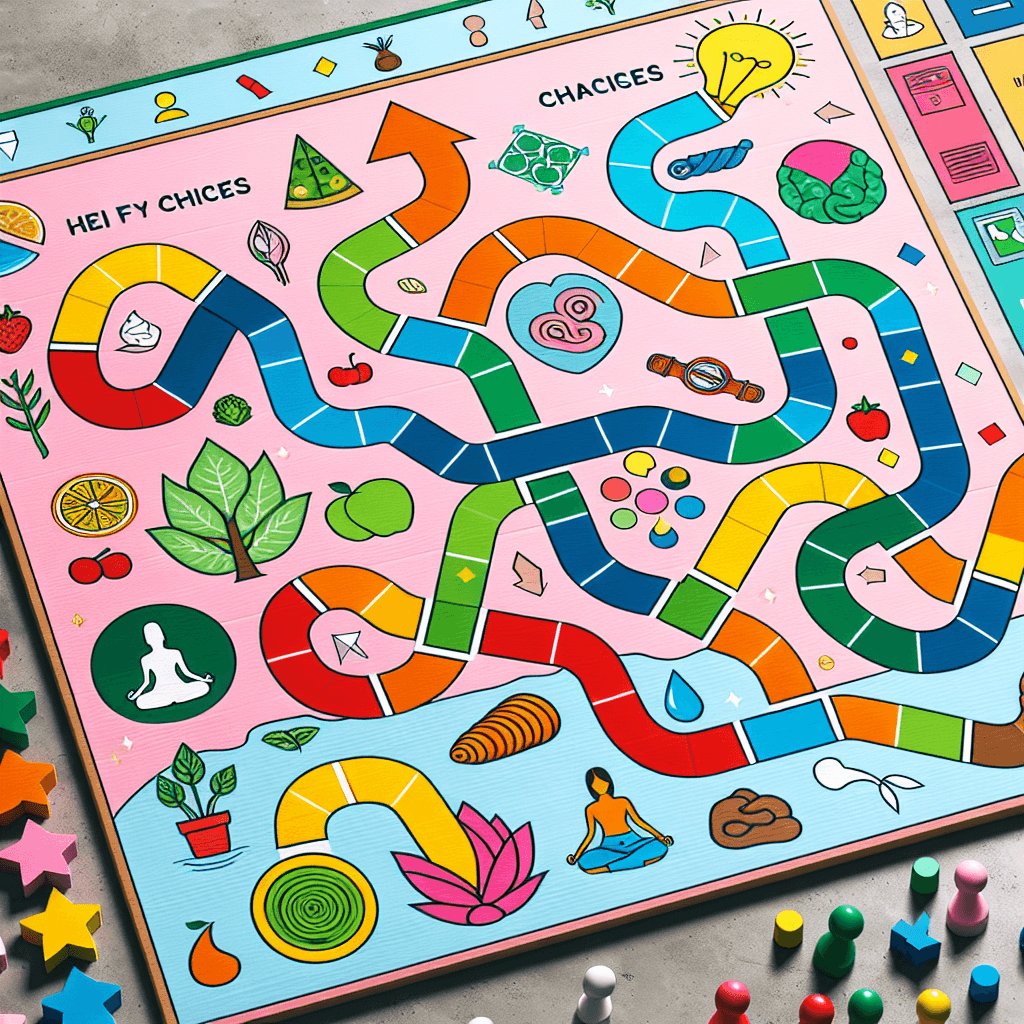
Mindful Choices: Healthy Decision-Making Game
Inquiry Framework
Question Framework
Driving Question
The overarching question that guides the entire project.How can we design a game that helps high school students practice making healthy decisions in various everyday scenarios while considering the impact of goal setting, mindfulness, peer pressure, and the consequences on physical and mental health?Essential Questions
Supporting questions that break down major concepts.- How do we make healthy decisions in everyday life?
- What are the consequences of our choices on our physical and mental health?
- How can goal setting influence our decision-making process?
- In what ways can we practice mindfulness to enhance decision-making?
- How does peer pressure affect our ability to make healthy choices?
Standards & Learning Goals
Learning Goals
By the end of this project, students will be able to:- Students will design a game that facilitates practice in making healthy decisions in various scenarios.
- Students will be able to explain the impact of goal setting and mindfulness on decision making.
- Students will analyze how peer pressure can influence their choices related to physical and mental health.
- Students will articulate the way different choices affect physical and mental well-being.
- Students will work collaboratively to create a game that integrates health education and decision-making.
Health Education Standards
Common Core English Language Arts Standards
Entry Events
Events that will be used to introduce the project to studentsEscape Room: The Consequence Code
Initiate the project with an 'Escape Room' scenario where students must solve puzzles related to health and wellness choices to "escape" various rooms in a set amount of time. Each puzzle solved requires critical decision-making and reflects real-life health challenges, encouraging teamwork and strategic thinking.Portfolio Activities
Portfolio Activities
These activities progressively build towards your learning goals, with each submission contributing to the student's final portfolio.Scenario Brainstorm Jam
Students engage in a creative brainstorming session to generate various real-life scenarios that will be included in the game. The focus is on situations where health decisions must be made, considering factors such as peer pressure, goal setting, and mindfulness.Steps
Here is some basic scaffolding to help students complete the activity.Final Product
What students will submit as the final product of the activityA list of detailed scenarios to be used in the game design.Alignment
How this activity aligns with the learning objectives & standardsAligns with Health Standard 9HL-2.1 by analyzing personal health behavior impacts, and Common Core ELA SL.1 by facilitating collaborative discussions.Mindfulness and Goal Setting Workshop
In this activity, students explore the concepts of mindfulness and effective goal setting. They will learn how these elements can influence decision-making processes, particularly in the scenarios identified during the brainstorming session.Steps
Here is some basic scaffolding to help students complete the activity.Final Product
What students will submit as the final product of the activityA personal reflection journal entry linking mindfulness and goal setting to decision-making scenarios.Alignment
How this activity aligns with the learning objectives & standardsAligns with Health Standard 9HL-1.1 on developing personal health goals and Common Core ELA SL.1 by preparing and participating in collaborative discussions.Design the Mindful Choices Game
Students will use their brainstorming ideas and insights from the workshop to design the core elements of the game, including rules, objectives, and potential outcomes based on decision-making paths.Steps
Here is some basic scaffolding to help students complete the activity.Final Product
What students will submit as the final product of the activityA prototype or storyboard of the Mindful Choices Game, including detailed rules and decision-making paths.Alignment
How this activity aligns with the learning objectives & standardsAligns with Health Standards 9HL-1.1, 9HL-2.1, and 9HL-4.2 by incorporating personal health goals, impacts of health behaviors, and peer influences. Supports ELA SL.1 through collaboration and communication.Peer Feedback and Iteration Session
This activity allows students to present their game prototype to peers and receive constructive feedback. They will analyze critiques to make improvements to their game design, focusing on enhancing the educational aspects related to health decision-making.Steps
Here is some basic scaffolding to help students complete the activity.Final Product
What students will submit as the final product of the activityAn improved version of the game prototype with refined rules and decision-making paths.Alignment
How this activity aligns with the learning objectives & standardsSupports Health Standards 9HL-2.1 and 9HL-4.2 by analyzing health behavior impacts and peer influences, and Common Core ELA SL.1 by preparing and participating in discussions.Rubric & Reflection
Portfolio Rubric
Grading criteria for assessing the overall project portfolioMindful Choices Game Design Rubric
Game Concept Development
Assesses the creativity and clarity in the development of game concepts related to health decision-making scenarios.Scenario Relevance
The extent to which scenarios chosen for the game are relevant to everyday health decision-making and align with health education standards.
Exemplary
4 PointsScenarios are highly relevant, creatively chosen, and clearly align with health education standards, showing a sophisticated understanding of health decisions.
Proficient
3 PointsScenarios are relevant and well-chosen, clearly align with health education standards, showing good understanding of health decisions.
Developing
2 PointsScenarios are somewhat relevant, with some alignment to health education standards, showing basic understanding of health decisions.
Beginning
1 PointsScenarios are minimally relevant and lack clear alignment with health education standards, showing limited understanding of health decisions.
Incorporation of Mindfulness and Goal Setting
Evaluates how well mindfulness and goal setting are integrated into the game scenarios.
Exemplary
4 PointsMindfulness and goal setting are seamlessly integrated throughout the scenarios, demonstrating exceptional insight into their influence on decision-making.
Proficient
3 PointsMindfulness and goal setting are effectively integrated into the scenarios, showing clear understanding of their role in decision-making.
Developing
2 PointsMindfulness and goal setting are partially integrated into the scenarios, showing some understanding.
Beginning
1 PointsIntegration of mindfulness and goal setting is minimal or unclear, showing limited understanding.
Game Design and Mechanics
Assesses the design of game rules, decision-making paths, and overall mechanics for logical consistency and creativity.Creativity and Innovation
The level of creativity and innovation present in the game design and mechanics.
Exemplary
4 PointsDesign is highly creative and innovative, shows exceptional originality and engagement potential.
Proficient
3 PointsDesign is creative and innovative, with clear originality and good engagement potential.
Developing
2 PointsDesign is somewhat creative and innovative, with some originality and engagement potential.
Beginning
1 PointsDesign lacks creativity and innovation, with minimal originality or engagement potential.
Logical Structuring of Rules
Evaluation of how effectively the rules are structured to guide decision-making pathways in the game.
Exemplary
4 PointsRules are exceptionally well-structured, facilitating logical and clear decision-making pathways.
Proficient
3 PointsRules are effectively structured, facilitating logical decision-making pathways.
Developing
2 PointsRules are somewhat structured, but decision-making pathways are not consistently logical.
Beginning
1 PointsRules lack structure and result in unclear decision-making pathways.
Collaboration and Iteration
Evaluates the effectiveness of teamwork, peer feedback integration, and iteration in improving the game design.Team Collaboration
Measures the effectiveness and synergy within the team during the project.
Exemplary
4 PointsDemonstrates outstanding collaboration, with all team members contributing equally in a synergistic manner.
Proficient
3 PointsDemonstrates effective collaboration with active contributions from all team members.
Developing
2 PointsTeam collaboration is inconsistent, with some members contributing more than others.
Beginning
1 PointsCollaboration is minimal, with most work dependent on few team members.
Feedback Integration
How effectively peer feedback is integrated into the game design to improve it.
Exemplary
4 PointsFeedback is fully and effectively integrated, leading to significant improvements in the game design.
Proficient
3 PointsFeedback is effectively integrated, contributing to noticeable improvements in the game design.
Developing
2 PointsFeedback is partially integrated, with limited impact on improving the game design.
Beginning
1 PointsFeedback integration is minimal, with negligible impact on improving the game design.