
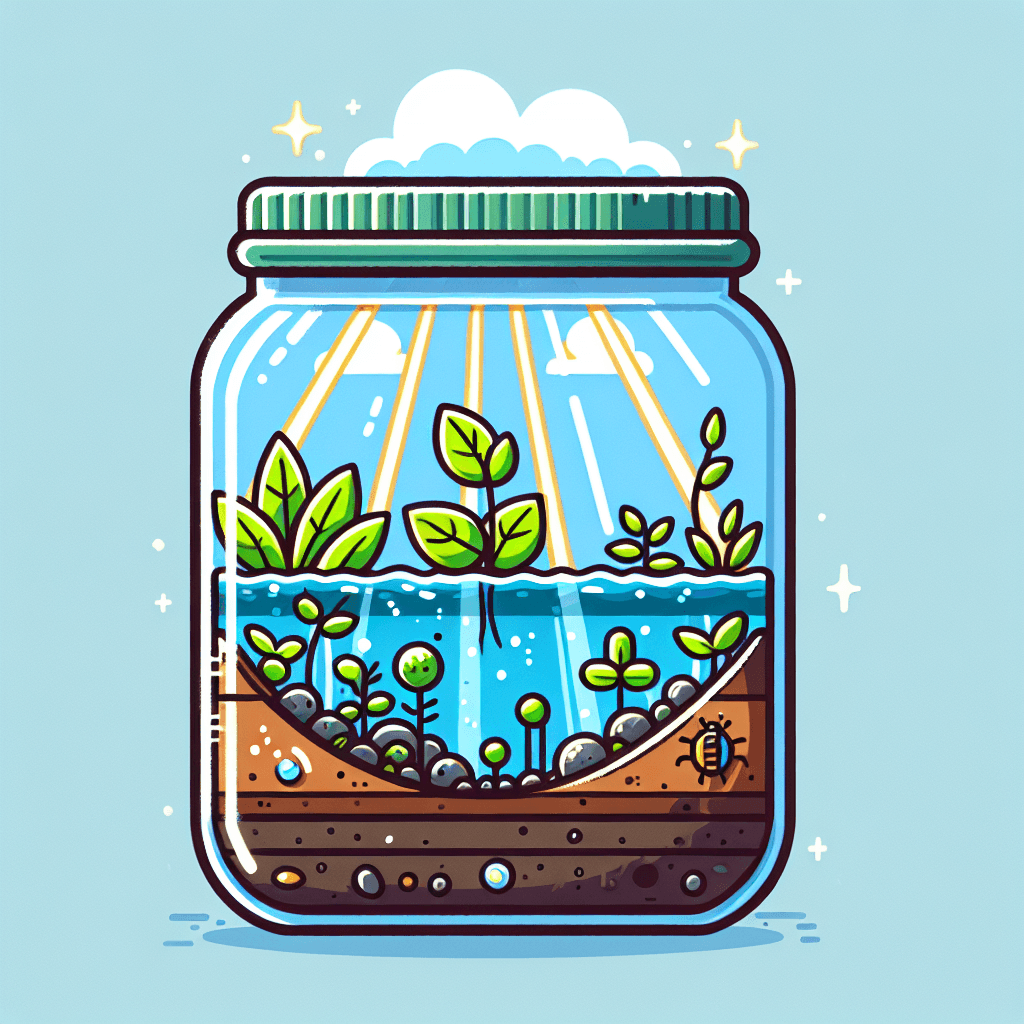
Mini Ecosystem in a Jar
Inquiry Framework
Question Framework
Driving Question
The overarching question that guides the entire project.How can we create and maintain a healthy mini ecosystem in a jar, while understanding the interactions between plants, animals, and their environment?Essential Questions
Supporting questions that break down major concepts.- What is an ecosystem and what are its main components?
- How do plants and animals interact within an ecosystem?
- What role do plants play in an ecosystem?
- What role do animals play in an ecosystem?
- How do changes in temperature and light affect our mini ecosystem?
Standards & Learning Goals
Learning Goals
By the end of this project, students will be able to:- Students will understand what an ecosystem is and identify its main components through creating a mini ecosystem.
- Students will learn how plants and animals interact within an ecosystem by observing and documenting their mini ecosystem.
- Students will investigate the roles of plants and animals in an ecosystem.
- Students will explore how changes in environmental factors like temperature and light affect the mini ecosystem.
- Students will develop skills in scientific observation, hypothesis formulation, and experimentation.
Next Generation Science Standards
Common Core Standards
Entry Events
Events that will be used to introduce the project to studentsEcosystem Detective
Students enter the classroom to find a mysterious sealed jar filled with various plants, soil, and water, along with several hidden 'clues' about the inhabitants inside. They are tasked with acting as detectives to uncover which organisms might live in the jar and predict how they interact with each other to create a self-sustaining environment.Portfolio Activities
Portfolio Activities
These activities progressively build towards your learning goals, with each submission contributing to the student's final portfolio.Ecosystem Architects
In this initial activity, students will gather materials to create their mini ecosystem jar. This will serve as the foundation of their learning journey, where they will start understanding the basic components of an ecosystem by setting up their own jar.Steps
Here is some basic scaffolding to help students complete the activity.Final Product
What students will submit as the final product of the activityA self-sustaining mini ecosystem jar.Alignment
How this activity aligns with the learning objectives & standards2-LS4-1 (Understanding ecosystems and habitats) & 2-LS2-1 (Determining the basic needs of plants).Interaction Investigators
Students will observe their mini ecosystems daily, documenting changes and interactions they notice between plants, water, soil, and light. This fosters a deeper understanding of relationships within ecosystems.Steps
Here is some basic scaffolding to help students complete the activity.Final Product
What students will submit as the final product of the activityAn observation journal with detailed notes and drawings of the mini ecosystem over time.Alignment
How this activity aligns with the learning objectives & standards2-LS4-1 (Observing and documenting interactions) & CCSS.ELA-LITERACY.W.2.2 (Writing informative texts).Temperature and Light Experimenters
Students will conduct experiments to observe how changes in temperature and light affect their mini ecosystem. This teaches cause and effect and the sensitivity of ecosystems to environmental changes.Steps
Here is some basic scaffolding to help students complete the activity.Final Product
What students will submit as the final product of the activityA set of observations and hypotheses on the effects of environmental changes, recorded in the observation journal.Alignment
How this activity aligns with the learning objectives & standards2-PS1-1 (Properties of materials) & 2-LS2-1 (Effects of environmental factors on plant growth).Ecosystem Engineers
After gathering sufficient observations, students will analyze their findings to make adjustments in their mini ecosystem to optimize conditions for plant and animal life.Steps
Here is some basic scaffolding to help students complete the activity.Final Product
What students will submit as the final product of the activityA refined mini ecosystem jar with adjustments made for optimal health.Alignment
How this activity aligns with the learning objectives & standards2-LS4-1 (Understanding the diversity and interactions) & CCSS.ELA-LITERACY.W.2.2 (Scientific writing and documentation).Presentation Pioneers
To synthesize their learning, students will create a presentation that details the process of creating and maintaining their mini ecosystem, including the challenges faced and solutions developed.Steps
Here is some basic scaffolding to help students complete the activity.Final Product
What students will submit as the final product of the activityA well-organized presentation showcasing the creation and analysis of the mini ecosystem.Alignment
How this activity aligns with the learning objectives & standards2-LS4-1 (Communicating ecosystem understanding) & CCSS.ELA-LITERACY.W.2.2 (Writing and presentation skills).Rubric & Reflection
Portfolio Rubric
Grading criteria for assessing the overall project portfolioMini Ecosystem Project Rubric
Ecosystem Understanding
Assessment of the student's ability to understand and explain ecosystem concepts, including components and interactions.Identification of Ecosystem Components
Ability to identify and explain the main components of the mini ecosystem (plants, soil, water, etc.) and their roles.
Exemplary
4 PointsCorrectly identifies all ecosystem components and provides detailed explanations of their roles.
Proficient
3 PointsIdentifies most ecosystem components with generally accurate explanations of their roles.
Developing
2 PointsIdentifies some components but explanations are limited or partially incorrect.
Beginning
1 PointsStruggles to identify components or provides mostly incorrect explanations.
Understanding Interactions
Ability to describe interactions and dependencies between plants and animals in the mini ecosystem.
Exemplary
4 PointsThoroughly describes interactions with specific examples and detailed observations.
Proficient
3 PointsDescribes most interactions accurately with some examples.
Developing
2 PointsDescribes a few interactions, but misses key examples.
Beginning
1 PointsStruggles to describe interactions; examples are vague or incorrect.
Scientific Observation Skills
Evaluation of the student's ability to observe, document, and infer based on their observations in the mini ecosystem.Accuracy of Observations
The precision and detail shown in documenting changes and interactions in the mini ecosystem.
Exemplary
4 PointsObservations are consistently detailed and accurate; effectively uses scientific language.
Proficient
3 PointsMost observations are accurate and detailed; uses scientific language appropriately.
Developing
2 PointsSome observations are detailed but often lack accuracy or scientific terminology.
Beginning
1 PointsObservations are often inaccurate or incomplete; lacks specificity.
Experimental Skills and Inquiry
Assessment of how well students conducted experiments and engaged with scientific inquiry around temperature and light.Conducting Experiments
The student's ability to correctly set up and conduct experiments on the ecosystem with varying environmental factors.
Exemplary
4 PointsExperiments are conducted methodically with clear understanding of variables and conditions.
Proficient
3 PointsExperiments generally follow correct procedures with few errors in variable manipulation.
Developing
2 PointsExperiments show partial understanding; some procedures are incorrect or incomplete.
Beginning
1 PointsExperiments are poorly executed; shows limited understanding of scientific processes.
Communication and Presentation Skills
Evaluation of the clarity and effectiveness of the student's communication of their ecosystem project and findings.Presentation Clarity and Organization
The clarity, organization, and logical flow of the student's presentation on their mini ecosystem project.
Exemplary
4 PointsPresentation is clear, well-organized, and highly engaging; effectively uses visual aids.
Proficient
3 PointsPresentation is generally clear and organized; uses visual aids appropriately.
Developing
2 PointsPresentation lacks clear organization or flow; visual aids are underutilized or ineffective.
Beginning
1 PointsPresentation is unclear and poorly organized; insufficient use of visual aids.