
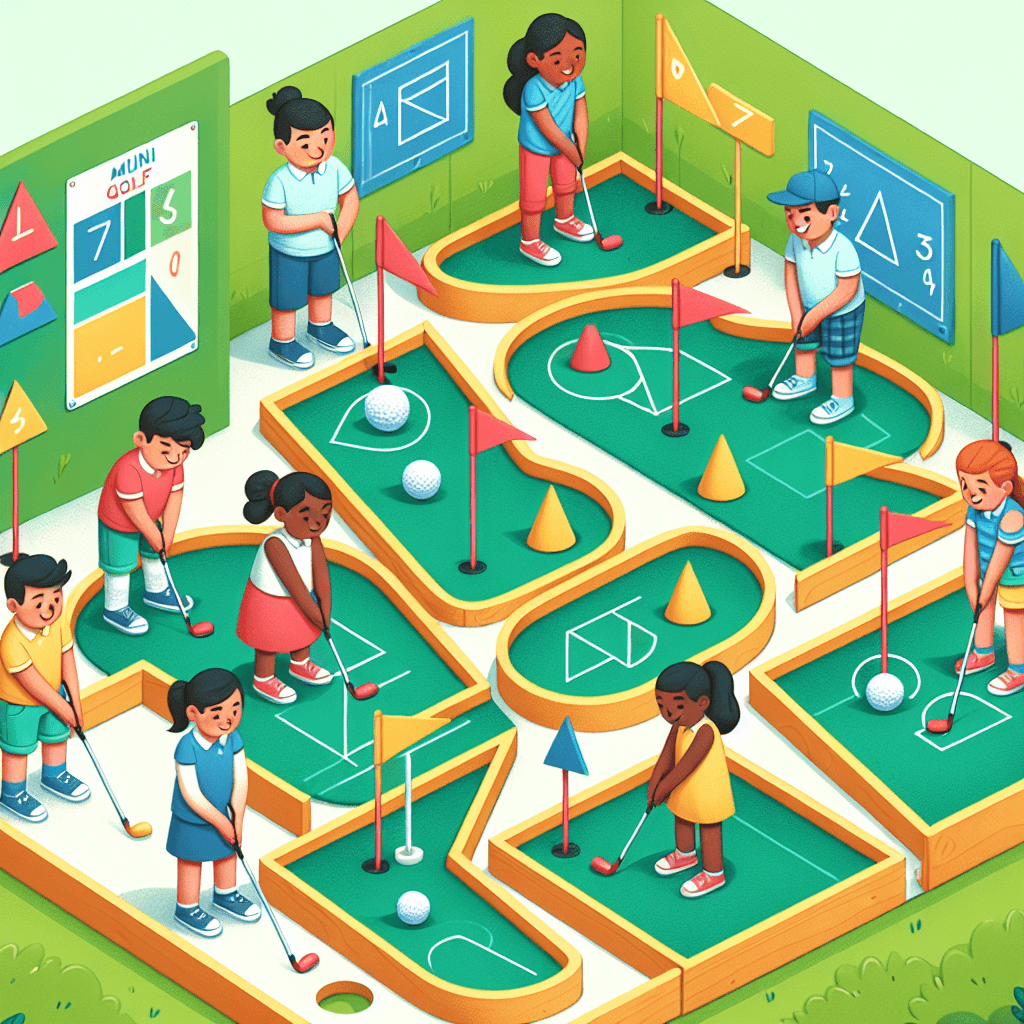
Mini Golf Geometry: Designing a Course with Geometric Principles
Inquiry Framework
Question Framework
Driving Question
The overarching question that guides the entire project.How can we use geometric principles to design and construct a miniature golf course that integrates various geometric shapes, calculations, and constructions?Essential Questions
Supporting questions that break down major concepts.- How can geometric principles be applied in real-world design and construction?
- How do you calculate the angles, area, and perimeter of geometric shapes?
- How can coordinates be used to determine the dimensions of a miniature golf course?
- What geometric shapes can be used to model real-world objects?
- How can you make geometric constructions with tools and methods?
Standards & Learning Goals
Learning Goals
By the end of this project, students will be able to:- Apply geometric principles to design a miniature golf course.
- Construct geometric shapes using a variety of tools.
- Calculate the angles, area, and perimeter of geometric shapes.
- Use coordinates to determine the dimensions of a miniature golf course.
- Model real-world objects with geometric shapes.
Common Core Standards
Entry Events
Events that will be used to introduce the project to studentsThe Broken Course Challenge
Students arrive to find their classroom transformed into a bizarre, broken mini-golf course with impossible angles and nonsensical designs. They must 'diagnose' the geometric errors and propose mathematically sound solutions to make the course playable, sparking initial inquiry into geometric principles.Portfolio Activities
Portfolio Activities
These activities progressively build towards your learning goals, with each submission contributing to the student's final portfolio.Geometric Glossary & Real-World Hunt
Students will research and define key geometric terms and identify real-world examples of these shapes, focusing on how they can be incorporated into mini-golf course design.Steps
Here is some basic scaffolding to help students complete the activity.Final Product
What students will submit as the final product of the activityA glossary of geometric terms (angle, circle, perpendicular line, parallel line, line segment) with diagrams and photographs of real-world examples that could be used in the mini-golf course.Alignment
How this activity aligns with the learning objectives & standardsHSG-CO.A.1 (Know precise definitions); HSG-MG.A.1 (Use geometric shapes to describe objects)Construction Skills Workshop: From Tools to Mini-Golf
Students will practice geometric constructions using various tools (compass, straightedge, dynamic geometric software) and explore how these constructions can create different mini-golf obstacles.Steps
Here is some basic scaffolding to help students complete the activity.Final Product
What students will submit as the final product of the activityA construction portfolio showcasing various geometric constructions (e.g., angle bisectors, perpendicular lines, circles) using different tools, with a description of how each construction could be used as a mini-golf obstacle.Alignment
How this activity aligns with the learning objectives & standardsHSG-CO.D.12 (Make formal geometric constructions); HSG-MG.A.1 (Use geometric shapes to describe objects)Blueprint Bonanza: Coordinate Geometry in Action
Students will design a scaled blueprint of their mini-golf hole, using coordinate geometry to define the boundaries, calculate perimeters, and determine areas of geometric shapes within the hole.Steps
Here is some basic scaffolding to help students complete the activity.Final Product
What students will submit as the final product of the activityA scaled blueprint of a mini-golf hole, including a coordinate grid, accurate dimensions, perimeter and area calculations for all geometric shapes, and a written justification for the design choices.Alignment
How this activity aligns with the learning objectives & standardsHSG-GPE.B.7 (Use coordinates to compute perimeters and areas); HSG-CO.A.1 (Know precise definitions)Rubric & Reflection
Portfolio Rubric
Grading criteria for assessing the overall project portfolioGeometric Glossary & Real-World Hunt Rubric
Geometric Glossary and Application
This category assesses the student's understanding and application of geometric terms through definitions, diagrams, and real-world examples.Geometric Definitions & Diagrams
Accuracy and completeness of geometric term definitions and diagrams.
Exemplary
4 PointsDemonstrates a sophisticated understanding of all geometric terms with accurate and detailed diagrams. Definitions are precise and thorough.
Proficient
3 PointsDemonstrates a thorough understanding of most geometric terms with accurate diagrams. Definitions are clear and complete.
Developing
2 PointsShows an emerging understanding of geometric terms with diagrams that may contain minor inaccuracies or omissions. Definitions are partially complete.
Beginning
1 PointsShows a beginning understanding of geometric terms with incomplete or inaccurate diagrams. Definitions are minimal or unclear.
Real-World Examples
Relevance and clarity of real-world examples, demonstrating the application of geometric concepts.
Exemplary
4 PointsProvides insightful and highly relevant real-world examples that creatively demonstrate the application of geometric concepts within a mini-golf context.
Proficient
3 PointsProvides relevant and clear real-world examples that effectively demonstrate the application of geometric concepts within a mini-golf context.
Developing
2 PointsProvides real-world examples that are somewhat relevant but may lack clarity or direct connection to mini-golf design.
Beginning
1 PointsProvides real-world examples that are vague, irrelevant, or do not demonstrate the application of geometric concepts.
Presentation Quality
Quality of presentation, including organization, labeling, and visual appeal.
Exemplary
4 PointsPresents a highly organized, visually appealing glossary with clear and accurate labeling of all diagrams and photographs. Demonstrates exceptional attention to detail.
Proficient
3 PointsPresents a well-organized glossary with clear labeling of diagrams and photographs. Demonstrates attention to detail.
Developing
2 PointsPresents a glossary that is somewhat organized, but may have inconsistencies in labeling or visual appeal.
Beginning
1 PointsPresents a glossary that is poorly organized, lacks clear labeling, and is visually unappealing.