
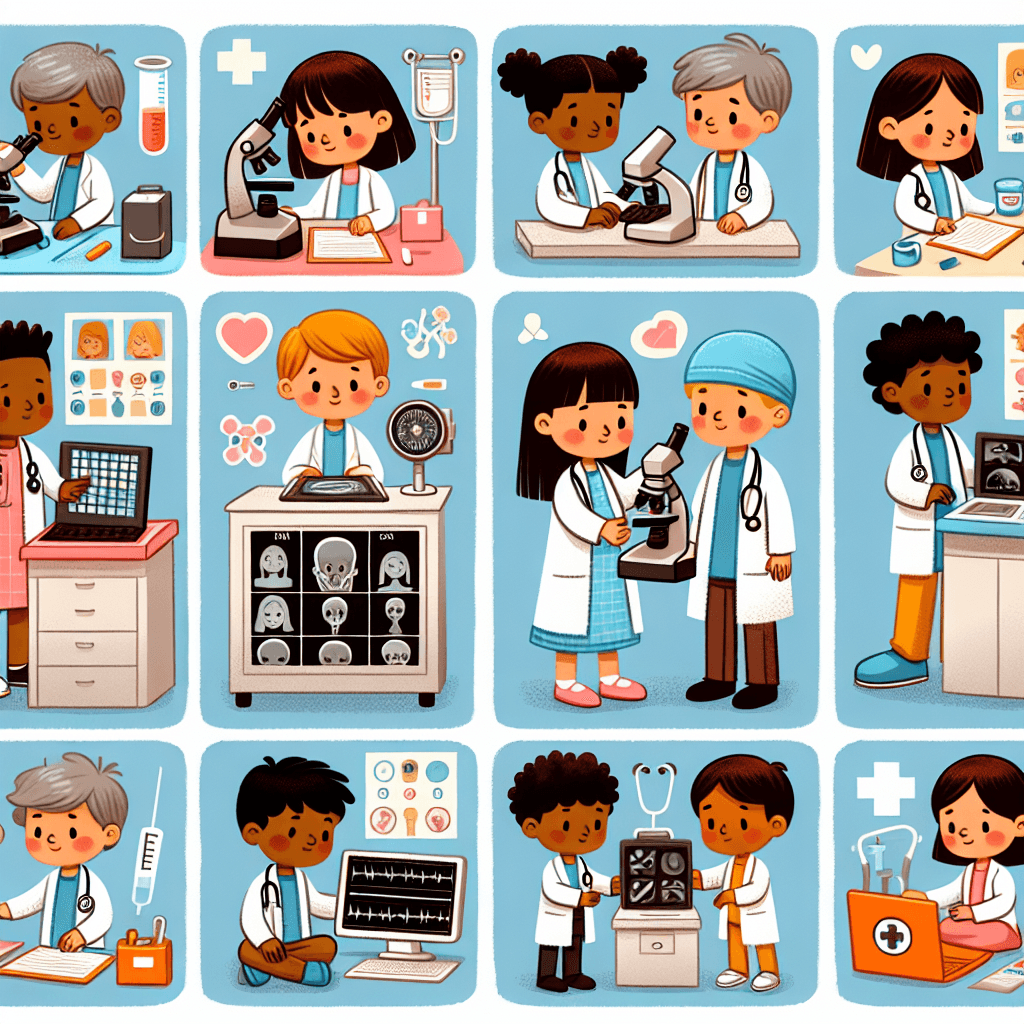
Mini Med Techs: Exploring Medical Technician Roles
Inquiry Framework
Question Framework
Driving Question
The overarching question that guides the entire project.How can we, as students, explore the responsibilities and skills needed to become a medical technician, and express our understanding through projects in science, math, art, and English?Essential Questions
Supporting questions that break down major concepts.- What are the key responsibilities of a medical technician?
- How do medical technicians use math in their daily tasks?
- What scientific principles are essential for a medical technician to understand?
- How can artistic skills contribute to the role of a medical technician?
Standards & Learning Goals
Learning Goals
By the end of this project, students will be able to:- Understand the role and key responsibilities of a medical technician.
- Demonstrate how math is used in the daily tasks of a medical technician.
- Identify and explain scientific principles essential to a medical technician's work.
- Explore the impact of artistic skills in the field of medical technology and healthcare.
- Develop communication and English language skills through project presentation and reporting.
Common Core Standards for English Language Arts
Common Core Standards for Mathematics
Next Generation Science Standards (NGSS)
Maine Learning Results for Art (3rd Grade)
Entry Events
Events that will be used to introduce the project to studentsA Day in the Life: Interactive Story
Create a choose-your-own-adventure style interactive story that lets students 'walk in the shoes' of a medical technician for a day. They'll make decisions based on real scenarios, learning about the responsibilities and skills required in this role.Virtual Hospital Tour
Invite students to a virtual tour of a hospital, highlighting the different roles of medical technicians in various departments. Students will see inside the labs and diagnostics areas and hear stories from real technicians about how they contribute to patient care.Be the Detective: Solve the Medical Mystery
Present a mock medical case where students play the role of junior medical technicians tasked with diagnosing a 'patient'. Using clues from 'tests' and 'labs', they will ask questions, analyze data, and solve the mystery, unlocking the core concepts behind the medical technician role.Portfolio Activities
Portfolio Activities
These activities progressively build towards your learning goals, with each submission contributing to the student's final portfolio.Role Exploration: Medical Technician Interview
Students will conduct an interview with a medical professional or watch an interview video to explore the role of a medical technician. This helps students develop communication skills and understand responsibilities in medical technology.Steps
Here is some basic scaffolding to help students complete the activity.Final Product
What students will submit as the final product of the activityA summary report on the role of a medical technician, highlighting key responsibilities and skills.Alignment
How this activity aligns with the learning objectives & standardsAligns with CCSS.ELA-LITERACY.SL.3.1 by engaging students in collaborative discussions and building on others’ ideas.Mystery Math: Solve the Patient's Puzzle
In this activity, students apply their math skills to solve time-sensitive medical cases by calculating time intervals and solving word problems.Steps
Here is some basic scaffolding to help students complete the activity.Final Product
What students will submit as the final product of the activityA solved patient case with calculated time intervals and solutions to the word problems.Alignment
How this activity aligns with the learning objectives & standardsAligns with CCSS.MATH.CONTENT.3.MD.A.1 by practicing time calculations in a real-world medical context.Design Lab: Creating Medical Tools
Students will design a simple medical tool using basic materials, addressing a specific need they identify. This incorporates engineering principles and creativity.Steps
Here is some basic scaffolding to help students complete the activity.Final Product
What students will submit as the final product of the activityA prototype of a medical tool with a presentation explaining its design and purpose.Alignment
How this activity aligns with the learning objectives & standardsAligns with NGSS.3-5-ETS1-1 by defining a design problem and creating a solution within constraints.Art in Medicine: Illustrate Your Findings
Students will create an art project that illustrates their understanding of the role of medical technicians and the impact of artistic skills in this field.Steps
Here is some basic scaffolding to help students complete the activity.Final Product
What students will submit as the final product of the activityAn art piece illustrating the role of medical technicians and the integration of art in healthcare.Alignment
How this activity aligns with the learning objectives & standardsAligns with Maine.Learning.Art.3.1 by encouraging the use of varied tools and techniques for expression.Rubric & Reflection
Portfolio Rubric
Grading criteria for assessing the overall project portfolioMedical Technician Portfolio Activities Rubric
Communication and Collaboration
Evaluates students' ability to communicate effectively and collaborate with peers during discussions about medical technician responsibilities and skills.Engagement in Discussions
Measures the ability to participate actively and effectively in both group and peer discussions, building on others' ideas about medical technician responsibilities.
Exemplary
4 PointsActively engages in discussions, consistently builds on others' ideas, and offers insightful contributions that advance the group's understanding.
Proficient
3 PointsEngages in discussions and contributes meaningfully, building on others' ideas to promote understanding.
Developing
2 PointsParticipates in discussions with some contribution to group ideas and understanding.
Beginning
1 PointsParticipates minimally in discussions with limited contribution to group ideas.
Report Comprehensiveness
Assesses the detail and accuracy of the summary report created after the interview with a medical professional, focusing on key responsibilities and skills.
Exemplary
4 PointsProvides a detailed and accurate report, thoroughly covering all key responsibilities and skills discussed in the interview.
Proficient
3 PointsProvides a comprehensive report covering most key responsibilities and skills discussed in the interview.
Developing
2 PointsProvides a report with some details of responsibilities and skills, but lacks depth in certain areas.
Beginning
1 PointsProvides an incomplete or minimal report lacking significant details about responsibilities and skills.
Mathematical Problem Solving
Assesses students' ability to apply mathematical concepts, specifically in calculating time intervals in medical scenarios.Accuracy of Calculations
Evaluates the correctness of the calculated time intervals and the use of mathematical methods to solve medical case problems.
Exemplary
4 PointsCalculations are entirely accurate and demonstrate a clear understanding of solving time interval problems.
Proficient
3 PointsCalculations are mostly accurate, reflecting a good understanding of solving time interval problems.
Developing
2 PointsCalculations are occasionally accurate but contain some inconsistencies, indicating partial understanding.
Beginning
1 PointsCalculations are mostly inaccurate, demonstrating limited understanding of solving time interval problems.
Representation Using Models
Measures the ability to effectively use visual models, like number lines, to solve and explain time interval problems.
Exemplary
4 PointsUses number lines effectively and creatively to accurately solve and illustrate time interval problems.
Proficient
3 PointsUses number lines accurately to solve time interval problems.
Developing
2 PointsAttempts to use number lines with partial success in solving time interval problems.
Beginning
1 PointsStruggles to use number lines accurately, showing little success in solving time interval problems.
Scientific and Design Thinking
Evaluates students' ability to apply scientific and design thinking in creating a solution to a medical-related problem.Identification and Problem Definition
Measures the ability to identify a relevant medical problem and clearly define it with criteria for a successful tool-based solution.
Exemplary
4 PointsIdentifies a highly relevant medical problem, clearly defining it with thorough criteria for a successful solution.
Proficient
3 PointsIdentifies a relevant medical problem and defines it with reasonable criteria for a solution.
Developing
2 PointsIdentifies a problem with limited criteria for success, showing a basic definition.
Beginning
1 PointsBarely identifies a problem with insufficient criteria or definition for success.
Prototype Design and Functionality
Assesses the creativity and practicality of the prototype design, including the appropriateness of the materials used.
Exemplary
4 PointsDesigns an innovative prototype that works effectively, using appropriate materials creatively.
Proficient
3 PointsDesigns a functional prototype using appropriate materials.
Developing
2 PointsDesigns a basic prototype with limited functionality and material appropriateness.
Beginning
1 PointsStruggles to design a functional prototype or use appropriate materials.
Artistic Expression and Understanding
Assesses students' ability to express understanding through art, focusing on the role of medical technicians and the use of art in medicine.Creativity and Execution
Evaluates the creativity and skill involved in creating an art piece that represents the role of medical technicians.
Exemplary
4 PointsCreates a highly creative and skillfully executed art piece that vividly represents the role of medical technicians.
Proficient
3 PointsCreates a creative and well-executed art piece representing the role of medical technicians.
Developing
2 PointsCreates an art piece with some creativity, though execution may lack finesse.
Beginning
1 PointsStruggles to create a coherent art piece, lacking both creativity and execution.
Integration of Artistic and Medical Concepts
Assesses how well students integrate art and medical understanding in their projects.
Exemplary
4 PointsSeamlessly integrates art and medical concepts to create a compelling project showing deep understanding.
Proficient
3 PointsEffectively integrates art and medical concepts to create a coherent project.
Developing
2 PointsAttempts to integrate art and medical concepts, with partial success.
Beginning
1 PointsShows little integration of art and medical concepts, resulting in a confusing project.