
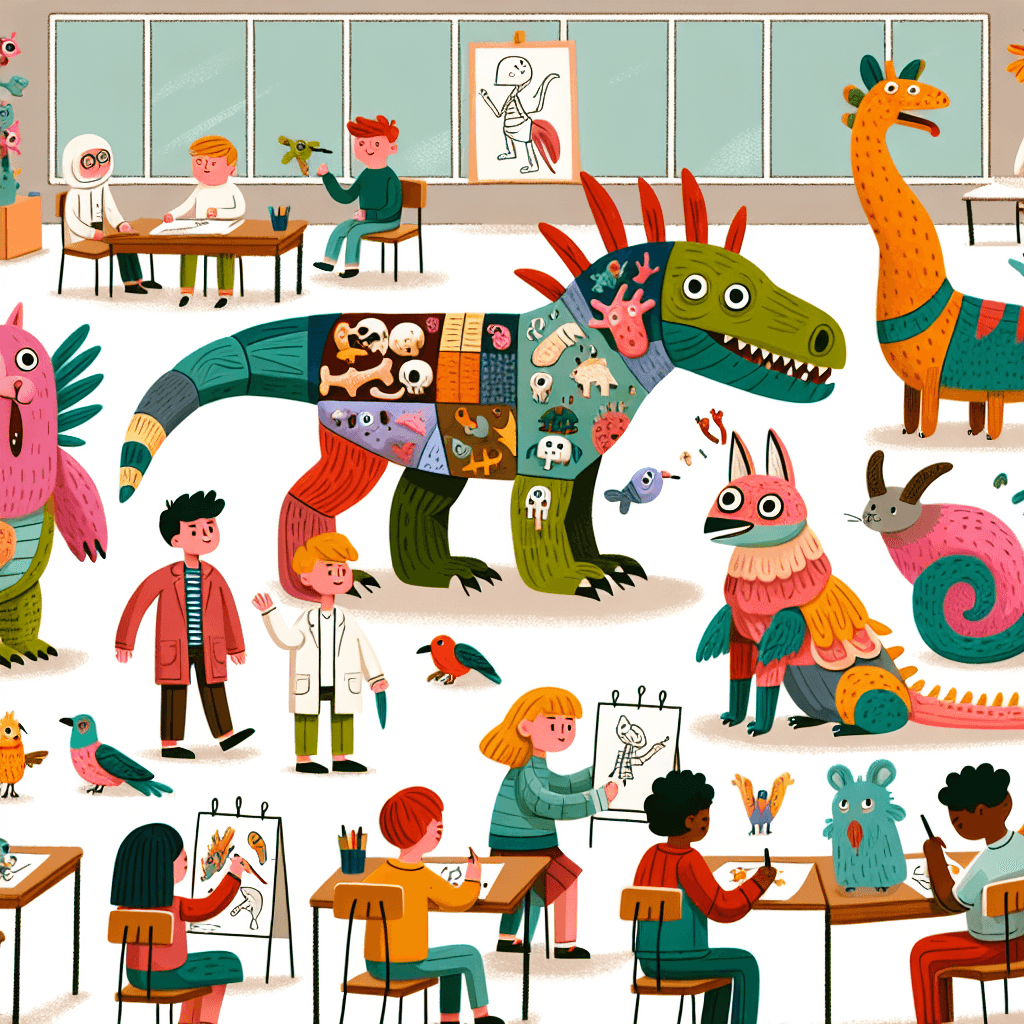
Mismatch Makers: Designing Collaborative Hybrid Creatures
Inquiry Framework
Question Framework
Driving Question
The overarching question that guides the entire project.How can we, as toy designers, combine our unique artistic styles to create a balanced hybrid creature that tells the story of our team?Essential Questions
Supporting questions that break down major concepts.- How can we use our individual artistic styles to contribute to a successful team project?
- What does it look like to be a productive collaborator when our creative ideas are different?
- How do artists use elements like color, texture, and shape to develop a unique 'aesthetic style'?
- How can we design 'connection points' so that mismatched parts come together to form a balanced and complete sculpture?
- In what ways does a 'hybrid' creature tell a story about the diverse group of people who created it?
Standards & Learning Goals
Learning Goals
By the end of this project, students will be able to:- Students will define and apply their own unique 'aesthetic style' using elements of art such as color, texture, and shape.
- Students will demonstrate productive collaboration by negotiating design decisions and merging diverse artistic styles into a single, cohesive sculpture.
- Students will engineer structural 'connection points' to ensure that mismatched sculptural components achieve physical balance and stability.
- Students will articulate a collaborative narrative that explains how the hybrid creature reflects the combined identities and contributions of the team members.
Teacher Defined / SEL
National Core Arts Standards (NCAS)
Common Core State Standards (ELA)
Entry Events
Events that will be used to introduce the project to studentsThe Eccentric Collector’s Challenge
The teacher presents a 'Top Secret' portfolio from an eccentric, billionaire toy collector who is bored with 'matching' toys. The collector challenges the class to create a 'Chimera Collection' where every limb must showcase a completely different artistic style (e.g., Cubism vs. Impressionism) while remaining physically connected, offering a 'contract' to the team that creates the most seamless collaboration.Portfolio Activities
Portfolio Activities
These activities progressively build towards your learning goals, with each submission contributing to the student's final portfolio.The Signature Style Scout
Before working as a team, each designer must discover their 'Signature Style.' In this activity, students explore different elements of art—such as line, color, texture, and shape—to create a visual 'brand' that they will contribute to the hybrid toy. This ensures that when the team comes together, each limb has a distinct, recognizable aesthetic that contrasts with the others.Steps
Here is some basic scaffolding to help students complete the activity.Final Product
What students will submit as the final product of the activityAn 'Aesthetic ID Card' featuring a swatch of the student's chosen textures, a signature color palette, and a sketch of a limb (arm, leg, wing, or tail) in their specific style.Alignment
How this activity aligns with the learning objectives & standardsThis activity aligns with VA:Cr2.1.4a (Explore and invent art-making techniques and approaches) by requiring students to define their own aesthetic brand using specific elements of art.The Blueprint Brainstorm & Contract
Now that every designer has a style, teams must meet to negotiate the design of their hybrid creature. Students must decide which body parts each person will build and, most importantly, how those mismatched parts will physically connect (e.g., through slots, tabs, or velcro). This activity focuses on the 'social contract' of collaboration: listening, compromising, and goal-setting.Steps
Here is some basic scaffolding to help students complete the activity.Final Product
What students will submit as the final product of the activityA 'Master Toy Blueprint'—a collaborative drawing of the full creature where each limb is labeled with a teammate's name and style.Alignment
How this activity aligns with the learning objectives & standardsThis activity aligns with VA:Cr1.2.4a (Collaboratively set goals and create artwork that is meaningful) and SL.4.1 (Engage effectively in collaborative discussions). It focuses on the primary standard 'I am a productive collaborator' through negotiation and planning.The Connection Engineering Lab
In this construction phase, students build their individual parts but must frequently check in with their 'neighbor' at the connection point. This 'Engineering Check-in' ensures that the diverse aesthetics don't prevent the toy from being structurally sound. Students must practice being productive collaborators by offering and accepting technical advice to make sure the parts fit together.Steps
Here is some basic scaffolding to help students complete the activity.Final Product
What students will submit as the final product of the activityA 'Connection Prototype'—a partially assembled version of the creature where at least two different styles are successfully joined and balanced.Alignment
How this activity aligns with the learning objectives & standardsThis activity aligns with VA:Cr2.1.4a (Invent art-making techniques) and VA:Cr3.1.4a (Revise artwork in progress on the basis of insights gained through peer discussion). It emphasizes the technical side of productivity and collaboration.The Chimera’s Origin Story Pitch
Every hybrid creature has a story! In this final portfolio activity, the team must develop a 'Collaborative Narrative' that explains why this creature exists and how its different parts help it survive. This process requires the group to weave their individual artistic identities into one cohesive team story, reflecting on their journey as collaborators.Steps
Here is some basic scaffolding to help students complete the activity.Final Product
What students will submit as the final product of the activityA 'Collector’s Catalog Entry'—a creative presentation (video, poster, or digital slide) that features the final sculpture and a written/recorded story of the creature's origins.Alignment
How this activity aligns with the learning objectives & standardsThis activity aligns with SL.4.1 (Building on others' ideas and expressing their own clearly) and VA:Cr1.2.4a (Creating artwork that is meaningful and has purpose). It fulfills the 'productive collaborator' standard by requiring a unified group presentation.Rubric & Reflection
Portfolio Rubric
Grading criteria for assessing the overall project portfolioThe Mismatch Toy Factory: Collaboration & Design Rubric
Collaborative Engineering & Social Dynamics
This category focuses on the interpersonal and technical collaborative skills required to co-create the hybrid toy, aligning with the 'Productive Collaborator' and NCAS Revision standards.Collaborative Productivity & Negotiation
Measures the ability to negotiate design decisions, share responsibilities, and build upon the ideas of others to achieve a common goal.
Exemplary
4 PointsThe student consistently takes a leadership role in facilitating group dialogue, proactively seeks out and integrates diverse viewpoints, and proposes innovative compromises that enhance the final design. Engagement is sophisticated and consistently elevates the group's productivity.
Proficient
3 PointsThe student engages effectively in collaborative discussions, contributes original ideas, and works with others to reach a consensus. They fulfill their assigned role and help maintain a positive team dynamic.
Developing
2 PointsThe student participates in the group but may struggle to compromise or may rely on others to make key decisions. Contribution to the team's shared goals is inconsistent.
Beginning
1 PointsThe student struggles to engage with the team, works mostly in isolation, or has difficulty listening to and respecting the artistic choices of others, hindering the group's progress.
Revision & Engineering Integration
Evaluates the student’s ability to use collaborative discussions and 'Fit Tests' to physically and aesthetically connect mismatched components.
Exemplary
4 PointsThe student demonstrates exceptional problem-solving by innovating new connection techniques. They actively lead the 'Fit Test' process and make sophisticated adjustments that ensure both physical stability and aesthetic flow.
Proficient
3 PointsThe student successfully uses the 'Fit Test' to adjust their limb’s design, ensuring it physically connects to a teammate's part. They use feedback to make meaningful revisions to their work.
Developing
2 PointsThe student attempts to connect their part but the structural stability is weak. They participate in the 'Fit Test' but require significant teacher support to make necessary revisions.
Beginning
1 PointsThe student fails to account for the connection points with teammates, resulting in a sculpture that cannot be assembled or lacks any structural integrity. Revision based on peer feedback is absent.
Artistic Identity & Narrative Integration
This category focuses on the artistic quality of the individual components and the ability to weave those individual styles into a collective, meaningful story.Personal Aesthetic Branding
Assesses the student's ability to define and apply a unique visual 'brand' through the specific use of art elements like color, texture, and shape.
Exemplary
4 PointsThe student creates a highly distinctive aesthetic that is consistently applied across the ID card and the toy limb. The use of texture, color, and shape shows a sophisticated understanding of art movements.
Proficient
3 PointsThe student clearly identifies three 'signature elements' and applies them effectively to their Aesthetic ID Card and toy limb, creating a recognizable personal style.
Developing
2 PointsThe student identifies some elements of style, but the application is inconsistent or lacks clear contrast from the rest of the team's work. The 'brand' is only partially formed.
Beginning
1 PointsThe student’s style is random or lacks specific elements of art. There is little to no distinction between their work and a generic toy part.
Narrative Synthesis & Presentation
Evaluates the final collaborative narrative and how well the team synthesizes their diverse styles into a unified story.
Exemplary
4 PointsThe team articulates a profound and imaginative narrative where every mismatched element is vital to the creature's identity. The presentation shows deep reflection on the value of diversity in design.
Proficient
3 PointsThe team develops a cohesive story that explains the origin of the creature and how its different parts function together. All team members' styles are represented in the narrative.
Developing
2 PointsThe narrative is a simple description of the creature rather than a story. Some styles are mentioned, but the connection between the 'mismatched' parts and the story is weak.
Beginning
1 PointsThe narrative is incomplete or fails to explain the hybrid nature of the toy. Individual contributions are not integrated into a shared team identity.