
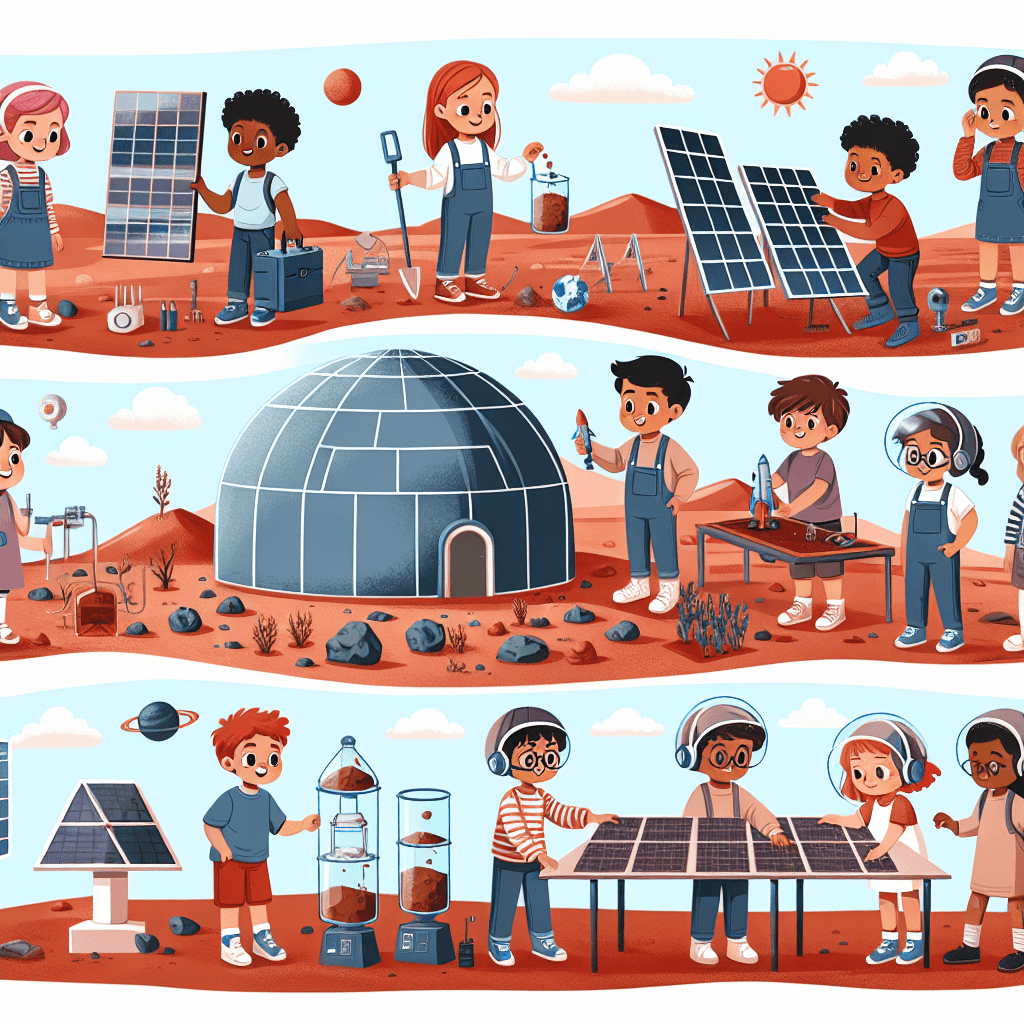
Mission to Mars: How Can Humans Live There?
Inquiry Framework
Question Framework
Driving Question
The overarching question that guides the entire project.How can we, as future space explorers, develop sustainable living conditions on Mars by understanding and addressing the basic needs for human survival, geographical challenges, and resource management?Essential Questions
Supporting questions that break down major concepts.- What are the basic needs of humans for survival on another planet?
- How can we create a sustainable environment on Mars similar to Earth?
- What challenges do astronauts face when traveling to and living on Mars?
- How does living on Mars differ from living on Earth in terms of geography and resources?
Standards & Learning Goals
Learning Goals
By the end of this project, students will be able to:- Students will be able to identify and describe the basic needs of humans for survival in a Mars environment.
- Students will understand how to design a sustainable habitat on Mars by applying principles of resource management and environmental science.
- Students will analyze the challenges astronauts face when traveling to and living on Mars, including geographical and environmental factors.
- Students will develop an understanding of how living on Mars may require adapting or altering current human cultures and practices.
Common Core Standards
Next Generation Science Standards
C3 Framework for Social Studies State Standards
ISTE Standards for Students
Entry Events
Events that will be used to introduce the project to studentsMars Habitat Design Expo
Set up an expo where students develop models of Mars habitats, using materials provided in class or found at home. As they present their designs, they must explain the choices based on the planet's geographical and technological challenges.Portfolio Activities
Portfolio Activities
These activities progressively build towards your learning goals, with each submission contributing to the student's final portfolio.Mars Mission Needs Assessment
Students will explore the basic needs of humans to survive on Mars by comparing them to conditions on Earth.Steps
Here is some basic scaffolding to help students complete the activity.Final Product
What students will submit as the final product of the activityA comprehensive chart comparing Earth's and Mars' environments with identified human needs adaptations.Alignment
How this activity aligns with the learning objectives & standardsAligns with CCSS.ELA-LITERACY.RI.4.3 as students explain scientific concepts of survival and geographical challenges.Martian Habitat Blueprint
Students will design and sketch a habitat that addresses the criteria for sustainable living on Mars using engineering principles.Steps
Here is some basic scaffolding to help students complete the activity.Final Product
What students will submit as the final product of the activityA detailed blueprint of a sustainable Martian habitat with labeled features.Alignment
How this activity aligns with the learning objectives & standardsAligns with NGSS.3-5-ETS1-1 as students define and design solutions to engineering challenges.Cultural Adaptation on Mars
Students explore how human culture may need to adapt for survival and socialization on Mars.Steps
Here is some basic scaffolding to help students complete the activity.Final Product
What students will submit as the final product of the activityA collaborative presentation on potential cultural adaptations and their rationale for life on Mars.Alignment
How this activity aligns with the learning objectives & standardsAligns with C3.D2.Geo.4.3-5 by exploring cultural modification and adaptation in a new environment.Innovative Problem Solving Workshop
Students work in teams to tackle open-ended problems related to Martian survival, employing creative and critical thinking skills.Steps
Here is some basic scaffolding to help students complete the activity.Final Product
What students will submit as the final product of the activityA team-developed, detailed solution for overcoming a specific challenge of living on Mars.Alignment
How this activity aligns with the learning objectives & standardsSupports ISTE.4.d by fostering perseverance and innovative thinking in solving open-ended problems.Rubric & Reflection
Portfolio Rubric
Grading criteria for assessing the overall project portfolioMars Mission: Sustainable Living Assessment Rubric
Understanding of Human Needs and Environmental Challenges
Assesses the student's ability to articulate the basic human needs for survival and the environmental challenges presented by Mars, aligned with CCSS.ELA-LITERACY.RI.4.3.Identification of Human Needs
Ability to identify and explain the essential needs for human survival in the Martian environment.
Exemplary
4 PointsThoroughly identifies and explains all human survival needs specific to Mars, providing detailed evidence and comparisons to Earth.
Proficient
3 PointsAccurately identifies and explains most human survival needs for Mars with adequate evidence and some comparison to Earth.
Developing
2 PointsIdentifies some human survival needs but lacks depth and only partial comparison to Earth's conditions.
Beginning
1 PointsStruggles to identify basic human survival needs and provides minimal or no comparison to Earth.
Explanation of Environmental Challenges
Explains the environmental challenges of Mars that affect human survival, such as atmosphere and weather conditions.
Exemplary
4 PointsProvides a detailed and articulate explanation of multiple environmental challenges on Mars, using specific examples and implications for human survival.
Proficient
3 PointsExplains the key environmental challenges of Mars adequately, including some examples and impacts on survival.
Developing
2 PointsProvides a basic explanation of some environmental challenges, but lacks detail and specific examples.
Beginning
1 PointsBarely explains the environmental challenges and provides limited understanding or examples.
Design and Innovation in Sustainable Habitat Development
Evaluates the student's ability to design and innovate in developing sustainable habitats on Mars, in line with NGSS.3-5-ETS1-1.Creativity and Innovation in Habitat Design
Demonstrates creativity and innovation in designing a sustainable habitat for Mars.
Exemplary
4 PointsShows outstanding creativity and innovation in habitat design, integrating multiple innovative features that address sustainability challenges comprehensively.
Proficient
3 PointsDesigns a creative and effective habitat integrating several innovative features that address sustainability challenges.
Developing
2 PointsDesign shows some creative elements and attempts to address sustainability, but lacks full integration of innovative features.
Beginning
1 PointsLimited or minimal creativity in design, with few innovative features addressing sustainability.
Technical Skill in Habitat Blueprint
Displays technical skill and precision in creating a detailed blueprint of the Martian habitat.
Exemplary
4 PointsProduces a highly detailed and precise blueprint with clear labels and accurate representation of habitat features.
Proficient
3 PointsCreates a detailed and clearly labeled blueprint, accurately representing most habitat features.
Developing
2 PointsBlueprint shows some details and labeling, but lacks precision and completeness in habitat representation.
Beginning
1 PointsIncomplete or unclear blueprint with minimal detail and poor labeling of habitat features.
Cultural Understanding and Adaptation
Measures the student's grasp of cultural adaptation needs and their ability to hypothesize potential adaptations for Martian living, aligned with C3.D2.Geo.4.3-5.Analysis of Cultural Elements for Adaptation
Ability to analyze and identify cultural elements that need adaptation for life on Mars.
Exemplary
4 PointsThoroughly analyzes cultural elements with insightful identification of adaptations, providing detailed examples and rationale.
Proficient
3 PointsAnalyzes and identifies most cultural elements needing adaptation, with examples and clear explanations.
Developing
2 PointsAttempts to analyze cultural elements, but provides limited examples and rationale for adaptation.
Beginning
1 PointsMinimal analysis of cultural needs with few or no examples of necessary adaptations.
Collaborative Presentation on Cultural Adaptations
Effectiveness in collaborating and presenting a well-developed presentation on cultural adaptations for Mars.
Exemplary
4 PointsDelivers an engaging and comprehensive presentation with effective collaboration; demonstrates in-depth understanding of cultural adaptations.
Proficient
3 PointsPresents a clear and well-organized presentation with good collaboration; demonstrates understanding of cultural adaptations.
Developing
2 PointsPresentation is somewhat organized but lacks depth; demonstrates partial understanding of cultural adaptations.
Beginning
1 PointsPresentation is unclear or poorly organized; lacks collaboration and understanding of cultural adaptations.
Problem-Solving and Critical Thinking
Focuses on student's problem-solving approach and critical thinking in tackling open-ended problems associated with Martian challenges, as per ISTE.4.d.Innovative Approach to Problem-Solving
Exhibits innovative thinking and perseverance in developing solutions to Martian challenges.
Exemplary
4 PointsShows exceptional innovation and critical thinking in developing solutions, demonstrating resilience and adaptability.
Proficient
3 PointsDemonstrates solid innovation and critical thinking with clear, practical solutions.
Developing
2 PointsOffers basic solutions with limited innovation; demonstrates some critical thinking.
Beginning
1 PointsStruggles to formulate solutions; demonstrates minimal innovation or critical thinking.
Teamwork and Feedback Utilization
Assesses teamwork and the ability to use feedback constructively to enhance problem-solving processes.
Exemplary
4 PointsActively collaborates with peers, effectively integrating feedback into improved solutions.
Proficient
3 PointsWorks well in teams, using feedback to moderately refine solutions.
Developing
2 PointsParticipates in team discussions but uses feedback sparingly to improve solutions.
Beginning
1 PointsLimited collaboration; struggles to incorporate feedback into problem-solving.