
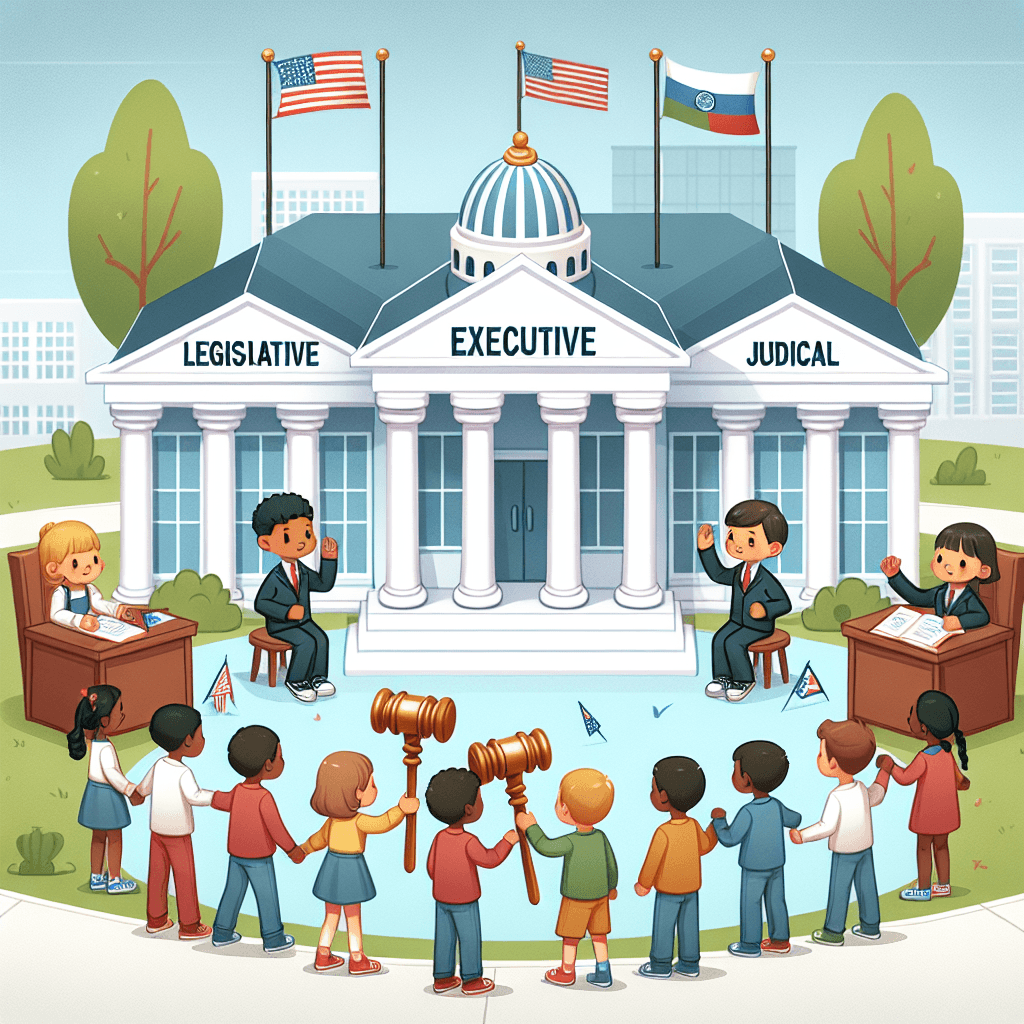
Mock Election: Exploring Government Branches
Inquiry Framework
Question Framework
Driving Question
The overarching question that guides the entire project.How can we, as citizens of our local community, organize and conduct a mock election to understand how the government functions, including the roles of its branches, law-making, and the importance of elections?Essential Questions
Supporting questions that break down major concepts.- What are the roles and responsibilities of the three branches of government?
- How are laws created and passed in our local community?
- What services does the local government provide to its community?
- Why are elections important and how do they impact our daily lives?
Standards & Learning Goals
Learning Goals
By the end of this project, students will be able to:- Students will understand the roles and responsibilities of the three branches of government through simulations and discussions.
- Students will learn how laws are created and passed by writing and debating mock laws within a classroom setting.
- Students will explore the various services provided by local government by researching and presenting their findings.
- Students will comprehend the purpose and importance of elections by organizing and participating in a mock election.
Pa Standards
Entry Events
Events that will be used to introduce the project to studentsMystery of the Missing Law
Begin with a staged 'mystery' where an important school rule has vanished overnight, causing chaos in the daily routine. Students must investigate which branch of government should address the issue and how new rules or laws can be created, mirroring real governmental processes. This scenario will keep students engaged and prompt them to explore the functioning of government branches and lawmaking.Portfolio Activities
Portfolio Activities
These activities progressively build towards your learning goals, with each submission contributing to the student's final portfolio.Government Branch Explorers
In this activity, students will delve into the three branches of government to understand their specific roles and responsibilities. This foundational activity sets the stage for understanding how these branches interact and function in the context of a mock election.Steps
Here is some basic scaffolding to help students complete the activity.Final Product
What students will submit as the final product of the activityA class set of detailed posters explaining the functions and responsibilities of the three branches of government.Alignment
How this activity aligns with the learning objectives & standardsAligns with 5.3.3.A by helping students identify the roles of the three branches of government.Lawmakers in Action
Students simulate a legislative session where they propose, debate, and vote on classroom laws. This activity helps students grasp the law-making process in their local community.Steps
Here is some basic scaffolding to help students complete the activity.Final Product
What students will submit as the final product of the activityA set of student-created classroom laws and a reflection on the law-making process.Alignment
How this activity aligns with the learning objectives & standardsAligns with 5.3.3.B by guiding students to identify how laws are made in the local community.Local Government Investigators
Students research local government services to understand their impact on the community. This will prepare them for upcoming debates in the mock election.Steps
Here is some basic scaffolding to help students complete the activity.Final Product
What students will submit as the final product of the activityIndividual reports or presentations on local government services.Alignment
How this activity aligns with the learning objectives & standardsAligns with 5.3.3.C by enabling students to identify services performed by local governments.Election Day Extravaganza
The culminating activity where students organize and conduct a mock election. This hands-on experience encapsulates their learning about government functions and the significance of elections.Steps
Here is some basic scaffolding to help students complete the activity.Final Product
What students will submit as the final product of the activityA mock election demonstrating student understanding of government roles and election significance.Alignment
How this activity aligns with the learning objectives & standardsAligns with 5.3.3.E by explaining the purpose for elections through practical experience.Rubric & Reflection
Portfolio Rubric
Grading criteria for assessing the overall project portfolioMock Election Learning Assessment Rubric
Understanding Government Branches
Evaluates students' comprehension of the three branches of government, their roles, and interdependence.Recognition of Branch Roles
Assesses ability to identify and explain the responsibilities of each government branch.
Exemplary
4 PointsProvides an in-depth explanation of each branch with examples of responsibilities and historical instances.
Proficient
3 PointsClearly explains the key functions and responsibilities of each branch.
Developing
2 PointsIdentifies main responsibilities of each branch with some inaccuracies.
Beginning
1 PointsHas difficulty identifying functions of each branch; explanations are minimal or inaccurate.
Collaboration and Communication
Measures collaboration in groups and effectiveness of communication in presentations.
Exemplary
4 PointsActively leads and contributes to group work, presenting information clearly and engagingly.
Proficient
3 PointsWorks well in a group, sharing ideas effectively and presenting clearly.
Developing
2 PointsParticipates in group activities with inconsistent communication in presentations.
Beginning
1 PointsLimited participation in group activities; communication is unclear or lacking.
Legislative Process Understanding
Assesses comprehension of the law-making process through classroom simulations.Proposing and Debating Laws
Evaluates ability to propose ideas, debate, and reflect on classroom law-making process.
Exemplary
4 PointsProposes innovative ideas and debates respectfully; reflects deeply on the legislative process.
Proficient
3 PointsProposes clear ideas and engages actively in debates; reflects on process elements.
Developing
2 PointsProposes ideas that are unclear or lacks engagement in debates; reflection is basic.
Beginning
1 PointsStruggles to propose or debate ideas; minimal reflection on the legislative process.
Understanding Local Government Services
Measures students' grasp of various local government services and their relevance.Research and Presentation
Evaluates research quality and clarity of presentation on assigned local government service.
Exemplary
4 PointsConducts thorough research and presents findings clearly, highlighting service relevance.
Proficient
3 PointsPresents well-researched and clear explanation of assigned service.
Developing
2 PointsResearch is basic and presentation lacks depth or clarity.
Beginning
1 PointsIncomplete research with unclear presentation of service findings.
Election Understanding and Participation
Evaluates understanding of the election process and active participation in simulation.Campaign and Election Participation
Assesses involvement in campaign activities and participation in the mock election.
Exemplary
4 PointsLeads campaign creation and engages fully in election activities, showing deep understanding.
Proficient
3 PointsActively participates in campaign creation and engages in all election activities.
Developing
2 PointsParticipates in campaign activities with minimal engagement in election roles.
Beginning
1 PointsShows limited participation in both campaign and election activities.