
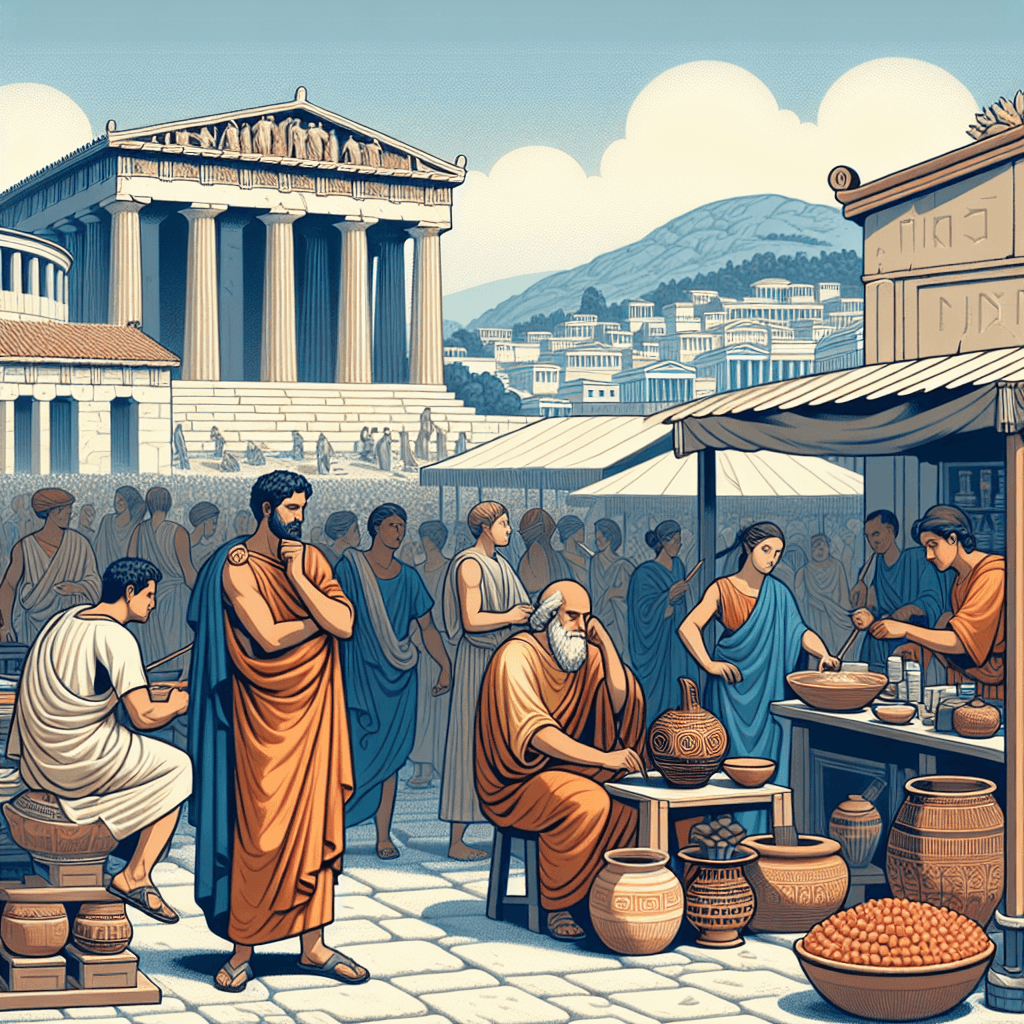
Model of Ancient Athens: Public Life & Social Structure
Inquiry Framework
Question Framework
Driving Question
The overarching question that guides the entire project.How can we create a detailed and accurate model that represents the main areas of public activities and daily life for different social groups in ancient Athens, reflecting its cultural, political, and economic values while understanding the factors that contributed to its development as an influential city-state?Essential Questions
Supporting questions that break down major concepts.- What were the main areas of public activities in ancient Athens and what roles did they play in the daily lives of its citizens?
- How did different social groups in ancient Athens experience daily life, and what were their roles in the city?
- What factors contributed to the development and organization of ancient Athens as an influential city-state?
- How does the structure and organization of ancient Athens reflect its cultural, political, and economic values?
Standards & Learning Goals
Learning Goals
By the end of this project, students will be able to:- Students will be able to identify and describe the main areas of public activities in ancient Athens and their significance to the culture.
- Students will understand and explain the roles and daily life of different social groups in ancient Athens.
- Students will analyze the factors that contributed to the development of Athens as a city-state and its influence on the world history.
- Students will create a model that represents the cultural, political, and economic values of ancient Athens.
Quebec Grade 7 History Standards
Entry Events
Events that will be used to introduce the project to studentsAncient Athens Discovery Box
Introduce a 'discovery box' filled with replicas and artifacts related to ancient Athens, such as coins, pottery shards, and tools. Ask students to hypothesize about the use and significance of each item, sparking curiosity about the daily life and public spaces in Athens. This hands-on exploration can lead to discussions about different social groups and their roles in ancient Athenian society.Virtual Reality Walkthrough of Athens
Kick off the project with a virtual reality tour of ancient Athens, allowing students to roam through the Agora, the Acropolis, and residential areas. This immersive experience makes them feel like they are stepping back in time, prompting questions about the architectural design, social activities, and cultural practices of the time.Athens Through a Social Media Lens
Ask students to imagine what it would be like if ancient Athens had social media. They will create mock social media profiles and posts for different social groups in Athens, encouraging them to explore values, daily routines, and interactions among citizens.Athenian Day in the Life Skit
Organize a day where students reenact a typical day in Athens, portraying roles from different social groups (e.g., politicians, artisans, women, slaves). This role-play activity can prompt questions about societal structure and inspire creative thinking about historical narratives.Interactive Athens City Map Puzzle
Begin with a giant, interactive puzzle that students collaboratively put together, depicting the city layout of ancient Athens. As each piece is placed, discuss the significance of the location and its inhabitants, providing an engaging way to understand how geography influenced social and political life.Portfolio Activities
Portfolio Activities
These activities progressively build towards your learning goals, with each submission contributing to the student's final portfolio.Athenian Treasure Hunt
Students participate in a scavenger hunt using clues related to ancient Athens to identify different public spaces and their significance.Steps
Here is some basic scaffolding to help students complete the activity.Final Product
What students will submit as the final product of the activityA completed worksheet with matched clues and facts about Athenian public spaces.Alignment
How this activity aligns with the learning objectives & standardsAligns with standard HSS-2 by helping students analyze social and political structures through identification of public spaces.Social Group Deep Dive
In this activity, students investigate the roles and daily lives of different social groups in Athens and present their findings.Steps
Here is some basic scaffolding to help students complete the activity.Final Product
What students will submit as the final product of the activityA visual presentation on the daily life and roles of a specific Athenian social group.Alignment
How this activity aligns with the learning objectives & standardsAligns with standard HSS-4 by encouraging exploration of different social groups and their roles in society.Athens Town Hall Puzzle
Collaborate on assembling an interactive map puzzle of Athens showing cultural, political, and technological advancements.Steps
Here is some basic scaffolding to help students complete the activity.Final Product
What students will submit as the final product of the activityAn interactive and collaboratively assembled map puzzle of ancient Athens.Alignment
How this activity aligns with the learning objectives & standardsSupports standard HSS-7 by focusing on the understanding and comparison of significant cultural and political developments.Rubric & Reflection
Portfolio Rubric
Grading criteria for assessing the overall project portfolioAncient Athens Model Project Rubric
Understanding of Ancient Athens' Public Spaces
Assesses students' ability to identify and describe significant public areas in ancient Athens and their societal impact.Identification of Public Spaces
Evaluate the accuracy and comprehensiveness in identifying key public areas in Athens.
Exemplary
4 PointsAccurately identifies all significant public spaces in ancient Athens with detailed descriptions of each area's historical role and impact on Athenian society.
Proficient
3 PointsIdentifies most significant public spaces with clear descriptions of their roles and impact on society.
Developing
2 PointsIdentifies some public spaces but with partial or inconsistent descriptions regarding their societal roles.
Beginning
1 PointsStruggles to identify public spaces, with minimal understanding of their significance.
Analysis of Space Significance
Assesses the ability to analyze and articulate the cultural, political, and economic significance of the public spaces identified.
Exemplary
4 PointsProvides a comprehensive analysis that connects each space to Athens' cultural, political, and economic values comprehensively.
Proficient
3 PointsOffers a clear analysis connecting most spaces to their cultural, political, and economic significance.
Developing
2 PointsProvides a basic analysis with limited connections to cultural, political, or economic contributions.
Beginning
1 PointsMinimal or no analysis of the significance of public spaces.
Understanding of Social Group Roles
Evaluates how well students explore and understand the daily lives and societal roles of different social groups in Athens.Research and Presentation of Social Roles
Evaluation of the depth and clarity of research into different social groups and presentation quality.
Exemplary
4 PointsPresents an in-depth, well-organized visual presentation, effectively describing daily life and roles of social groups.
Proficient
3 PointsPresents clear information about social group roles with good organization and clarity.
Developing
2 PointsPresentation reflects basic understanding with some organizational issues and unclear information.
Beginning
1 PointsResearch and presentation lack clarity and depth, with significant gaps in understanding.
Cultural and Political Analysis
Assesses students’ ability to identify, compare, and articulate major cultural and political aspects of ancient Athens.Comparison with Other Societies
Measures ability to effectively compare Athens to other ancient societies in terms of cultural and political developments.
Exemplary
4 PointsPresents detailed, insightful comparisons between Athens and other societies, highlighting unique cultural and political aspects.
Proficient
3 PointsOffers clear and relevant comparisons with other societies; covers most major aspects.
Developing
2 PointsMakes basic comparisons with limited depth, lacking in comprehensive coverage.
Beginning
1 PointsComparisons are vague and offer little insight into cultural or political nuances.
Collaboration and Creativity
Evaluates students' ability to work collaboratively and creatively in assembling and presenting the project.Collaboration and Teamwork
Assesses the quality of student collaboration and contribution to group efforts.
Exemplary
4 PointsDemonstrates leadership and consistently contributes high-quality input to group activities.
Proficient
3 PointsParticipates actively and contributes significantly to group tasks.
Developing
2 PointsSometimes participates in group activities but with inconsistent contribution.
Beginning
1 PointsRarely contributes or participates in group activities, requiring additional support.