
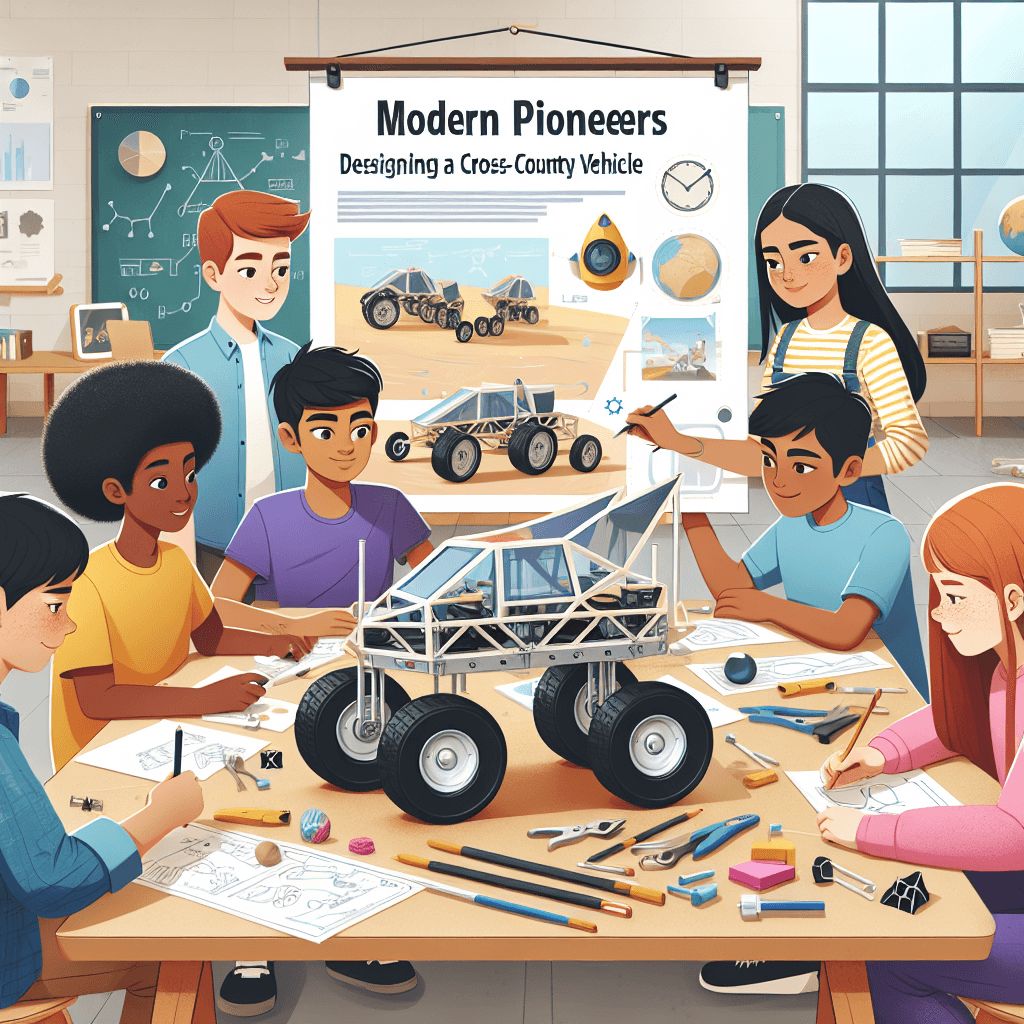
Modern Pioneers: Designing a Cross-Country Vehicle
Inquiry Framework
Question Framework
Driving Question
The overarching question that guides the entire project.How can we use our research on 19th-century pioneer travel to design and pitch a modern vehicle that meets all the survival needs of a cross-country move?Essential Questions
Supporting questions that break down major concepts.- How can we design a modern vehicle that meets all our survival needs for a cross-country journey, inspired by the lessons of early pioneers?
- How did the design and packing of pioneer wagons reflect the challenges of traveling across the United States in the 1800s?
- What are the essential differences between 'wants' and 'needs' when planning for a journey where resources are unavailable?
- How does research into the past help us solve engineering and design problems for the future?
- How can we use visual models and evidence-based reasoning to persuade others that our vehicle design is the most effective?
Standards & Learning Goals
Learning Goals
By the end of this project, students will be able to:- Conduct targeted research on 19th-century pioneer transportation to identify how historical designs addressed survival challenges and resource constraints.
- Apply engineering design principles to create a modern vehicle prototype that addresses the logistical needs of a cross-country journey without access to external resources.
- Differentiate between 'wants' and 'needs' through critical analysis of survival requirements and interior space management.
- Develop a comprehensive visual model (poster or digital diagram) that integrates researched evidence and original design solutions.
- Construct and deliver a persuasive presentation that justifies design decisions using evidence-based reasoning and responds to peer feedback.
Common Core State Standards for English Language Arts
Next Generation Science Standards (NGSS)
C3 Framework for Social Studies State Standards
Entry Events
Events that will be used to introduce the project to studentsThe Trail-Blazer Prototype Challenge
A local 'Travel Consultant' (guest speaker or teacher in character) issues a high-stakes challenge: a modern travel company wants to offer 'Extreme Pioneer Tours' where travelers cross the country without using any gas stations or grocery stores. Students are tasked with designing the prototype vehicle that can handle rugged 19th-century terrain while carrying 21st-century necessities.Portfolio Activities
Portfolio Activities
These activities progressively build towards your learning goals, with each submission contributing to the student's final portfolio.The Wagon Blueprint Investigation
In this foundational activity, students act as historical detectives. They research the engineering and packing strategies of 19th-century pioneers. By examining diagrams of Conestoga wagons and 'prairie schooners,' students identify how these vehicles were designed to withstand specific geographical challenges and how every inch of space was utilized for survival.Steps
Here is some basic scaffolding to help students complete the activity.Final Product
What students will submit as the final product of the activityAn 'Anatomy of a Wagon' annotated diagram that identifies key parts of a pioneer vehicle and explains why specific items were packed for the journey.Alignment
How this activity aligns with the learning objectives & standardsThis activity aligns with RI.4.7 by requiring students to interpret historical diagrams and visuals of pioneer wagons. It also meets W.4.7 as students conduct research to build knowledge on the topic, and D2.Geo.8 by exploring how the environment influenced the design and movement of pioneer transport.Survival Essentials: The Needs vs. Wants Audit
Students shift from the past to the present-day challenge. They must define the 'Extreme Pioneer Tour' problem: how to travel across the country today without using any modern infrastructure (gas stations or stores). Students brainstorm modern equivalents to pioneer needs and grapple with the constraints of vehicle space versus survival requirements.Steps
Here is some basic scaffolding to help students complete the activity.Final Product
What students will submit as the final product of the activityA 'Modern Survival Manifest' and a 'Problem Definition Statement' that outlines the specific challenges their vehicle must solve.Alignment
How this activity aligns with the learning objectives & standardsThis activity aligns with 3-5-ETS1-1 by defining a design problem with specific constraints (no stores, limited space). It also supports W.4.7 as students investigate modern survival needs and move from historical research to modern application.Prototype Architect: Inside and Out
Now, students become vehicle architects. Using their research and manifest, they will design their modern cross-country vehicle. This involves choosing a base vehicle (like a 4x4, a bus, or a truck) and modifying it. They must show the exterior (for terrain) and the interior (for storage and living).Steps
Here is some basic scaffolding to help students complete the activity.Final Product
What students will submit as the final product of the activityA large-scale poster board display featuring a 'cutaway' view of their vehicle, showing the internal packing layout and the external modifications.Alignment
How this activity aligns with the learning objectives & standardsThis activity aligns with SL.4.5 by having students create a visual display to enhance their main ideas. It also covers W.4.6 by using technology/internet to find and modify images, and 3-5-ETS1-2 by generating a specific design solution to the travel problem.The Trail-Blazer Pitch & Peer Review
In the final stage, groups present their designs to the 'Travel Consultants' (the class). Each group must justify their design choices—why they chose that vehicle, how they prioritized space, and how they learned from pioneer history. Peers will act as evaluators, looking for evidence and reasoning in each pitch.Steps
Here is some basic scaffolding to help students complete the activity.Final Product
What students will submit as the final product of the activityA formal group presentation and a 'Design Review Reflection' where students compare their vehicle to their classmates' models.Alignment
How this activity aligns with the learning objectives & standardsThis activity aligns with SL.4.3 as students listen to others and identify the evidence provided. It also meets 3-5-ETS1-2 by comparing different solutions to see which best meets the criteria, and SL.4.5 as the final step of the visual presentation.Rubric & Reflection
Portfolio Rubric
Grading criteria for assessing the overall project portfolioCross-Country Vehicle Design & Research Rubric
Research & Historical Context
Evaluating the depth of historical investigation and the understanding of how environment influences design.Historical Research & Geographic Analysis (RI.4.7, D2.Geo.8)
Measures the ability to research 19th-century pioneer wagons and explain how their engineering features (e.g., Conestoga design, materials) addressed specific geographical and environmental challenges.
Exemplary
4 PointsProvides a sophisticated analysis of multiple wagon features, drawing deep connections between design and specific geographical obstacles (rivers, mountains). Research is thorough and uses specific historical terminology.
Proficient
3 PointsAccurately identifies key wagon features and explains their purpose in relation to pioneer travel. Research is clear and aligns with historical facts.
Developing
2 PointsIdentifies basic features of pioneer wagons but provides limited or inconsistent explanations of how those features helped travelers cross the country.
Beginning
1 PointsLists minimal information about pioneer wagons with little to no explanation of design purpose or environmental connection.
Engineering & Problem Solving
Assessing the application of engineering principles to create a functional modern solution.Engineering Design & Innovation (3-5-ETS1-1)
Evaluates the student's ability to define the modern travel problem, identify constraints (no stores/gas), and design a vehicle with specific modifications that solve these problems.
Exemplary
4 PointsDefines the design problem with exceptional clarity. The vehicle includes innovative, highly functional modifications (e.g., integrated solar, advanced filtration) that perfectly address all specified constraints.
Proficient
3 PointsClearly defines the design problem and includes logical modifications to the vehicle that address the primary constraints of the journey.
Developing
2 PointsIdentifies a basic design problem but modifications are either standard or do not fully address the constraints of a store-less, off-grid journey.
Beginning
1 PointsStruggles to define the design problem. The vehicle lacks modifications or the modifications do not address the requirements of the trip.
Content Synthesis: Needs vs. Wants
Evaluating critical thinking regarding survival priorities and spatial constraints.Critical Resource Management (W.4.7)
Measures the ability to distinguish between survival 'needs' and 'wants' while justifying the placement and inclusion of items based on limited space and resource availability.
Exemplary
4 PointsManifest shows a sophisticated understanding of survival; every item is justified with evidence-based reasoning. Packing layout demonstrates expert spatial management and weight distribution.
Proficient
3 PointsManifest clearly distinguishes between needs and wants. Most items are justified logically, and the packing layout shows a functional use of vehicle space.
Developing
2 PointsLists items for the trip but the distinction between needs and wants is occasionally blurred. Packing layout is basic or lacks clear organization.
Beginning
1 PointsManifest includes mostly 'wants' or lacks a logical organization. There is little evidence of spatial planning or survival priority.
Visual Communication & Modeling
Assessing the effectiveness of the visual representation in communicating complex ideas.Visual Modeling & Technical Illustration (SL.4.5, W.4.6)
Evaluates the quality, clarity, and detail of the visual poster, specifically the 'cutaway' view and the use of labels/diagrams to communicate the design.
Exemplary
4 PointsVisual display is professional and exceptionally detailed. The cutaway view provides a clear, 3D-like understanding of the interior/exterior integration. Labels are precise and enhance the viewer's understanding.
Proficient
3 PointsVisual display is clean, organized, and uses diagrams effectively to show the vehicle's features. Labels are accurate and support the main ideas.
Developing
2 PointsVisual display is present but may be cluttered or lack sufficient detail in the cutaway view. Some features are unlabeled or difficult to interpret.
Beginning
1 PointsVisual display is incomplete, messy, or fails to show the internal layout of the vehicle. Information is difficult to follow.
Communication & Collaborative Reflection
Evaluating communication skills and the ability to analyze arguments and solutions.Evidence-Based Pitch & Peer Review (SL.4.3, 3-5-ETS1-2)
Measures the student's ability to present their design using evidence, and their ability to listen to and evaluate the reasoning provided by their peers.
Exemplary
4 PointsPresentation is highly persuasive, using strong evidence from research. Peer feedback is insightful, identifying specific strengths and weaknesses in others' reasoning with high accuracy.
Proficient
3 PointsPresentation clearly explains design choices using evidence. Peer feedback identifies specific reasons or evidence used by other speakers.
Developing
2 PointsPresentation explains some choices but lacks strong supporting evidence. Peer feedback is general and does not always point to specific evidence used by others.
Beginning
1 PointsPresentation is disorganized or lacks a clear rationale. Peer feedback is minimal or does not address the reasoning of others.