
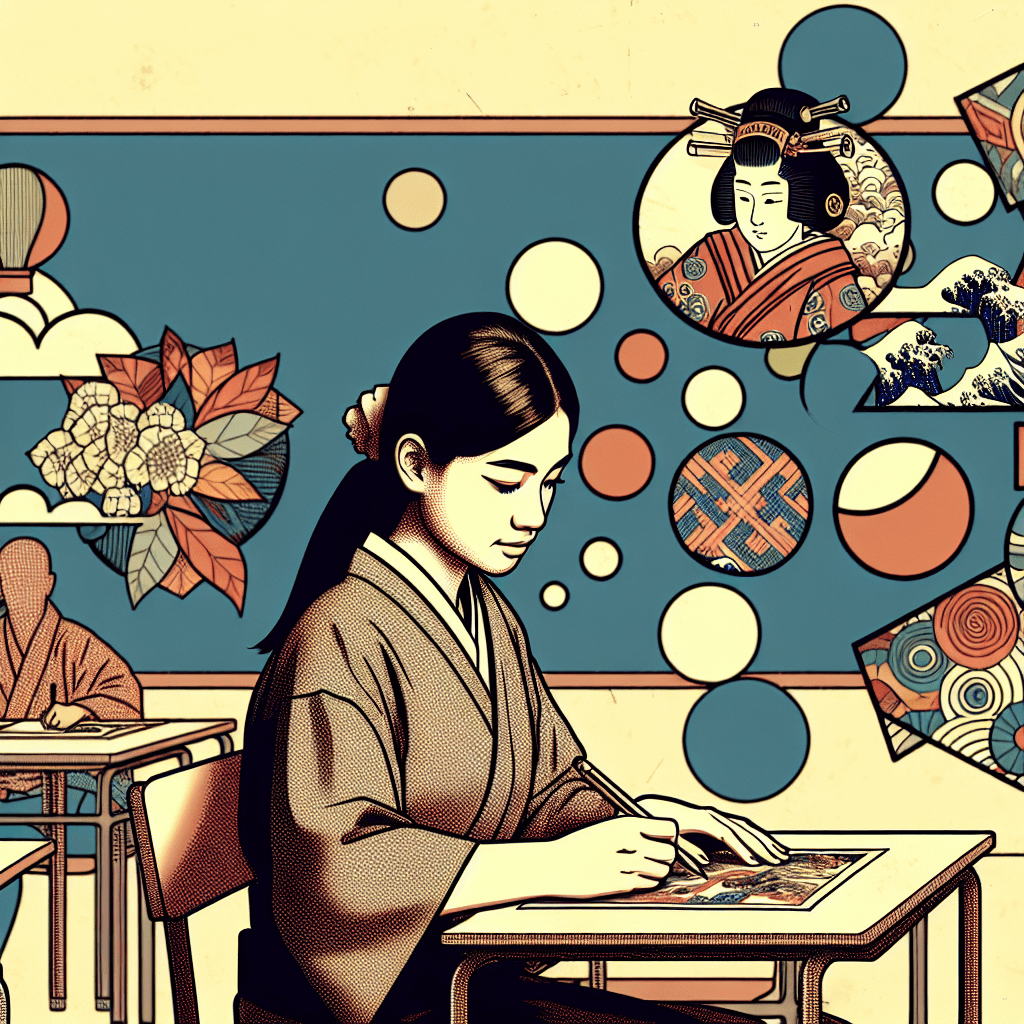
Modern Ukiyo-e: Tradition Meets Modern Themes
Inquiry Framework
Question Framework
Driving Question
The overarching question that guides the entire project.How can we reinterpret the traditional Ukiyo-e woodblock print style to create modern art pieces that convey both personal and social justice messages, while reflecting cultural and historical contexts?Essential Questions
Supporting questions that break down major concepts.- What are the defining characteristics of traditional Ukiyo-e art?
- How can modern themes or subjects be integrated into traditional art forms?
- What techniques are involved in creating a Japanese woodblock print?
- How do cultural and historical contexts influence art and its interpretation?
- In what ways can art be a medium for social justice messages?
- How does art reflect personal and societal identity?
Standards & Learning Goals
Learning Goals
By the end of this project, students will be able to:- Students will understand the traditional techniques and themes of Ukiyo-e prints and use this understanding to innovate and create personal art pieces that incorporate modern themes.
- Students will develop their ability to analyze both personal and cultural themes in art and apply this understanding to create socially relevant art pieces.
- Students will gain proficiency in printmaking techniques inspired by Japanese woodblock prints and demonstrate this through their art projects.
- Students will explore and apply concepts of social justice through art, creating pieces that communicate personal and societal messages.
- Students will critically engage with the cultural and historical contexts of Ukiyo-e art and reflect this understanding in their critiques and art pieces.
- Students will reflect on their artistic process and its relation to personal and societal identity, integrating these themes into their final projects.
National Core Arts Standards
Social Emotional Learning Standards
Social Justice Standards
Entry Events
Events that will be used to introduce the project to studentsUkiyo-e Art Exhibit
Transform your classroom into an art gallery featuring authentic ukiyo-e prints alongside modern interpretations created by local artists. Students will explore this fusion of traditional and contemporary art, analyzing the themes and techniques before brainstorming their own concepts.Portfolio Activities
Portfolio Activities
These activities progressively build towards your learning goals, with each submission contributing to the student's final portfolio.Woodblock Print Technique Exploration
Students will get hands-on experience by learning the woodblock print techniques used in Ukiyo-e. This activity will involve practical skill-building and adaptation of traditional methods to their contemporary designs.Steps
Here is some basic scaffolding to help students complete the activity.Final Product
What students will submit as the final product of the activityA basic woodblock print created by each student, showcasing their understanding of the technique.Alignment
How this activity aligns with the learning objectives & standardsAligns with learning goals of gaining proficiency in printmaking techniques inspired by Japanese woodblock prints.Cultural Context Critique
Students will engage with the cultural and historical implications of Ukiyo-e art, discussing how these factors influence both traditional and contemporary works. This critique will develop their analytical skills and understanding of art’s broader context.Steps
Here is some basic scaffolding to help students complete the activity.Final Product
What students will submit as the final product of the activityA written critique comparing traditional and modern Ukiyo-e art and reflecting on cultural influences.Alignment
How this activity aligns with the learning objectives & standardsAligns with VA:Re7.1.HSIII, enabling students to analyze how art responses develop over time.Social Justice Art Piece
In this culminating activity, students will create their own Ukiyo-e inspired print that incorporates modern themes and social justice messages. This synthesis of traditional techniques and contemporary ideas reflects their growth and understanding throughout the project.Steps
Here is some basic scaffolding to help students complete the activity.Final Product
What students will submit as the final product of the activityA finished print that combines modern themes with traditional Ukiyo-e techniques, displayed in a class exhibition.Alignment
How this activity aligns with the learning objectives & standardsAligns with multiple standards including VA:Cr1.2.HSIII, SEL:Self-Awareness.3.11, and SJ:DI.10-12.5, reflecting students' personal, artistic, and social understandings.Rubric & Reflection
Portfolio Rubric
Grading criteria for assessing the overall project portfolioModern Ukiyo-e Art Project Assessment Rubric
Technical Proficiency
Assesses the student's skill and accuracy in applying traditional Ukiyo-e woodblock print techniques.Accuracy in Printing Technique
Evaluates the student's ability to correctly execute traditional woodblock printing techniques learned during the project.
Exemplary
4 PointsExecution of woodblock printing techniques is flawless; each step from carving to inking and printing is performed with precision and attention to detail.
Proficient
3 PointsWoodblock printing techniques are applied correctly with minor errors; most steps are executed smoothly with good attention to detail.
Developing
2 PointsSome understanding of woodblock techniques shown, but inconsistencies in execution; several steps display errors or lack of detail.
Beginning
1 PointsMinimal understanding and application of woodblock techniques; significant errors in multiple steps and lack of attention to detail.
Material Usage
Assesses the student's proficient and safe use of materials during the creation of their print.
Exemplary
4 PointsStudent demonstrates exceptional understanding and safe handling of all materials, choosing the most appropriate tools for desired effects.
Proficient
3 PointsStudent uses materials safely and appropriately, with some exploration of different tools to achieve various effects.
Developing
2 PointsStudent shows basic safe use of materials, but limited in selecting appropriate tools for desired effects.
Beginning
1 PointsStudent struggles with safe material use and rarely chooses appropriate tools, affecting print results.
Creative Expression and Innovation
Evaluates the student's creativity and ability to innovate by integrating modern themes with traditional Ukiyo-e style.Integration of Modern Themes
Measures the effectiveness of integrating modern themes and social justice messages into the traditional art form.
Exemplary
4 PointsModern themes and social justice messages are seamlessly integrated with traditional art forms, showing deep insight and originality.
Proficient
3 PointsModern themes and social justice messages are effectively incorporated, with clear connections to traditional styles.
Developing
2 PointsModern themes are present but integration with traditional styles lacks cohesion and depth.
Beginning
1 PointsMinimal attempt to integrate modern themes; traditional and modern elements are disjointed.
Originality and Personal Voice
Assesses the student's originality and the extent to which personal voice and perspective are expressed in their artwork.
Exemplary
4 PointsArtwork is highly original and displays a strong personal voice and perspective, making it unique and insightful.
Proficient
3 PointsArtwork shows originality and personal voice, with some unique insights and perspectives.
Developing
2 PointsSome originality and personal voice evident, but heavily reliant on known themes without unique insights.
Beginning
1 PointsLittle originality or personal voice; artwork lacks distinctive personal perspective.
Cultural and Contextual Understanding
Assesses the student's understanding of cultural and historical influences on Ukiyo-e and modern art.Cultural Context Analysis
Measures the ability to analyze the cultural and historical contexts of Ukiyo-e and relate them to modern interpretations.
Exemplary
4 PointsStudent offers a comprehensive analysis, insightfully connecting cultural and historical contexts with modern interpretations in their critique.
Proficient
3 PointsStudent provides a detailed analysis with clear connections between cultural contexts and modern art interpretations.
Developing
2 PointsAnalysis of cultural contexts is superficial, with some attempt to connect with modern interpretations but lacking depth.
Beginning
1 PointsLacks understanding of cultural contexts, with weak or incorrect connections to modern interpretations.