
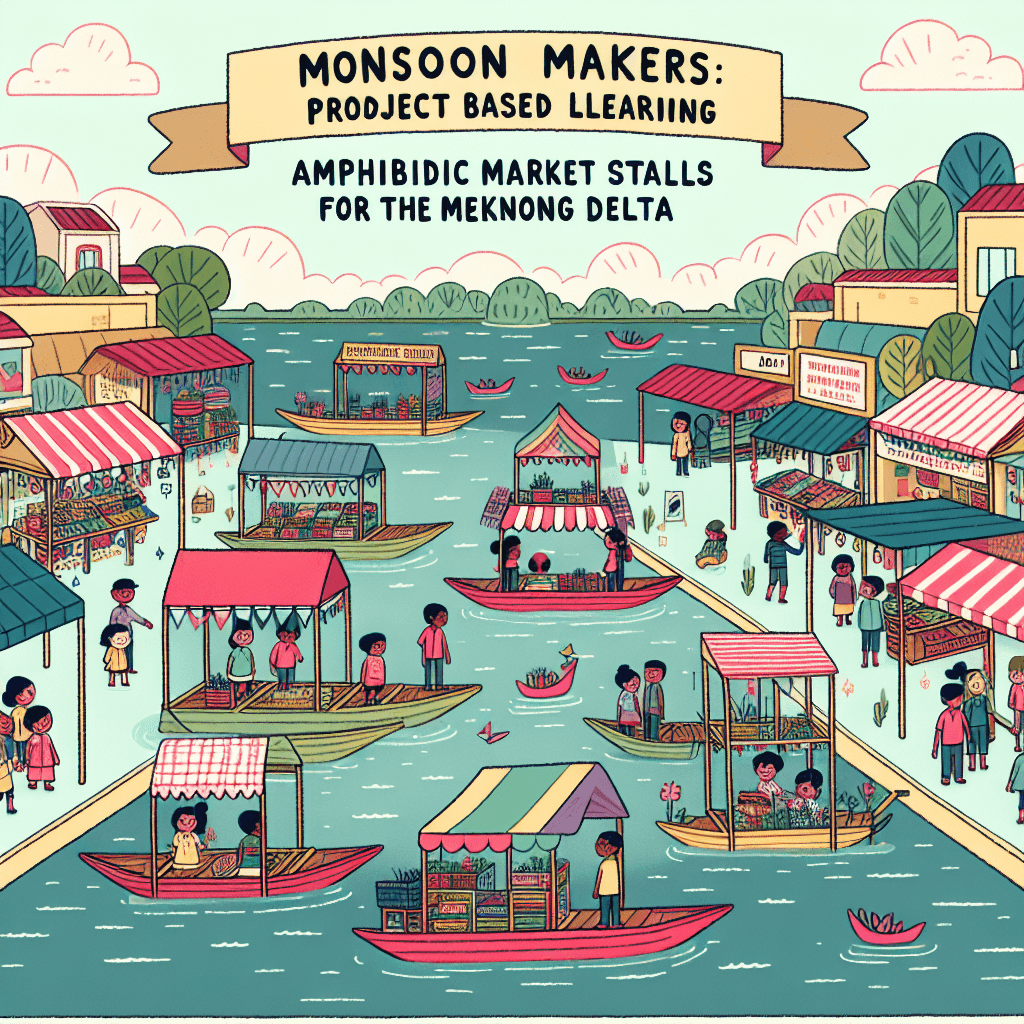
Monsoon Makers: Amphibious Market Stalls for the Mekong Delta
Inquiry Framework
Question Framework
Driving Question
The overarching question that guides the entire project.How can we, as innovative geographers and engineers, design amphibious market stalls that allow Mekong Delta traders to sustain their local economy during extreme seasonal flooding?Essential Questions
Supporting questions that break down major concepts.- How does the unique physical geography of the Mekong Delta shape the daily lives and economic activities of its people?
- In what ways have humans adapted their lifestyles and structures to coexist with the seasonal flooding of the Mekong River?
- How do extreme seasonal changes, like monsoons, create both opportunities and challenges for traders in Southeast Asia?
- How can human innovation and engineering modify the environment to ensure community resilience against natural disasters?
- What happens to a local economy when traditional physical marketplaces are disrupted by environmental factors?
Standards & Learning Goals
Learning Goals
By the end of this project, students will be able to:- Analyze the physical characteristics of the Mekong Delta to identify how the monsoon season and seasonal flooding impact local trade and economic stability.
- Evaluate various human adaptations and environmental modifications in Southeast Asia, determining their effectiveness in overcoming geographic challenges.
- Design and prototype an amphibious market stall that demonstrates an understanding of the relationship between physical environment and human economic activity.
- Communicate the rationale behind design choices by citing specific geographic evidence and economic needs of Mekong Delta communities.
- Synthesize research on monsoon patterns and regional geography to predict the long-term impact of climate-resilient architecture on local economies.
State Social Studies Standards (Grade 6)
C3 Framework for Social Studies State Standards
Common Core State Standards (ELA/Literacy)
Next Generation Science Standards (NGSS)
Entry Events
Events that will be used to introduce the project to studentsThe Vanishing Land Map-Walk
The classroom floor is covered in a giant satellite map of the Mekong Delta, and students are given 'Event Cards' like 'Heavy Rain upstream' or 'Sea Level Rise.' As they move their 'market stall' tokens across the map, they realize that land is literally disappearing, forcing them to brainstorm how a business can exist without a fixed piece of ground.Portfolio Activities
Portfolio Activities
These activities progressively build towards your learning goals, with each submission contributing to the student's final portfolio.The Flooded Delta Dossier
Before students can build, they must understand the 'opponent'—the monsoon and the geography of the Mekong Delta. In this activity, students act as geographic analysts, synthesizing data from satellite maps, weather charts, and economic reports to create a comprehensive profile of the region's seasonal transformation.Steps
Here is some basic scaffolding to help students complete the activity.Final Product
What students will submit as the final product of the activityAn 'Environmental Impact Dossier' containing annotated maps, a monsoon timeline, and a list of three specific ways seasonal flooding disrupts current market practices.Alignment
How this activity aligns with the learning objectives & standardsAligns with SS.6.G.13 (Physical environment influences human activities) and CCSS.ELA-LITERACY.RI.6.7 (Integrating information from different formats). Students analyze how the specific physical features of the Mekong Delta dictate the timing and methods of trade.Adaptation Archives: Learning from the Locals
Students research how the people of Southeast Asia have historically modified their lives to fit the water. They will look at stilt houses, floating markets, and traditional boats to understand the balance between 'living with' and 'overcoming' environmental challenges.Steps
Here is some basic scaffolding to help students complete the activity.Final Product
What students will submit as the final product of the activityA 'Legacy of Adaptation' Comparison Chart that evaluates the strengths and weaknesses of three current adaptation strategies used in the Mekong Delta.Alignment
How this activity aligns with the learning objectives & standardsAligns with C3.D2.Geo.4.6-8 (Explaining how economic decisions influence environments and daily lives) and Learning Goal #2 (Evaluating various human adaptations). Students examine existing human modifications to understand successful design patterns.The Trader’s Blueprints: Defining the Solution
Transitioning from research to engineering, students define the specific needs of a Mekong Delta trader. They must balance the physical constraints (buoyancy, weight) with economic constraints (storage space, display area, portability).Steps
Here is some basic scaffolding to help students complete the activity.Final Product
What students will submit as the final product of the activityA 'Trader’s Technical Brief' which includes a labeled blueprint of the stall and a checklist of 'Design Constraints' (e.g., Must hold 50kg of produce, must float in 2 feet of water).Alignment
How this activity aligns with the learning objectives & standardsAligns with NGSS.MS-ETS1-1 (Defining criteria and constraints of a design problem). Students must translate economic needs into engineering requirements, ensuring their human modification is practical.The Prototype Pilot: Building for the Rise
Using their blueprints, students build a 1:10 scale model of their amphibious market stall. This is the 'Makers' phase where they test how their structure interacts with the physical environment.Steps
Here is some basic scaffolding to help students complete the activity.Final Product
What students will submit as the final product of the activityA physical scale model of the amphibious stall, accompanied by a 'Test Log' video or photo series showing the stall floating in a simulated flood tank.Alignment
How this activity aligns with the learning objectives & standardsAligns with SS.6.G.13 (Human activities modify the physical environment) and Learning Goal #3 (Designing and prototyping). This is the physical manifestation of modifying the environment to sustain human activity.The Resilience Pitch: Selling the Future
In the final phase, students present their designs to a panel (or the class), explaining how their modification of the environment ensures economic resilience. They must cite geographic evidence to justify why their specific design is the best solution for the Mekong Delta.Steps
Here is some basic scaffolding to help students complete the activity.Final Product
What students will submit as the final product of the activityA 'Resilience Pitch' presentation (digital or oral) that connects the physical design features of the stall to the geographic and economic data gathered in Activity 1.Alignment
How this activity aligns with the learning objectives & standardsAligns with CCSS.ELA-LITERACY.RI.6.7 and Learning Goal #4 (Communicating the rationale behind design choices). Students synthesize their geographic and economic findings into a persuasive argument.Rubric & Reflection
Portfolio Rubric
Grading criteria for assessing the overall project portfolioMonsoon Makers: Mekong Delta Adaptation Rubric
Geographic & Historical Analysis
Foundational knowledge of the physical environment and existing human modifications.Geographic Analysis & Adaptation Research
Measures the student's ability to synthesize satellite imagery, monsoon data, and historical adaptation strategies to understand the relationship between the Mekong Delta's physical environment and human economic activity.
Exemplary
4 PointsProvides a sophisticated synthesis of geographic data; identifies nuanced connections between monsoon cycles and trade disruptions. Evaluates traditional adaptations with deep insight into material use and environmental effectiveness.
Proficient
3 PointsAccurately interprets maps and monsoon data to identify major challenges for traders. Provides a clear comparison of traditional adaptations and their relevance to the current problem.
Developing
2 PointsIdentifies basic geographic features and rainfall patterns but makes inconsistent connections to economic impacts. Comparison of adaptations is present but lacks detail on effectiveness.
Beginning
1 PointsDemonstrates minimal understanding of the Mekong Delta geography. Fails to link environmental data to the challenges faced by local traders.
Technical Design & Constraints
The translation of geographic and economic needs into a viable technical plan.Engineering Design & Planning
Evaluates the precision of the design process, including the identification of constraints (buoyancy, weight, space) and the technical quality of the labeled blueprints.
Exemplary
4 PointsBlueprint is highly detailed and labeled with precise material choices and scale. Explicitly defines complex constraints including buoyancy calculations and specific trader needs with high accuracy.
Proficient
3 PointsBlueprint is clearly labeled and addresses key constraints such as buoyancy and storage. Design choices are logical and reflect the needs of the identified trader role.
Developing
2 PointsBlueprint is basic or missing labels. Design constraints are identified but may be vague or lack consideration for practical trade requirements (e.g., weight limits).
Beginning
1 PointsBlueprint is incomplete or does not address the core problem of flotation and stability. Design constraints are not defined.
Model Construction & Performance
The physical manifestation and testing of the environmental modification.Iterative Prototyping & Testing
Assesses the physical construction of the 1:10 scale model and its performance during the simulated 'Flood Test' regarding stability, buoyancy, and durability.
Exemplary
4 PointsPrototype shows exceptional craftsmanship and innovative material use. Remains perfectly stable and dry during the flood test even when loaded with maximum 'inventory' weight.
Proficient
3 PointsPrototype is functional and follows the blueprint. Successfully floats and maintains stability during the flood test with representative weight.
Developing
2 PointsPrototype is partially functional; may float but shows signs of instability or water leakage. Build quality is inconsistent with the blueprint.
Beginning
1 PointsPrototype fails to float or sustain weight. Construction is incomplete or does not utilize suggested materials for buoyancy.
Communication & Resilience Pitch
Communication of the design's value and its impact on human-environment interaction.Evidence-Based Rationale & Synthesis
Measures the student's ability to argue for their design using geographic evidence and to predict the long-term economic impact of their innovation on the Mekong Delta communities.
Exemplary
4 PointsDelivers a compelling pitch that masterfully connects design features to specific geographic data. Predicts profound, long-term economic shifts with high levels of critical thinking and empathy.
Proficient
3 PointsProvides a clear rationale for design choices by citing specific data from the dossier. Explains how the stall contributes to community resilience and economic stability.
Developing
2 PointsDescribes the design but provides limited evidence from research to justify choices. Predictions about economic impact are superficial or unrealistic.
Beginning
1 PointsPitch is disorganized and lacks connection to the geographic context or economic needs of the region. Provides no evidence-based reasoning.