
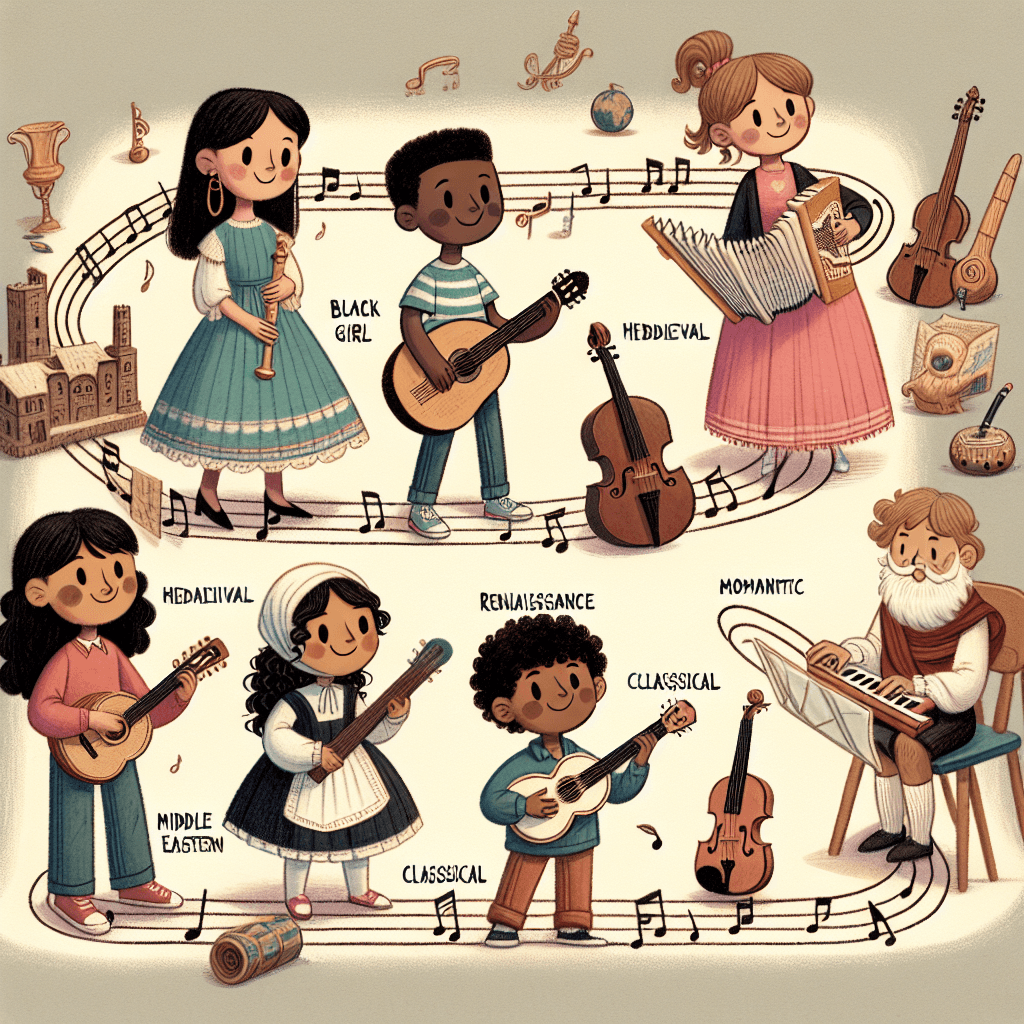
Musical Time Travelers: A Performance Styles Journey Through Time
Inquiry Framework
Question Framework
Driving Question
The overarching question that guides the entire project.How can we, as musical time travelers, authentically recreate and perform music from different eras, showcasing the evolution of performance styles?Essential Questions
Supporting questions that break down major concepts.- How do different time periods influence musical performance styles?
- What makes a performance authentic to a specific musical era?
- How can we recreate historical performance styles in our own performances?
Standards & Learning Goals
Learning Goals
By the end of this project, students will be able to:- Students will be able to identify characteristics of musical performance styles from different eras.
- Students will be able to compare and contrast musical performance styles from different eras.
- Students will be able to recreate musical performances in the style of a specific era.
Entry Events
Events that will be used to introduce the project to studentsHistorical Sound Clash
Students participate in a 'sound clash' where different musical eras (Baroque, Classical, Romantic, Modern) compete. Each era is represented by a short, impactful performance, followed by student-led discussions on the unique characteristics and performance styles of each period.An Interview with a Time-Traveling Musician
A performer dressed as a musician from a past era visits the class and performs a short piece. Students interview the 'time traveler' about their performance techniques, the cultural context of their music, and how their style differs from modern performances, bridging the gap between history and lived experience.Portfolio Activities
Portfolio Activities
These activities progressively build towards your learning goals, with each submission contributing to the student's final portfolio.Era Exploration Launch
Students begin their journey by diving into the distinct characteristics of four musical eras: Baroque, Classical, Romantic, and Modern. They'll listen to representative pieces from each era, focusing on identifying unique elements such as instrumentation, tempo, dynamics, and overall mood.Steps
Here is some basic scaffolding to help students complete the activity.Final Product
What students will submit as the final product of the activityA detailed chart comparing the characteristics of musical pieces from the four eras.Alignment
How this activity aligns with the learning objectives & standardsAddresses the learning goal of identifying characteristics of musical performance styles from different eras.Performance Style Deep Dive
In this activity, students select one musical era to investigate further. They will research the historical context, typical performance practices, and significant composers of their chosen era. Students will also analyze recordings and/or scores to identify specific stylistic elements.Steps
Here is some basic scaffolding to help students complete the activity.Final Product
What students will submit as the final product of the activityA comprehensive research report detailing the performance style of their chosen era, including historical context and musical examples.Alignment
How this activity aligns with the learning objectives & standardsAddresses the learning goals of identifying characteristics and comparing/contrasting musical performance styles from different eras.Authenticity Challenge: Recreating a Performance
Students put their knowledge into practice by selecting a short musical excerpt from their chosen era and attempting to recreate a performance that is authentic to that style. This involves careful attention to dynamics, phrasing, ornamentation, and other stylistic elements. Students may work individually or in small groups.Steps
Here is some basic scaffolding to help students complete the activity.Final Product
What students will submit as the final product of the activityA recorded performance of a musical excerpt, recreated in the style of a specific era, accompanied by a written reflection on the challenges and successes of achieving authenticity.Alignment
How this activity aligns with the learning objectives & standardsAddresses the learning goal of recreating musical performances in the style of a specific era.Rubric & Reflection
Portfolio Rubric
Grading criteria for assessing the overall project portfolioMusical Time Travelers: Performance Style Portfolio Rubric
Era Exploration & Identification
Demonstrates understanding of the characteristics of musical performance styles from different eras (Baroque, Classical, Romantic, Modern).Identification of Era Characteristics
Accurately identifies and describes the defining characteristics of each musical era (instrumentation, tempo, dynamics, mood).
Exemplary
4 PointsProvides a comprehensive and insightful analysis of the defining characteristics of each musical era, demonstrating a sophisticated understanding of nuances and subtleties.
Proficient
3 PointsAccurately identifies and describes the key characteristics of each musical era, demonstrating a solid understanding of the main elements.
Developing
2 PointsIdentifies some characteristics of each musical era, but descriptions may be incomplete or lack detail.
Beginning
1 PointsStruggles to identify and describe the characteristics of different musical eras, showing a limited understanding of their defining features.
Comparative Analysis
Effectively compares and contrasts the musical styles of different eras, highlighting similarities and differences.
Exemplary
4 PointsPresents a highly detailed and insightful comparative analysis, revealing nuanced connections and distinctions between eras with exceptional clarity.
Proficient
3 PointsProvides a clear and accurate comparison of musical styles across different eras, effectively highlighting both similarities and differences.
Developing
2 PointsAttempts to compare musical styles, but the analysis is superficial and lacks depth or specific examples.
Beginning
1 PointsStruggles to compare musical styles across different eras, demonstrating minimal understanding of their relationships.
Performance Style Deep Dive: Research & Analysis
Demonstrates in-depth research and analysis of a chosen musical era, including historical context, performance practices, and stylistic elements.Historical Context & Performance Practices
Presents a thorough and accurate account of the historical context and performance practices of the chosen era.
Exemplary
4 PointsPresents a comprehensive and nuanced account of the historical context and performance practices, demonstrating a deep understanding of their influence on musical style.
Proficient
3 PointsProvides a detailed and accurate overview of the historical context and performance practices of the chosen era.
Developing
2 PointsPresents some information on the historical context and performance practices, but details may be incomplete or inaccurate.
Beginning
1 PointsStruggles to present the historical context and performance practices of the chosen era, showing a limited understanding of their significance.
Stylistic Element Analysis
Identifies and analyzes specific stylistic elements (e.g., ornamentation, dynamics, phrasing) characteristic of the chosen era.
Exemplary
4 PointsProvides a highly detailed and insightful analysis of stylistic elements, demonstrating a sophisticated understanding of their role in creating an authentic performance style.
Proficient
3 PointsIdentifies and analyzes key stylistic elements of the chosen era, providing clear and accurate examples from musical scores or recordings.
Developing
2 PointsIdentifies some stylistic elements, but the analysis is superficial and lacks specific examples or detailed explanations.
Beginning
1 PointsStruggles to identify and analyze stylistic elements, showing a limited understanding of their significance.
Authenticity Challenge: Performance & Reflection
Demonstrates the ability to recreate a musical performance in the style of a specific era, reflecting on the challenges and successes of achieving authenticity.Authenticity of Performance
Recreates a musical performance that demonstrates a strong understanding of the chosen era's stylistic elements and performance practices.
Exemplary
4 PointsRecreates a highly authentic performance, demonstrating a sophisticated understanding of the chosen era's stylistic elements and performance practices; the performance is compelling and convincing.
Proficient
3 PointsRecreates a performance that demonstrates a good understanding of the chosen era's stylistic elements and performance practices; the performance is generally authentic.
Developing
2 PointsAttempts to recreate a performance in the style of the chosen era, but the performance lacks authenticity in some areas.
Beginning
1 PointsStruggles to recreate a performance in the style of the chosen era, showing a limited understanding of its stylistic elements and performance practices.
Reflection on Authenticity
Provides a thoughtful and insightful reflection on the challenges and successes of achieving authenticity in the performance.
Exemplary
4 PointsProvides a highly insightful and reflective analysis of the challenges and successes of achieving authenticity, demonstrating a deep understanding of the complexities involved.
Proficient
3 PointsProvides a clear and thoughtful reflection on the challenges and successes of achieving authenticity in the performance, offering specific examples and insights.
Developing
2 PointsProvides a basic reflection on the challenges and successes of achieving authenticity, but lacks depth or specific examples.
Beginning
1 PointsStruggles to reflect on the challenges and successes of achieving authenticity, showing a limited understanding of the process.