
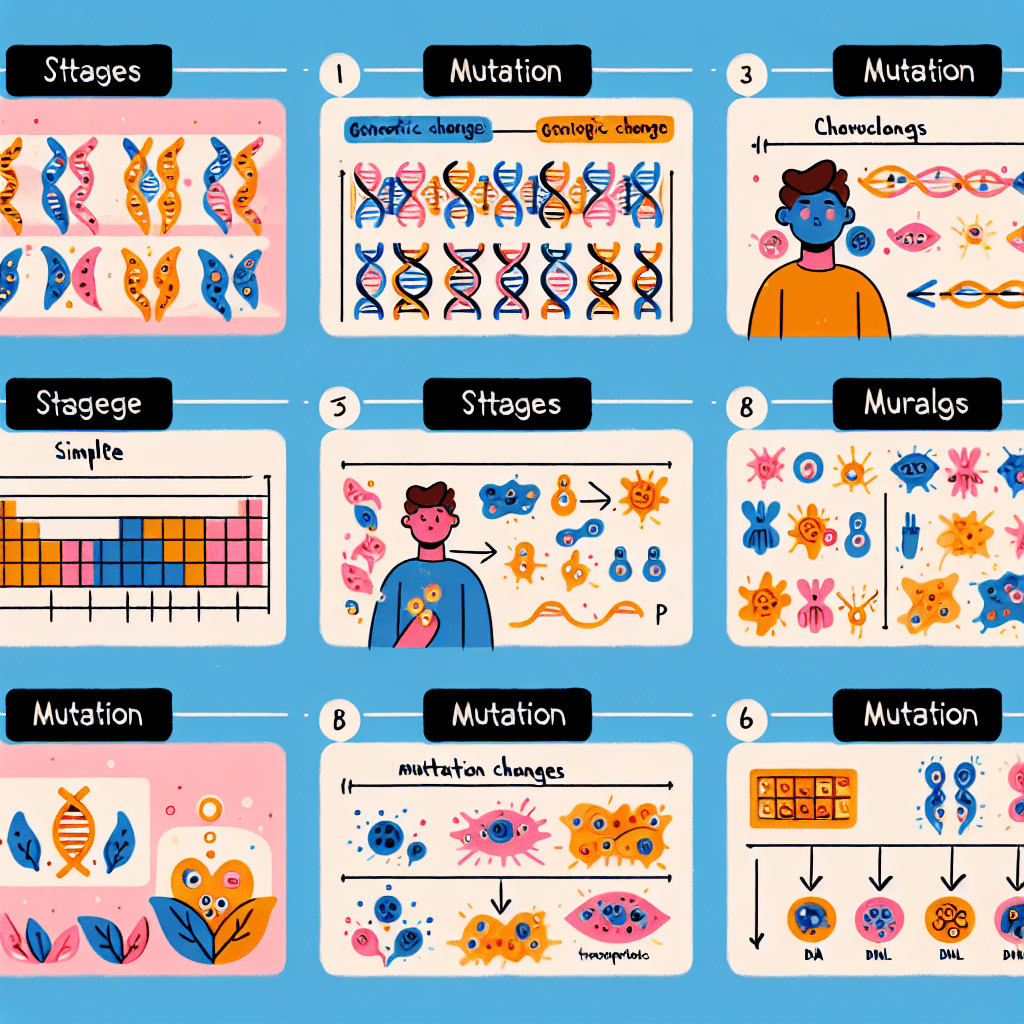
Mutation Marvels Storyboard: Visualizing Genetic Changes
Inquiry Framework
Question Framework
Driving Question
The overarching question that guides the entire project.How can we creatively represent the diverse impacts and mechanisms of genetic mutations on organisms and their evolutionary paths?Essential Questions
Supporting questions that break down major concepts.- What are genetic mutations and how do they occur?
- How do genetic mutations impact living organisms?
- What are the different types of genetic mutations and how do they differ?
- How can genetic mutations be both beneficial and harmful
- How are genetic mutations linked to evolution and adaptation in species?
Standards & Learning Goals
Learning Goals
By the end of this project, students will be able to:- Understand the mechanisms and types of genetic mutations.
- Analyze the impacts of genetic mutations on organisms.
- Differentiate between beneficial and harmful mutations.
- Explore the relationship between genetic mutations and evolutionary processes.
- Develop skills in creative expression and visualization through storyboard creation.
Next Generation Science Standards (NGSS)
Common Core State Standards for English Language Arts & Literacy
Entry Events
Events that will be used to introduce the project to studentsMutation In The New Age: Debating The Ethics Of Genetic Engineering
Start with a provocative debate on the modern implications of genetic mutations and engineering, using current events and innovations, such as CRISPR, as a backdrop. Encourage students to delve into the ethical ramifications, driving them towards a deeper understanding of how real genetic mutations influence current and future scientific discussions.Interactive Genetic Mutation Escape Room
Transform the classroom into an escape room where students must solve mutation-related puzzles and challenges to 'escape.' Each station focuses on different types of mutations and their consequences, requiring students to apply theoretical knowledge to practical problems, thereby blending fun with education.Portfolio Activities
Portfolio Activities
These activities progressively build towards your learning goals, with each submission contributing to the student's final portfolio.Mutation Media Presentation
Students delve deeper into a specific genetic mutation, creating a multimedia presentation that details its mechanism, impacts on organisms, and potential evolutionary benefits or hazards.Steps
Here is some basic scaffolding to help students complete the activity.Final Product
What students will submit as the final product of the activityA multimedia presentation that highlights a specific genetic mutation, covering its mechanism and impacts.Alignment
How this activity aligns with the learning objectives & standardsSupports HS-LS3-2 and CCSS.ELA-LITERACY.W.11-12.7 through research and presentation of a genetic mutation's causes and effects.Rubric & Reflection
Portfolio Rubric
Grading criteria for assessing the overall project portfolioGenetic Mutation Storyboard Rubric
Understanding of Genetic Concepts
Measures understanding of genetic mutations, including types, mechanisms, and impacts on organisms.Mechanism Explanation
Evaluates the ability to explain the mechanisms of the selected mutation.
Exemplary
4 PointsProvides a comprehensive explanation of the mutation mechanism, using precise scientific vocabulary and clear, accurate examples.
Proficient
3 PointsExplains the mutation mechanism accurately with appropriate scientific vocabulary and relevant examples.
Developing
2 PointsProvides a basic explanation of the mutation mechanism, with some inaccuracies or lack of specific examples.
Beginning
1 PointsStruggles to explain the mutation mechanism, with several inaccuracies or missing examples.
Impact Analysis
Assesses the ability to analyze the impacts of mutations on organisms.
Exemplary
4 PointsInsightfully analyzes the impacts of the mutation with detailed examples of both beneficial and detrimental effects, supported by reliable sources.
Proficient
3 PointsAccurately analyzes the impacts with examples of beneficial and detrimental effects, mostly supported by solid sources.
Developing
2 PointsOffers basic analysis of impacts with limited examples or incomplete use of sources.
Beginning
1 PointsProvides an incomplete or inaccurate analysis of impacts, with few if any examples.
Research and Evidence
Evaluates research thoroughness and the ability to integrate and cite evidence from various sources.Research Depth
Examines the breadth and depth of research conducted on the chosen mutation.
Exemplary
4 PointsConducts extensive and thorough research, integrating multiple high-quality sources with exceptional depth and insight.
Proficient
3 PointsConducts thorough research with multiple sources integrated effectively and independently.
Developing
2 PointsEngages with basic research using limited sources with minimal integration.
Beginning
1 PointsEngages in minimal research with poorly integrated or inappropriate sources.
Evidence Use
Assesses the ability to use and cite evidence to support claims and analysis.
Exemplary
4 PointsUses evidence expertly to support claims with precise citation of diverse sources, enhancing the analysis significantly.
Proficient
3 PointsUses evidence appropriately to support most claims, with adequate citation and integration of sources.
Developing
2 PointsUses evidence to support some claims, with inconsistent citation or weak integration.
Beginning
1 PointsRarely uses evidence to support claims or fails to properly cite sources.
Creative Presentation and Communication
Evaluates the effectiveness of the multimedia presentation in clearly communicating ideas, using creative elements.Presentation Clarity
Measures the clarity and organization of the multimedia presentation.
Exemplary
4 PointsPresentation is highly clear and logically organized, engaging the audience with advanced multimedia elements.
Proficient
3 PointsPresentation is clear and well-organized with effective use of multimedia to enhance understanding.
Developing
2 PointsPresentation lacks clarity in some parts with few multimedia elements that support understanding.
Beginning
1 PointsPresentation is unclear and disorganized, with minimal or ineffective multimedia use.
Creative Elements
Assesses creativity and originality in the presentation of the genetic mutation.
Exemplary
4 PointsExhibits exceptional creativity and originality, displaying innovative approaches that vividly depict genetic mutations.
Proficient
3 PointsDisplays creativity and originality effectively, using engaging methods to convey genetic mutations.
Developing
2 PointsContains some creative elements, but lacks full originality or engagement in depicting mutations.
Beginning
1 PointsLacks creativity and originality, with minimal impact in presentation.