
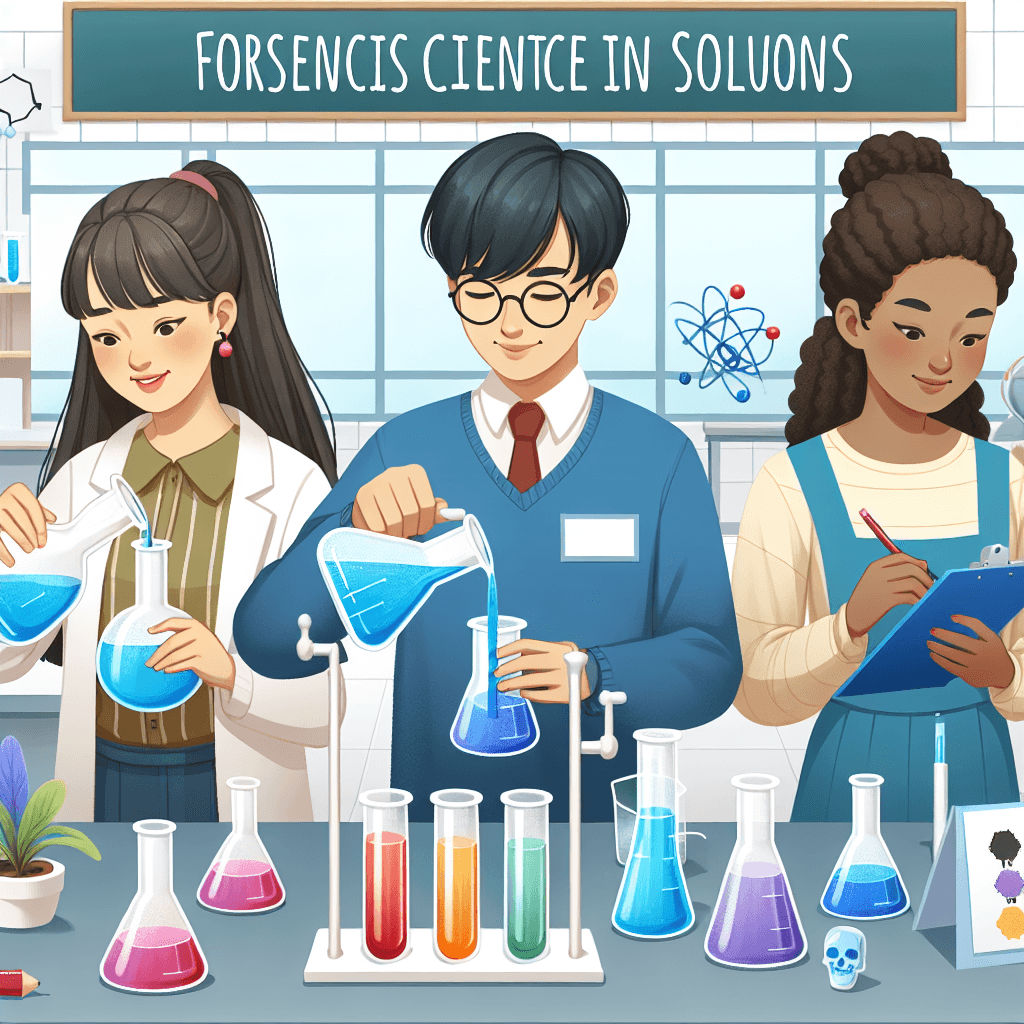
Mystery Mixtures: Forensic Science in Solutions
Inquiry Framework
Question Framework
Driving Question
The overarching question that guides the entire project.Can we solve the mystery of an unknown substance by analyzing its solution properties?Essential Questions
Supporting questions that break down major concepts.- How do we know a mixture is a solution?
- What properties can be used to identify unknown substances?
- How does water's structure make it a good solvent?
- How can we separate the components of a solution?
- How do the properties of a solution change with different solutes?
Standards & Learning Goals
Learning Goals
By the end of this project, students will be able to:- Students will be able to define solutions and their components (solute, solvent).
- Students will be able to classify solutions based on the state of matter of their components.
- Students will be able to explain the process of solution formation, with emphasis on water as a universal solvent.
- Students will be able to distinguish between different types of solutions based on their properties.
Next Generation Science Standards
Entry Events
Events that will be used to introduce the project to studentsThe Great Soda Showdown
A local soda company claims their new drink is superior to all others. Students conduct experiments to analyze the solution properties of various sodas and determine which one is truly the 'best' based on scientific evidence.Portfolio Activities
Portfolio Activities
These activities progressively build towards your learning goals, with each submission contributing to the student's final portfolio.Solution Sleuths: Defining Solutions
Students will begin their journey by defining key terms related to solutions and identifying the components of various mixtures.Steps
Here is some basic scaffolding to help students complete the activity.Final Product
What students will submit as the final product of the activityA detailed infographic or diagram defining solutions, solutes, and solvents, with real-world examples.Alignment
How this activity aligns with the learning objectives & standardsAddresses the learning goal: Students will be able to define solutions and their components (solute, solvent).Rubric & Reflection
Portfolio Rubric
Grading criteria for assessing the overall project portfolioSolution Sleuths Portfolio Assessment Rubric
Understanding of Solution Concepts
Assessment of students' grasp of the terms 'solution', 'solute', and 'solvent' as well as identification of these in common mixtures.Definition Accuracy
Evaluates the accuracy and clarity of students' definitions for 'solution', 'solute', and 'solvent'.
Exemplary
4 PointsProvides precise and clear definitions of 'solution', 'solute', and 'solvent', including comprehensive real-world examples.
Proficient
3 PointsProvides accurate definitions of 'solution', 'solute', and 'solvent', including relevant real-world examples.
Developing
2 PointsProvides basic definitions of 'solution', 'solute', and 'solvent' with limited real-world examples.
Beginning
1 PointsProvides incomplete or incorrect definitions of 'solution', 'solute', and 'solvent', with minimal or irrelevant examples.
Component Identification
Ability to correctly identify solute and solvent in a variety of solutions including saltwater, sugar water, and air.
Exemplary
4 PointsCorrectly identifies solute and solvent in all provided examples and explains the rationale.
Proficient
3 PointsCorrectly identifies solute and solvent in most examples with adequate explanation.
Developing
2 PointsCorrectly identifies solute and solvent in some examples with limited explanation.
Beginning
1 PointsStruggles to identify solute and solvent correctly with minimal explanation.
Visual Representation Skills
Evaluation of the quality and effectiveness of visual diagrams or infographics created by students to illustrate solutions.Clarity and Organization
Focuses on the clarity and logical organization of the visual representation illustrating solutions, solutes, and solvents.
Exemplary
4 PointsVisual is exceptionally clear, well-organized, and effectively communicates core concepts with enhanced details.
Proficient
3 PointsVisual is clear and well-organized, effectively communicating the core concepts.
Developing
2 PointsVisual is somewhat clear and organized, but may have some elements that are confusing.
Beginning
1 PointsVisual lacks clarity and organization, leading to confusion about the concepts.
Integration of Real-World Examples
Assessment of students' ability to integrate real-world examples within their visual representation.
Exemplary
4 PointsEffectively integrates multiple relevant real-world examples that enhance understanding of the solution concepts.
Proficient
3 PointsIntegrates relevant real-world examples that support understanding of the solution concepts.
Developing
2 PointsIncludes limited real-world examples with partial relevance to the solution concepts.
Beginning
1 PointsFails to integrate or inaccurately applies real-world examples, lacking relevance to solution concepts.