
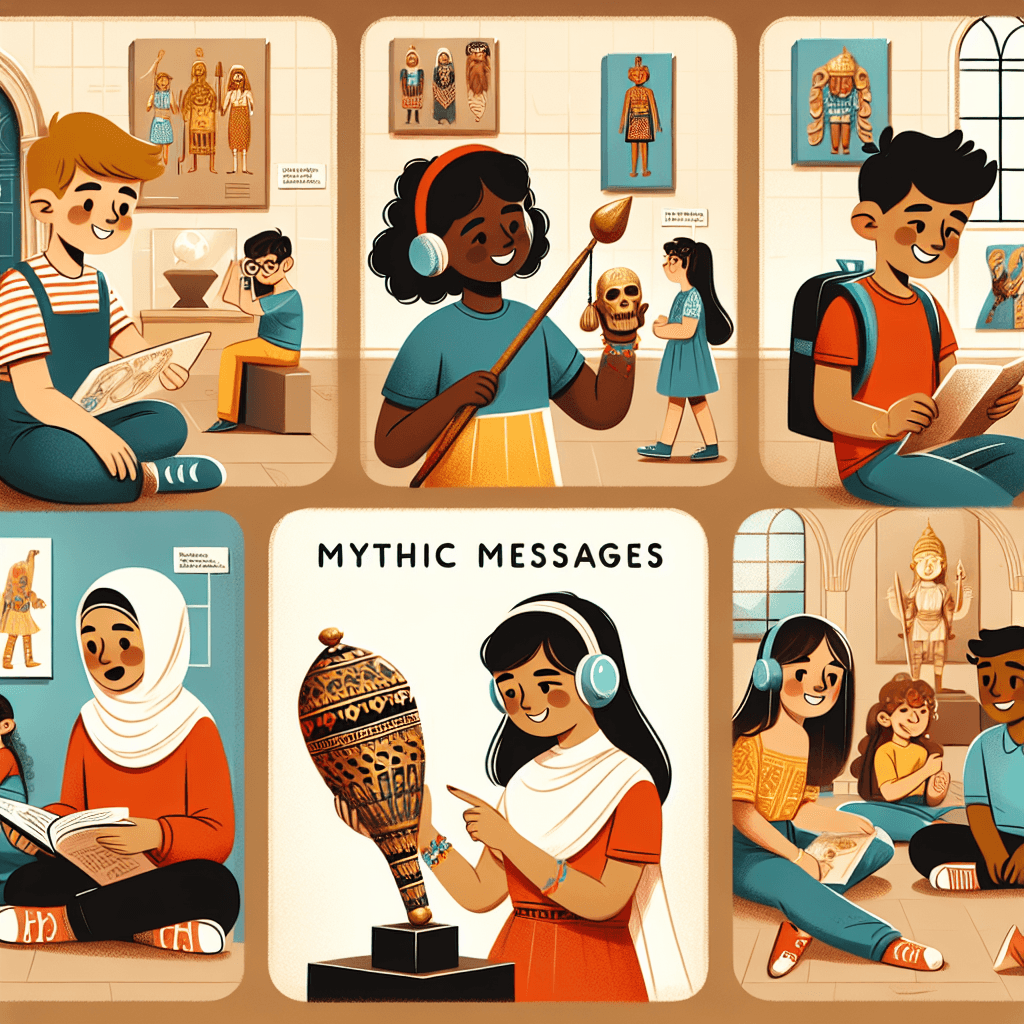
Mythic Messages: A Cultural Empathy Museum
Inquiry Framework
Question Framework
Driving Question
The overarching question that guides the entire project.How can we, as museum curators, design interactive exhibits that use world myths to help our community discover common life lessons and feel empathy for people around the world?Essential Questions
Supporting questions that break down major concepts.- How do myths from different cultures teach us lessons that are still important today?
- How can we use key details from a story to discover its central message or moral?
- How do storytellers use characters and events to make a reader feel empathy?
- How can we transform a written story into an interactive experience that teaches others a lesson?
- What do myths from around the world tell us about what all humans have in common?
Standards & Learning Goals
Learning Goals
By the end of this project, students will be able to:- Students will be able to recount myths from diverse cultures and determine the central message, lesson, or moral by citing specific key details from the text.
- Students will describe how characters' traits, feelings, and actions within myths contribute to the central message and evoke empathy in the audience.
- Students will synthesize their understanding of a myth to design an interactive museum exhibit that effectively communicates a universal life lesson.
- Students will compare and contrast myths from different cultures to identify common human themes and values, fostering a global perspective.
- Students will write clear, informative museum placards and deliver oral presentations that explain the significance of their myth and exhibit to museum visitors.
Common Core State Standards (ELA)
Entry Events
Events that will be used to introduce the project to studentsThe Curator’s Locked Trunk
A weathered, travel-worn trunk arrives in the classroom labeled 'Property of the Global Heritage Agency: Fragile.' Inside, students find strange, tactile artifacts—a golden feather, a jar of black volcanic sand, and a hand-carved wooden mask—but the 'Field Guide' explaining their cultural meanings and stories is missing, requiring the students to become investigators.Portfolio Activities
Portfolio Activities
These activities progressively build towards your learning goals, with each submission contributing to the student's final portfolio.The Myth Investigator's Dossier
Before curators can build an exhibit, they must master the story. In this activity, students select a myth from a diverse collection and use a 'Detective Dossier' to map out the narrative structure. They will focus on identifying the specific culture of origin and recounting the beginning, middle, and end of the story using key details.Steps
Here is some basic scaffolding to help students complete the activity.Final Product
What students will submit as the final product of the activityA 'Myth Investigator’s Dossier' featuring a story map and a 5-sentence summary of the myth.Alignment
How this activity aligns with the learning objectives & standardsThis activity directly aligns with the 'Recount stories' portion of CCSS.ELA-LITERACY.RL.3.2. By breaking the myth into a sequence of events and identifying specific details, students build the foundational understanding needed to later determine the central message.Heart of the Hero: An Empathy Map
To help museum visitors feel empathy, students must first step into the shoes of the characters. Students will create an 'Empathy Map' for the protagonist of their myth, analyzing their traits, their internal feelings, and the external challenges they face. This helps students see how the character's choices lead directly to the story's lesson.Steps
Here is some basic scaffolding to help students complete the activity.Final Product
What students will submit as the final product of the activityA visual 'Empathy Map' of the character, decorated with symbols representing their traits and a short 'In Their Shoes' reflection paragraph.Alignment
How this activity aligns with the learning objectives & standardsThis activity aligns with CCSS.ELA-LITERACY.RL.3.3, which requires students to describe characters and explain how their actions contribute to the sequence of events. Understanding character motivations is a prerequisite for understanding the 'moral' of a story (RL.3.2).Decoding the Moral Mosaic
In this activity, students connect the dots between the story's events and its big idea. They will identify the central message or moral of their myth and then meet with a 'Curator Partner' who studied a myth from a different culture to see if their stories share a 'Universal Thread'—a common human value like honesty, courage, or respect for nature.Steps
Here is some basic scaffolding to help students complete the activity.Final Product
What students will submit as the final product of the activityA 'Moral Mosaic' poster that states the myth's central message and includes a 'Universal Thread' comparison note.Alignment
How this activity aligns with the learning objectives & standardsThis activity is the core of CCSS.ELA-LITERACY.RL.3.2 (Determining the central message/lesson/moral) and RL.3.9 (Comparing themes across cultures). It requires students to move from plot details to abstract lessons.The Curator’s Guidebook & Placards
Now, students transition from investigators to designers. They will write the official museum placards that will accompany their interactive exhibit. These placards must explain the myth, its cultural origin, and the central message in a way that is clear and engaging for museum visitors.Steps
Here is some basic scaffolding to help students complete the activity.Final Product
What students will submit as the final product of the activityA professionally formatted 'Curator's Museum Placard' and a sketch of the proposed interactive exhibit element.Alignment
How this activity aligns with the learning objectives & standardsThis activity aligns with CCSS.ELA-LITERACY.W.3.2 (Write informative/explanatory texts). Students must synthesize their literary analysis into a clear, informative format for an audience.The Grand Cultural Premiere
The project culminates in the opening of the Cultural Empathy Museum. Students set up their interactive exhibits (which could include dioramas, 'choose your own adventure' boards, or tactile artifacts). They act as docents, guiding visitors through their exhibit and explaining how the myth’s message applies to our lives today.Steps
Here is some basic scaffolding to help students complete the activity.Final Product
What students will submit as the final product of the activityA live 'Museum Exhibit Experience' and an oral presentation delivered to peers and community guests.Alignment
How this activity aligns with the learning objectives & standardsThis activity fulfills CCSS.ELA-LITERACY.SL.3.4 (Report on a topic or text with appropriate facts and descriptive details). It also serves as the final summative assessment for RL.3.2 as students must orally explain the central message.Rubric & Reflection
Portfolio Rubric
Grading criteria for assessing the overall project portfolioCultural Empathy Museum: World Myths Portfolio Rubric
Mythological Analysis
Focuses on the student's ability to master the narrative structure and sequence of the chosen myth.Narrative Recounting & Structure
Ability to recount the myth with accuracy, maintaining chronological order and identifying key detail clues that support the plot.
Exemplary
4 PointsThe student recounts the myth with exceptional detail and perfect chronological order. Key detail clues are sophisticated and clearly show the story's progression and cultural context.
Proficient
3 PointsThe student recounts the myth accurately with a clear beginning, middle, and end. Three key detail clues are identified and related to the plot.
Developing
2 PointsThe student recounts the story but may miss minor events or struggle with chronological order. Key detail clues are present but may not be the most significant moments.
Beginning
1 PointsThe student provides an incomplete or confusing recount of the myth. Key details are missing or do not relate to the story's main events.
Thematic Understanding
Assesses the student's ability to move from plot details to abstract lessons and cross-cultural comparisons.Central Message & Universal Themes
The ability to determine the central lesson or moral of a myth and explain how it is supported by textual evidence and shared across cultures.
Exemplary
4 PointsProvides a profound central message statement supported by multiple pieces of specific evidence. Seamlessly identifies 'Universal Threads' that connect the lesson to other cultures.
Proficient
3 PointsDetermines a clear central message or moral and supports it with two pieces of evidence from the text. Identifies a logical similarity with a peer's myth.
Developing
2 PointsIdentifies a basic lesson or moral but the connection to text evidence is weak. Attempts to find a 'Universal Thread' but the comparison is surface-level.
Beginning
1 PointsStruggles to identify a central message or provides a lesson that is not supported by the story events. No cultural comparison is attempted.
Empathetic Perspective
Evaluates the student's insight into character development and their ability to empathize with different perspectives.Character Analysis & Empathy
The ability to analyze character traits and motivations to understand how their journey evokes empathy and drives the story's lesson.
Exemplary
4 PointsDeeply analyzes internal and external traits, providing a nuanced 'In Their Shoes' reflection that demonstrates significant empathy and understanding of the character's growth.
Proficient
3 PointsIdentifies 3 internal and 3 external traits. Explains how the character's actions changed the outcome and completes a clear 'In Their Shoes' reflection.
Developing
2 PointsIdentifies basic traits (mostly external) and describes the character's feelings but may not clearly link actions to the story's outcome.
Beginning
1 PointsLists very few traits and struggles to describe how the character felt. The reflection lacks a connection to the character's experience.
Curatorial Communication
Assesses the student's ability to synthesize information and communicate it effectively to a public audience.Expository Writing & Exhibit Design
Writing clear, informative placards that explain the myth's origin and message while engaging an audience with interactive instructions.
Exemplary
4 PointsPlacards are professionally formatted and exceptionally clear. Writing is highly engaging, using 'Empathy Power' to draw the reader in, with no grammatical errors.
Proficient
3 PointsWrites a clear placard that introduces the myth, explains the message, and provides simple interactive instructions. Tone is appropriate and informative.
Developing
2 PointsThe placard contains the necessary information but may be disorganized or lack clarity. Instructions for visitors are vague or difficult to follow.
Beginning
1 PointsThe placard is missing key sections (like the cultural origin or central message) and contains significant errors that hinder understanding.
Summative Presentation
Evaluates the student's public speaking skills and the effectiveness of their interactive exhibit component.Oral Presentation & Interactive Engagement
Presenting the final exhibit orally and through interactive elements, demonstrating knowledge of the myth and its global significance.
Exemplary
4 PointsDelivers a captivating presentation with excellent pace and eye contact. The interactive element is innovative and perfectly reinforces the central message of the myth.
Proficient
3 PointsReports on the myth and its lesson clearly at an understandable pace. The interactive element (diorama, wheel, etc.) functions well and supports the curator talk.
Developing
2 PointsPresentation is mostly clear but the student may rely heavily on notes. The interactive element is present but may not clearly link to the story's lesson.
Beginning
1 PointsPresentation is difficult to follow or too brief. The interactive element is missing, incomplete, or unrelated to the myth's message.