
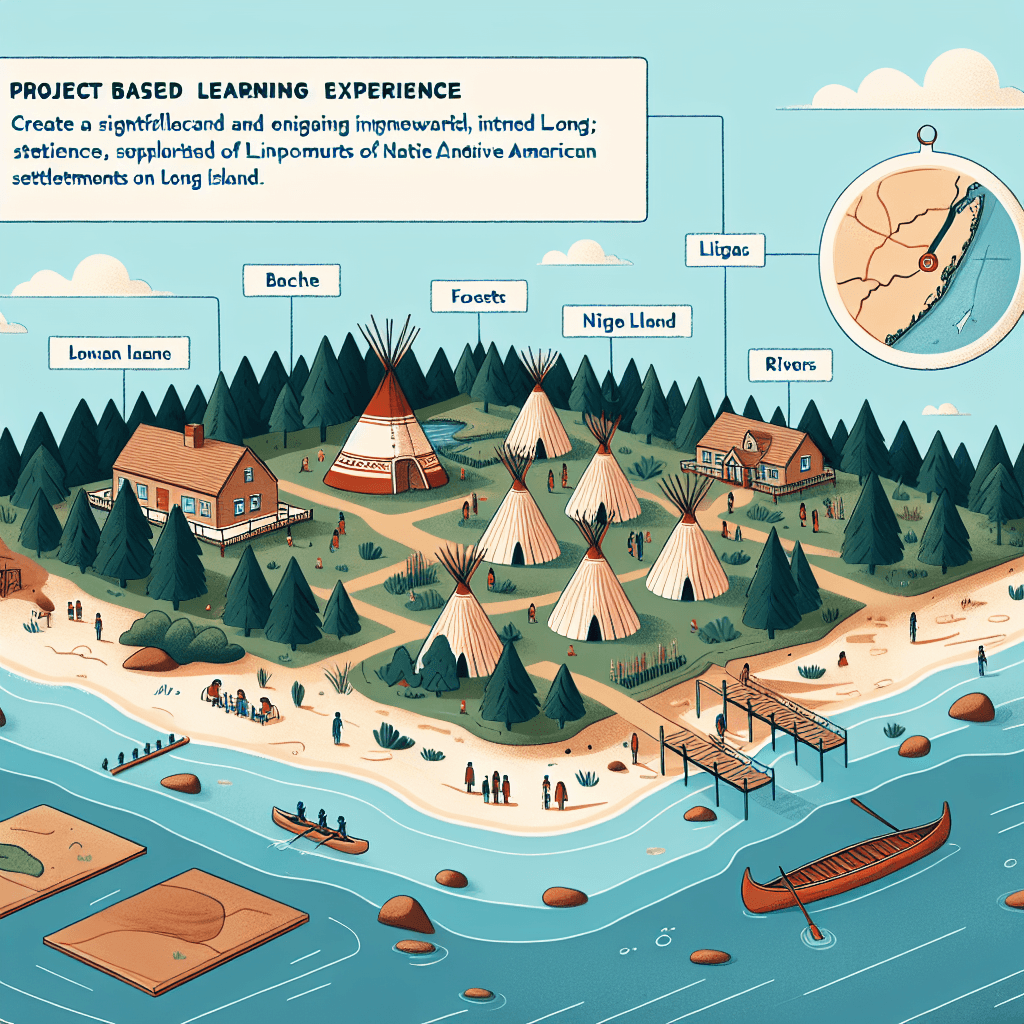
Native American Settlements on Long Island Exploration
Inquiry Framework
Question Framework
Driving Question
The overarching question that guides the entire project.How did Native American communities on Long Island adapt to their natural environment, and what factors influenced their settlement patterns and survival strategies?Essential Questions
Supporting questions that break down major concepts.- What does it mean to settle?
- How did the natural environment affect settlement patterns of Native American communities on Long Island?
- What factors contributed to the sustainability and resilience of the Native American settlements?
- How did spiritual beliefs and practices shape the daily lives and community organization?
- In what ways did the geographic and ecological context influence the lifestyles and survival strategies of Native American settlements?
- How can different disciplines such as archaeology, cultural history, and anthropology help us understand indigenous communities?
- How can mathematical and artistic skills be applied to study historical settlements?
- What roles did social structures play in supporting the survival of early indigenous communities?
- How do we integrate multiple types of evidence to better understand past human activities?
- How can we effectively communicate our research findings through writing and visual presentations?
Standards & Learning Goals
Learning Goals
By the end of this project, students will be able to:- Develop critical research skills by analyzing historical and archaeological information about Native American settlements on Long Island.
- Understand the complexity of indigenous cultures, focusing on social structures, spiritual beliefs, and survival strategies.
- Apply interdisciplinary approaches, including archaeology, cultural history, environmental science, anthropology, and artistic representation.
- Enhance visual and written communication skills through comprehensive research papers, visual presentations, and artistic models.
- Cultivate a deep respect for Native American historical experiences through direct engagement with their historical sites.
- Analyze the ecological context of Native American settlements to understand their adaptation and survival strategies.
- Demonstrate mathematical skills through creating scaled architectural drawings and calculating population densities.
- Reflect on challenges and insights gained from the interdisciplinary research process through maintaining a reflection journal.
Common Core Standards
NGSS
National Curriculum Standards for Social Studies
National Core Arts Standards
Entry Events
Events that will be used to introduce the project to studentsSurvival Challenges: Living off the Land
Students will engage in a hands-on survival challenge that replicates the resourcefulness required to thrive on Long Island centuries ago. Activities might include building a miniature shelter using natural materials, identifying native plants for food and medicine, and mastering traditional crafts, providing practical insights into Native American innovations and survival skills.Portfolio Activities
Portfolio Activities
These activities progressively build towards your learning goals, with each submission contributing to the student's final portfolio.Settlement Team-Builder
In this kick-off activity, students get into their research groups and explore an introductory scenario related to indigenous settlements. Each group receives a "mystery" about their assigned settlement that they must solve using basic prior knowledge and research skills.Steps
Here is some basic scaffolding to help students complete the activity.Final Product
What students will submit as the final product of the activityA brief presentation of initial findings with a research plan for further exploration.Alignment
How this activity aligns with the learning objectives & standardsThis activity aligns with standard 4.RI.7 by encouraging students to interpret visual and textual clues to form an initial understanding of their topic.Eco-Detective Field Trip
Students will visit local Native American settlement sites on Long Island, practicing archaeological field research techniques and taking detailed field notes.Steps
Here is some basic scaffolding to help students complete the activity.Final Product
What students will submit as the final product of the activityDetailed field notes and a report summarizing site observations and initial interpretations.Alignment
How this activity aligns with the learning objectives & standardsEngages students in standard 4.ESS3-1, helping them understand how Native Americans used environment-based resources and adapted to their landscapes.3D Visualization Task
Students will create 3D models of their assigned Native American settlement using clay or digital tools to represent the settlement's layout and structures.Steps
Here is some basic scaffolding to help students complete the activity.Final Product
What students will submit as the final product of the activity3D representation of Native American settlement structures, highlighting key settlement features.Alignment
How this activity aligns with the learning objectives & standardsAddresses standards 4.G.A.3 and 4.ART.VA.3 by focusing on symmetry in figures and artistic creation to understand cultural development.Cultural Connection Writing Workshop
A workshop focused on composing informative texts that explore the cultural and spiritual aspects of Native American settlements.Steps
Here is some basic scaffolding to help students complete the activity.Final Product
What students will submit as the final product of the activityAn informative essay on Native American spiritual and cultural practices related to their settlement on Long Island.Alignment
How this activity aligns with the learning objectives & standardsDevelops 4.W.2 standard by requiring students to write informative texts conveying clear ideas and complex cultural insights.Interactive Settlement Fair
Students finalize their projects and showcase their findings in a fair, where each group presents their research and visual models to the class and possibly to other students or parents.Steps
Here is some basic scaffolding to help students complete the activity.Final Product
What students will submit as the final product of the activityComprehensive and interactive presentations of their research findings, including visual models and reports.Alignment
How this activity aligns with the learning objectives & standardsAligns with 4.C.1 by connecting historical settlements to cultural development, fostering understanding through interactive presentations.Rubric & Reflection
Portfolio Rubric
Grading criteria for assessing the overall project portfolioNative American Settlement Project Rubric
Research Skills and Historical Analysis
Assessment of students' ability to research and analyze historical and archaeological information regarding Native American settlements.Depth of Research
Measures the thoroughness and depth of research conducted by students on their assigned Native American settlement.
Exemplary
4 PointsConducts thorough research with a utilization of diverse sources, providing detailed and nuanced understanding of the settlement.
Proficient
3 PointsConducts substantial research, using multiple sources effectively to provide a comprehensive understanding of the settlement.
Developing
2 PointsConducts basic research with a limited number of sources, resulting in a partially complete understanding of the settlement.
Beginning
1 PointsConducts minimal research with insufficient sources, leading to an incomplete understanding of the settlement.
Historical Contextualization
Assesses the ability to relate findings to the historical and cultural context of Native American settlements.
Exemplary
4 PointsProvides insightful connections between research findings and the broader historical and cultural context, showing a deep understanding of indigenous experiences.
Proficient
3 PointsMakes clear connections between research findings and historical context, demonstrating a solid understanding of indigenous experiences.
Developing
2 PointsIdentifies some connections between findings and context, demonstrating a basic understanding of indigenous experiences.
Beginning
1 PointsProvides minimal or unclear connections between findings and context, showing limited understanding of indigenous experiences.
Interdisciplinary Integration and Creativity
Evaluation of students' ability to integrate multiple disciplines and showcase creativity in representation of their findings.Interdisciplinary Approach
Measures how well students integrate concepts from various disciplines such as archaeology, environmental science, and art.
Exemplary
4 PointsSeamlessly integrates concepts from various disciplines, offering a comprehensive understanding of the settlement's complexity.
Proficient
3 PointsEffectively integrates relevant disciplinary concepts, contributing to a well-rounded understanding of the settlement.
Developing
2 PointsAttempts integration of some disciplinary concepts, though with limited effectiveness.
Beginning
1 PointsShows minimal integration of disciplinary concepts, resulting in a narrow understanding.
Creativity and Innovation
Assesses the creativity and originality in students' visual and written representations of Native American settlements.
Exemplary
4 PointsPresents highly original and innovative representations that captivate audience and effectively convey depth of research.
Proficient
3 PointsDemonstrates creative and thoughtful representations that clearly convey the research findings.
Developing
2 PointsDisplays conventional representations with some elements of creativity.
Beginning
1 PointsShows minimal creativity in representations, relying on basic or common approaches.
Communication and Collaboration
Assessment of students' communication skills in presenting their research findings, both written and oral, and their ability to collaborate effectively within groups.Written Communication
Evaluates the clarity, coherence, and effectiveness of students' written research papers and essays.
Exemplary
4 PointsProduces exceptionally clear and coherent writing that conveys complex ideas and insights effectively.
Proficient
3 PointsProduces clear and coherent writing that effectively conveys ideas and insights.
Developing
2 PointsProduces writing that conveys basic ideas with some clarity but lacks depth.
Beginning
1 PointsProduces unclear or fragmented writing that fails to convey ideas effectively.
Oral Presentation
Assesses how effectively students communicate their findings orally during presentations.
Exemplary
4 PointsDelivers engaging and articulate presentations with strong audience interaction and clarity.
Proficient
3 PointsDelivers clear and effective presentations with good audience engagement.
Developing
2 PointsDelivers presentations with some clarity but lacks confidence or engagement.
Beginning
1 PointsDelivers unclear presentations with minimal audience engagement.
Collaboration Skills
Measures the extent to which students work effectively in their groups, contributing to collective goals.
Exemplary
4 PointsExhibits outstanding collaboration, demonstrating leadership and consistent contributions to group efforts.
Proficient
3 PointsParticipates actively and consistently contributes to group efforts.
Developing
2 PointsContributes inconsistently to group efforts, occasionally requiring direction.
Beginning
1 PointsContributes minimally to group efforts, relies heavily on others to meet objectives.