
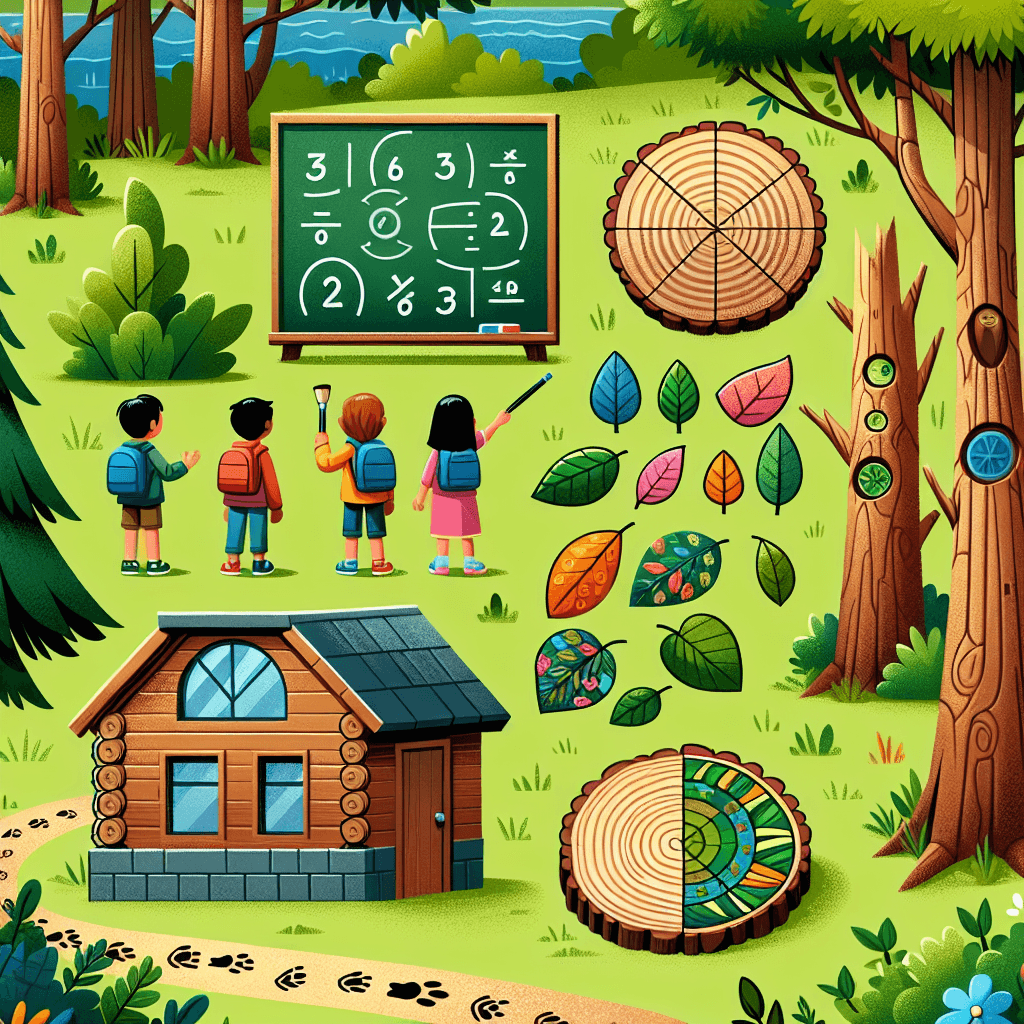
Nature's Fractions: Trail of Patterns
Inquiry Framework
Question Framework
Driving Question
The overarching question that guides the entire project.How can we create a nature trail that helps us discover and explain fractions in the world around us?Essential Questions
Supporting questions that break down major concepts.- What are fractions and how can we identify them in nature?
- How do fractions help us understand and describe the world around us?
- In what ways can fractions be represented visually and verbally?
Standards & Learning Goals
Learning Goals
By the end of this project, students will be able to:- Students will be able to identify fractions in natural objects and patterns during the nature trail activity.
- Students will create a visual representation of fractions as part of the nature trail, mapping them to a real-world context.
- Students will develop the ability to compare and explain different fractions by examining natural examples.
- Students will enhance their understanding of fractions as parts of a whole, using concrete examples from nature.
Common Core Standards
Entry Events
Events that will be used to introduce the project to studentsDesign a Nature Maze
Students are challenged to design a nature maze on paper where each path represents a different fraction, incorporating local flora. This pushes them to apply their understanding of fractions in creative and spatially relevant ways.Fraction Scavenger Hunt
Students explore a virtual or local nature trail to find and photograph natural items that exemplify fractions (like a leaf divided into sections). This immersive experience introduces the concept of fractions in a naturally engaging way.Nature Detective Mystery
A mystery is uncovered: a nature trail has been marked with unusual fractions that need decoding. Students become detectives, solving riddles and using fraction skills to reveal clues about the trail's history.Portfolio Activities
Portfolio Activities
These activities progressively build towards your learning goals, with each submission contributing to the student's final portfolio.Fraction Art Explorers
Students create artistic representations of fractions they see in nature, combining art and math to deepen their fraction understanding.Steps
Here is some basic scaffolding to help students complete the activity.Final Product
What students will submit as the final product of the activityA piece of art depicting fractions in nature, with labeled components.Alignment
How this activity aligns with the learning objectives & standardsAligns with 3.NF.A.1 by reinforcing the understanding of fractions as parts of a whole.Nature's Fraction Number Line
Students create a physical number line using a nature trail, placing fractions along the path to visualize their size and order.Steps
Here is some basic scaffolding to help students complete the activity.Final Product
What students will submit as the final product of the activityA nature trail number line, marked with fractions at various stops.Alignment
How this activity aligns with the learning objectives & standardsAligns with 3.NF.A.2 by representing fractions on a number line diagram.Fraction Compare Safari
In this activity, students will compare fractions found in nature and discuss their equivalence and relative size through observations and games.Steps
Here is some basic scaffolding to help students complete the activity.Final Product
What students will submit as the final product of the activityA collection of fraction examples arranged to show equivalence and order.Alignment
How this activity aligns with the learning objectives & standardsAligns with 3.NF.A.3 by explaining equivalence of fractions and comparing by size.Rubric & Reflection
Portfolio Rubric
Grading criteria for assessing the overall project portfolioNature's Fractions Mastery Rubric
Fraction Identification and Explanation
Assess students' ability to identify fractions in natural patterns and objects and explain their understanding of fractions as parts of a whole.Identification of Fractions
Evaluates the student’s ability to accurately identify fractions during nature activities and explain them effectively.
Exemplary
4 PointsAccurately identifies and explains multiple fractions in a variety of natural objects with comprehensive reasoning and clear examples. Exhibits a deep understanding of fractions as parts of a whole.
Proficient
3 PointsAccurately identifies and explains fractions in natural objects with clear reasoning. Shows a good understanding of fractions as parts of a whole.
Developing
2 PointsIdentifies some fractions in natural objects but with inconsistent or unclear reasoning. Shows a basic understanding of fractions.
Beginning
1 PointsStruggles to identify fractions in natural objects and provide clear explanations. Shows limited understanding of fractions.
Explanation of Fraction Representations
Measures the student's ability to explain the use of fractions to represent natural patterns artistically and spatially.
Exemplary
4 PointsProvides a thorough and creative explanation of fractions in natural representations, demonstrating excellent artistic and spatial reasoning.
Proficient
3 PointsProvides a clear explanation of fractions in natural representations, demonstrating effective artistic and spatial reasoning.
Developing
2 PointsProvides an explanation with some clarity but with gaps in artistic or spatial reasoning.
Beginning
1 PointsProvides little to no explanation of fractions in representations. Demonstrates limited reasoning skills.
Fraction Representation and Application
Evaluates how well students can represent fractions visually and spatially using natural objects and number line concepts.Artistic Representation of Fractions
Assesses the student's ability to creatively and accurately depict fractions artistically through their chosen medium.
Exemplary
4 PointsCreates an outstanding artistic representation displaying excellent accuracy and creativity in depicting fractions.
Proficient
3 PointsCreates a clear and accurate artistic representation depicting fractions.
Developing
2 PointsCreates an artistic representation with some inaccuracies in depicting fractions.
Beginning
1 PointsCreates an incomplete or inaccurate artistic representation of fractions.
Creation of Nature Trail Number Line
Evaluates the student’s ability to create and utilize a number line through a nature trail for fraction placement and order.
Exemplary
4 PointsDesigns a comprehensive and well-organized nature trail number line, accurately placing and explaining fractions in order.
Proficient
3 PointsCreates a clear and organized nature trail number line, accurately placing fractions in order.
Developing
2 PointsCreates a number line with some organizational issues or misplacements of fractions.
Beginning
1 PointsAttempts to create a number line but struggles with organization and accuracy.
Fraction Comparison and Equivalence
Focuses on the student’s ability to compare fractions and recognize equivalences within a natural context.Comparison of Collected Fractions
Assesses the student’s ability to effectively compare and order fractions found during activities.
Exemplary
4 PointsCorrectly compares and orders fractions with a comprehensive explanation of their equivalences and differences.
Proficient
3 PointsCorrectly compares and orders fractions with clear explanations of most equivalences and differences.
Developing
2 PointsCompares and orders fractions with some difficulty providing clear explanations.
Beginning
1 PointsStruggles to compare and order fractions, providing unclear or incomplete explanations.