
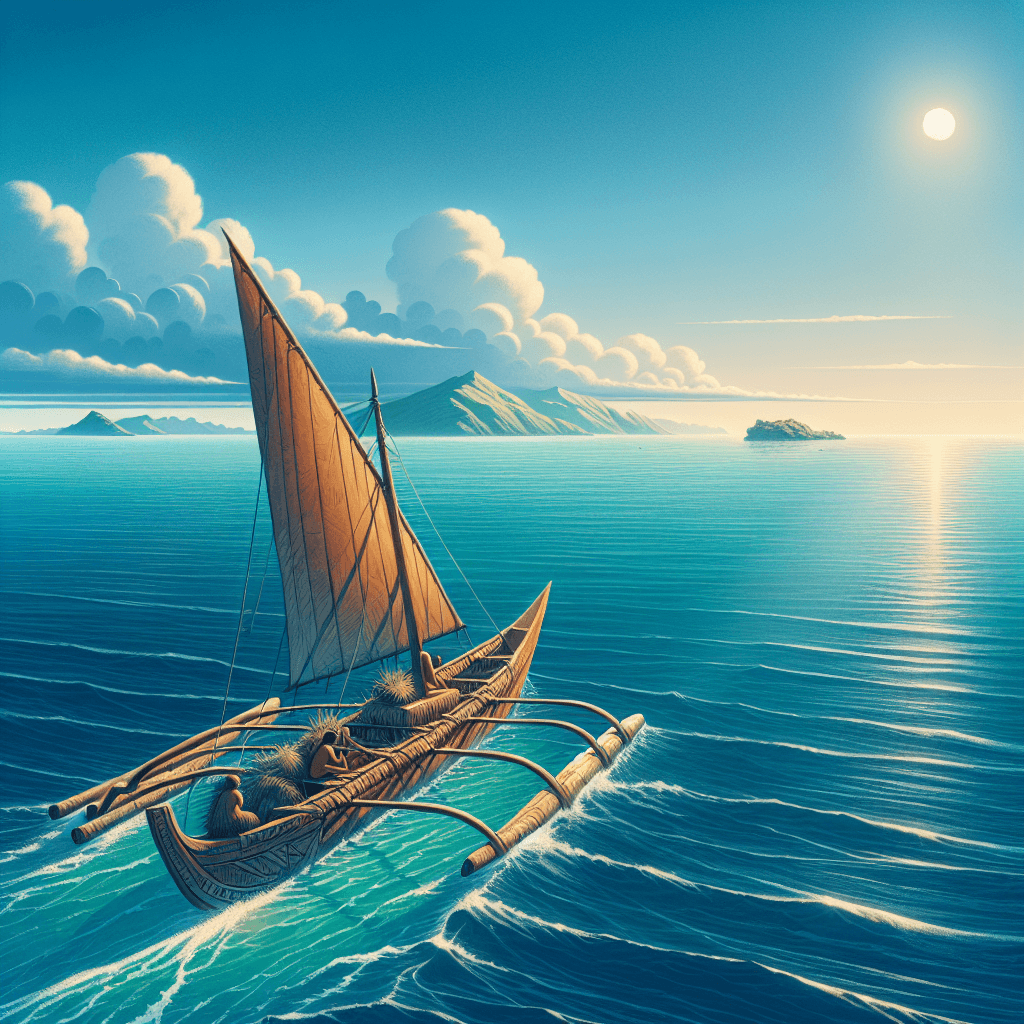
Navigating the Pacific: Polynesian Voyaging
Inquiry Framework
Question Framework
Driving Question
The overarching question that guides the entire project.How did Polynesian navigators successfully explore and settle the vast Pacific Ocean, and what were the lasting impacts of their voyages on the environment, diverse societies, and the cultural landscape of Oceania?Essential Questions
Supporting questions that break down major concepts.- How did Polynesian explorers navigate the vast Pacific Ocean?
- What were the motivations behind Polynesian exploration and expansion?
- What impact did Polynesian exploration have on the environment and societies they encountered?
- How do primary and secondary sources help us understand Polynesian voyages and their significance?
- What role did Polynesian navigation and exploration play in shaping the cultural, political, and social landscape of the Pacific?
- What were the key social, religious, and cultural features of Polynesian societies?
- What significant challenges did Polynesian explorers face?
- What can we learn from the experiences of both the explorers and the indigenous populations they encountered?
- How do different historical interpretations shed light on Polynesian exploration?
Standards & Learning Goals
Learning Goals
By the end of this project, students will be able to:- Understand the navigation techniques used by Polynesian explorers to traverse the vast Pacific Ocean.
- Analyze the motivations behind Polynesian exploration and the impacts on the environment and societies encountered.
- Examine the social, religious, and cultural features of Polynesian societies and how exploration influenced these aspects.
- Evaluate the challenges faced by Polynesian explorers and the solutions they employed.
- Utilize primary and secondary sources to construct well-supported historical arguments about Polynesian voyages.
- Interpret diverse historical perspectives and explain their significance in understanding Polynesian exploration.
- Develop insightful historical questions to guide inquiry into Polynesian exploration and its effects.
Australian Curriculum: History
Entry Events
Events that will be used to introduce the project to studentsStar Navigation Challenge
Imagine you are adrift in the vast Pacific with only the stars and currents to guide you. Build a basic navigation tool using everyday materials and attempt to chart a course to a nearby island.Myth & Legend Decipher
Uncover a forgotten story. Research and translate a traditional Polynesian myth or legend, exploring its connections to navigation, societal values, or historical events.Archaeological Dig
You're an archaeologist uncovering an ancient Polynesian settlement. Analyze artifacts (pictures, replicas, descriptions) to piece together clues about daily life, social structure, and the society's interactions with the environment.Exploration Impact Debate
Debate the impacts of Polynesian exploration. Form teams to argue the positive and negative consequences of this era for different groups involved, considering social, environmental, and cultural factors.Museum Exhibit Creation
Design an interactive museum exhibit showcasing a key aspect of Polynesian exploration. This could focus on navigation technology, cultural exchange, or the environmental impact of voyages.Portfolio Activities
Portfolio Activities
These activities progressively build towards your learning goals, with each submission contributing to the student's final portfolio.Polynesian Society Investigator
Students will investigate the social, religious, cultural, and environmental features of Polynesian societies before embarking on voyages.Steps
Here is some basic scaffolding to help students complete the activity.Final Product
What students will submit as the final product of the activityA research report detailing the key features of Polynesian societies, including their social structures, religious beliefs, cultural practices, and interactions with their environment.Alignment
How this activity aligns with the learning objectives & standardsAC9HH8K12, AC9HH8S01, AC9HH8S08Voyage Motivations & Challenges
Students will explore the motivations behind Polynesian exploration and the challenges faced during these voyages, using both primary and secondary sources.Steps
Here is some basic scaffolding to help students complete the activity.Final Product
What students will submit as the final product of the activityA presentation that explains the reasons for Polynesian exploration and the significant challenges encountered during their voyages.Alignment
How this activity aligns with the learning objectives & standardsAC9HH8K13, AC9HH8S02, AC9HH8S03Exploration Impact Analysis
Students will analyze the impact of Polynesian exploration on the environment and the societies they encountered, evaluating different perspectives.Steps
Here is some basic scaffolding to help students complete the activity.Final Product
What students will submit as the final product of the activityA comparative analysis essay examining the impacts of Polynesian exploration from multiple perspectives, including explorers and indigenous populations.Alignment
How this activity aligns with the learning objectives & standardsAC9HH8K14, AC9HH8S04, AC9HH8S06Polynesian Explorer Profile
Students will research the role and achievements of significant individuals and groups in Polynesian exploration and analyze historical interpretations.Steps
Here is some basic scaffolding to help students complete the activity.Final Product
What students will submit as the final product of the activityA multimedia presentation profiling a significant individual or group involved in Polynesian exploration. This presentation should include an analysis of different historical interpretations of their achievements.Alignment
How this activity aligns with the learning objectives & standardsAC9HH8K15, AC9HH8S07, AC9HH8K16Rubric & Reflection
Portfolio Rubric
Grading criteria for assessing the overall project portfolioPolynesian Exploration Portfolio Assessment Rubric
Historical Understanding and Knowledge
Assesses the student's understanding of Polynesian societies, exploration motivations, environmental and societal impacts, and significant individuals or groups.Understanding of Social Structures and Cultural Practices
Evaluates understanding of Polynesian social structures, cultural, religious practices, and how these are influenced by exploration.
Exemplary
4 PointsDemonstrates advanced understanding of Polynesian social and cultural structures with insightful connections to exploration influences.
Proficient
3 PointsShows thorough understanding of Polynesian social and cultural structures with appropriate connections to exploration influences.
Developing
2 PointsShows basic understanding of Polynesian social and cultural structures with limited connections to exploration influences.
Beginning
1 PointsLimited understanding of Polynesian social and cultural structures with few or no connections to exploration influences.
Analysis of Exploration Motivations and Challenges
Assesses ability to analyze the motivations driving Polynesian exploration and the challenges faced during their voyages.
Exemplary
4 PointsProvides a detailed analysis of motivations and challenges with clear evidence from diverse sources.
Proficient
3 PointsProvides an accurate analysis of motivations and challenges with supporting evidence from a range of sources.
Developing
2 PointsGives a basic analysis of motivations and challenges with limited supporting evidence.
Beginning
1 PointsLimited or inaccurate analysis with little to no supporting evidence.
Environmental and Societal Impact Assessment
Evaluates the student's ability to assess the environmental and societal impacts of Polynesian exploration using primary and secondary sources.
Exemplary
4 PointsEffectively assesses impacts using a wide range of evidence, demonstrating comprehensive insight into the effects on both environment and societies.
Proficient
3 PointsAccurately assesses impacts with clear use of evidence, showing good understanding of effects.
Developing
2 PointsProvides a basic assessment of impacts with limited or inconsistent use of evidence.
Beginning
1 PointsLimited assessment with minimal or no supportive evidence.
Role and Achievements of Significant Individuals or Groups
Examines understanding of contributions made by key Polynesian figures or groups and different historical interpretations.
Exemplary
4 PointsComplete understanding of individual or group contributions, supported with diverse evidence and multiple historical interpretations.
Proficient
3 PointsThorough understanding of contributions with evidence and some historical interpretation.
Developing
2 PointsBasic understanding of individual or group contributions, with limited historical interpretations.
Beginning
1 PointsLimited understanding with minimal engagement with historical interpretations.
Research and Source Analysis
Focuses on the student's ability to effectively use and analyze primary and secondary sources to draw conclusions and support historical inquiry.Source Evaluation and Interpretation
Evaluates ability to identify, interpret, and assess the relevance and reliability of primary and secondary sources.
Exemplary
4 PointsExemplary source evaluation with insightful interpretation of reliability and relevance, showing advanced understanding.
Proficient
3 PointsAccurate evaluation and interpretation of sources, using them effectively to support arguments.
Developing
2 PointsBasic evaluation and interpretation with limited source use.
Beginning
1 PointsLimited evaluation and interpretation with minimal or ineffective source use.
Creating Historical Arguments and Presentations
Assesses ability to use evidence from sources to create coherent historical explanations and engaging presentations.
Exemplary
4 PointsCreates compelling historical arguments with diverse evidence, presented in an engaging and innovative format.
Proficient
3 PointsDevelops well-structured historical arguments with clear evidence and logical presentation.
Developing
2 PointsProvides basic historical arguments with limited evidence and simple presentation format.
Beginning
1 PointsMinimal historical argumentation with weak evidence and unclear presentation.