
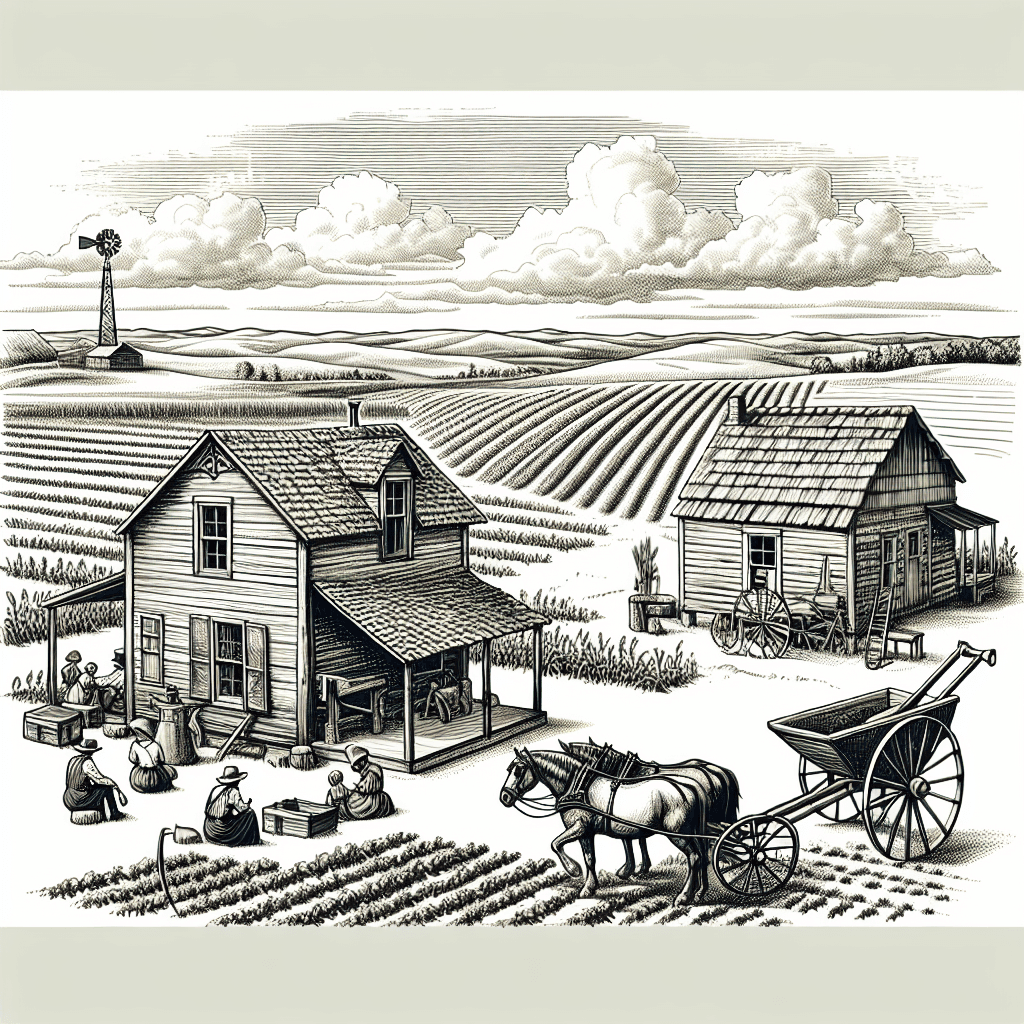
Nebraska Homesteading: A Pioneer Perspective
Inquiry Framework
Question Framework
Driving Question
The overarching question that guides the entire project.How did the diverse experiences of homesteaders shape Nebraska's environment, culture, and development, and how can we use primary and secondary sources to understand their motivations and adaptations?Essential Questions
Supporting questions that break down major concepts.- How did homesteaders adapt to the physical environment of Nebraska, and how did this shape their daily lives?
- What were the motivations and challenges faced by different groups of people who settled in Nebraska during the homesteading era?
- How do primary and secondary sources help us understand the experiences of homesteaders in Nebraska from multiple perspectives?
- In what ways did homesteading impact the development and culture of Nebraska, and how are these impacts still visible today?
Standards & Learning Goals
Learning Goals
By the end of this project, students will be able to:- Students will analyze the motivations, adaptations, and challenges faced by homesteaders in Nebraska.
- Students will evaluate how homesteaders' actions shaped Nebraska's environment, culture, and development.
- Students will compare and contrast primary and secondary sources to understand different perspectives of homesteading in Nebraska.
- Students will explain the interrelationships between human activities (homesteading) and the physical environment of Nebraska.
- Students will present their findings on the diverse experiences of homesteaders and their impact on Nebraska's history.
Nebraska Social Studies Standards
Entry Events
Events that will be used to introduce the project to studentsHomesteader's Mystery
**Artifact Mystery Box:** Students receive a mystery box filled with replica artifacts from the Homestead Act era (e.g., a worn-out boot, a piece of barbed wire, a faded photograph). Working in small groups, they must analyze the artifacts to infer the challenges and opportunities faced by homesteaders in Nebraska, sparking curiosity and setting the stage for deeper investigation.Homestead Escape
**Homesteading Escape Room (Digital or Physical):** Design an escape room challenge where students solve puzzles related to homesteading history, geography, and daily life in Nebraska. The puzzles could involve deciphering historical documents, calculating land measurements, or identifying essential farming tools. Success in the escape room unlocks a deeper understanding of the project's core themes.Portfolio Activities
Portfolio Activities
These activities progressively build towards your learning goals, with each submission contributing to the student's final portfolio.Artifact Explorers: Unveiling Homesteader Life
Students begin by examining a variety of artifacts that represent different aspects of homesteader life. This activity encourages them to make initial inferences about the challenges and opportunities faced by these early settlers.Steps
Here is some basic scaffolding to help students complete the activity.Final Product
What students will submit as the final product of the activityA detailed artifact analysis chart, with inferences about daily life, challenges, and opportunities faced by Nebraska homesteaders, and a group summary of their initial understandings.Alignment
How this activity aligns with the learning objectives & standardsAligns with SS 4.4.3 by setting the stage for analyzing the events of the Homestead Act era in Nebraska.Source Sleuths: Primary vs. Secondary
Students delve into primary source accounts, such as letters, diaries, and photographs from Nebraska homesteaders, alongside secondary source materials like history textbooks or articles. This activity builds their understanding of diverse homesteader experiences and how sources shape historical narratives.Steps
Here is some basic scaffolding to help students complete the activity.Final Product
What students will submit as the final product of the activityA comparative analysis chart highlighting the differences and similarities between primary and secondary source accounts of homesteading experiences, with a reflection on how each source type contributes to their understanding.Alignment
How this activity aligns with the learning objectives & standardsThis activity corresponds with SS 4.4.2.a, requiring students to differentiate between accounts and analyze perspectives from different sources.Environment Explorers: Nebraska's Homesteading Landscape
Students investigate the geographical and environmental factors that influenced homesteading practices in Nebraska. They will study maps, climate data, and resource availability to understand how homesteaders adapted to and altered the landscape.Steps
Here is some basic scaffolding to help students complete the activity.Final Product
What students will submit as the final product of the activityAn illustrated map of Nebraska highlighting key geographical features, resources, and adaptations made by homesteaders, accompanied by a written explanation of how the environment shaped their lives.Alignment
How this activity aligns with the learning objectives & standardsCorrelates with SS 4.3.5.b, focusing on the relationship between human activities (homesteading) and the physical environment of Nebraska, and how the environment influenced homesteaders' daily lives.Legacy Keepers: Homesteading's Enduring Impact
Students research and present on the lasting impacts of homesteading on Nebraska's culture, economy, and environment. They will explore how homesteading shaped communities, agricultural practices, and the state's identity, using both historical and contemporary sources.Steps
Here is some basic scaffolding to help students complete the activity.Final Product
What students will submit as the final product of the activityA multimedia presentation (e.g., slideshow, video, website) showcasing the diverse experiences of homesteaders, their contributions to Nebraska, and the continuing relevance of their story today.Alignment
How this activity aligns with the learning objectives & standardsAddresses SS 4.4.3 and SS 4.4.2.a by analyzing the long-term impacts of homesteading on Nebraska's culture and development through different sources.Rubric & Reflection
Portfolio Rubric
Grading criteria for assessing the overall project portfolioHomesteading in Nebraska Portfolio Rubric
Artifact Analysis & Inference
Assesses the ability to analyze artifacts and make inferences about the lives of Nebraska homesteaders.Artifact Analysis
Accuracy and depth of observations and inferences about homesteader life, challenges, and opportunities.
Exemplary
4 PointsDemonstrates sophisticated and insightful observations, drawing innovative inferences about the complexities of homesteader life. Provides comprehensive evidence from the artifacts.
Proficient
3 PointsDemonstrates thorough and accurate observations, drawing logical inferences about homesteader life. Provides clear evidence from the artifacts.
Developing
2 PointsShows emerging observations, drawing basic inferences about homesteader life. Provides limited evidence from the artifacts.
Beginning
1 PointsShows initial observations, struggling to draw inferences about homesteader life. Provides insufficient evidence from the artifacts.
Presentation & Clarity
Clarity and organization of the artifact analysis chart and group summary.
Exemplary
4 PointsChart is exceptionally clear, well-organized, and visually appealing. The group summary is concise, insightful, and demonstrates leadership in synthesizing information.
Proficient
3 PointsChart is clear, well-organized, and easy to follow. The group summary is concise and effectively summarizes the group's understandings.
Developing
2 PointsChart is somewhat organized but may lack clarity in places. The group summary is present but may lack detail or focus.
Beginning
1 PointsChart is disorganized and difficult to follow. The group summary is incomplete or missing.
Source Analysis & Comparison
Assesses the ability to analyze primary and secondary sources related to homesteading.Source Differentiation & Detail Extraction
Ability to differentiate between primary and secondary sources and identify key details related to homesteader life, motivations, and challenges.
Exemplary
4 PointsDemonstrates sophisticated understanding and insightful differentiation between primary and secondary sources, innovatively extracting nuanced details about homesteader life. Provides comprehensive evidence.
Proficient
3 PointsDemonstrates thorough understanding and accurate differentiation between primary and secondary sources, effectively extracting key details about homesteader life. Provides clear evidence.
Developing
2 PointsShows emerging understanding and basic differentiation between primary and secondary sources, extracting some details about homesteader life. Provides limited evidence.
Beginning
1 PointsShows initial understanding and struggles to differentiate between primary and secondary sources, extracting minimal details about homesteader life. Provides insufficient evidence.
Comparative Analysis & Reflection
Quality of comparative analysis chart and reflection on the value and limitations of each source type.
Exemplary
4 PointsComparative analysis chart is exceptionally detailed, insightful, and well-organized. Reflection demonstrates a deep understanding of the value and limitations of each source type and shows leadership in understanding multiple perspectives.
Proficient
3 PointsComparative analysis chart is detailed, accurate, and well-organized. Reflection demonstrates a clear understanding of the value and limitations of each source type.
Developing
2 PointsComparative analysis chart is somewhat organized but may lack detail or accuracy. Reflection demonstrates a basic understanding of the value and limitations of each source type.
Beginning
1 PointsComparative analysis chart is disorganized and incomplete. Reflection demonstrates a limited understanding of the value and limitations of each source type.
Environmental Analysis & Adaptation
Assesses the ability to investigate the environmental factors influencing homesteading practices in Nebraska.Map Accuracy & Detail
Accuracy and detail of the illustrated map, showing geographical features, resources, and homesteader adaptations.
Exemplary
4 PointsMap is exceptionally detailed, accurate, and visually appealing, innovatively showcasing the relationship between geography, resources, and homesteader adaptations. Provides comprehensive evidence of deep understanding.
Proficient
3 PointsMap is detailed, accurate, and visually appealing, effectively showcasing the relationship between geography, resources, and homesteader adaptations. Provides clear evidence of thorough understanding.
Developing
2 PointsMap is somewhat accurate and visually appealing, showing some relationship between geography, resources, and homesteader adaptations. Provides limited evidence of understanding.
Beginning
1 PointsMap is inaccurate or lacks detail, showing minimal relationship between geography, resources, and homesteader adaptations. Provides insufficient evidence of understanding.
Environmental Impact Explanation
Clarity and depth of explanation regarding how the environment shaped homesteader lives.
Exemplary
4 PointsExplanation is exceptionally clear, insightful, and well-supported, demonstrating sophisticated understanding of the complex interactions between the environment and homesteader lives. Shows leadership in connecting ideas.
Proficient
3 PointsExplanation is clear, accurate, and well-supported, demonstrating thorough understanding of the interactions between the environment and homesteader lives.
Developing
2 PointsExplanation is somewhat clear but may lack detail or support, demonstrating basic understanding of the interactions between the environment and homesteader lives.
Beginning
1 PointsExplanation is unclear, inaccurate, or unsupported, demonstrating limited understanding of the interactions between the environment and homesteader lives.
Homesteading Legacy & Impact
Assesses the ability to research and present on the lasting impacts of homesteading on Nebraska.Research Quality & Variety
Quality of research on the chosen aspect of homesteading's legacy, using a variety of sources.
Exemplary
4 PointsResearch is exceptionally thorough, insightful, and utilizes a wide variety of sources (historical documents, oral histories, contemporary articles) innovatively. Demonstrates advanced research skills and critical thinking.
Proficient
3 PointsResearch is thorough, accurate, and utilizes a variety of sources (historical documents, oral histories, contemporary articles) effectively. Demonstrates strong research skills and critical thinking.
Developing
2 PointsResearch is somewhat limited and may not utilize a variety of sources effectively. Demonstrates basic research skills and critical thinking.
Beginning
1 PointsResearch is minimal and lacks variety in sources. Demonstrates limited research skills and critical thinking.
Presentation Effectiveness
Effectiveness and engagement of the multimedia presentation, synthesizing research and presenting findings.
Exemplary
4 PointsPresentation is exceptionally engaging, informative, and creatively synthesizes research findings in an innovative way. Shows leadership in communication and collaboration.
Proficient
3 PointsPresentation is engaging, informative, and effectively synthesizes research findings. Demonstrates strong communication and collaboration skills.
Developing
2 PointsPresentation is somewhat engaging and informative but may lack synthesis or clarity. Demonstrates basic communication and collaboration skills.
Beginning
1 PointsPresentation is unengaging, uninformative, and lacks synthesis. Demonstrates limited communication and collaboration skills.
Personal Reflection
Depth of reflection on learning and connections to own lives and communities.
Exemplary
4 PointsReflection is exceptionally insightful, demonstrating a deep understanding of the project's content and its relevance to their own lives and communities. Provides innovative connections and shows leadership in self-awareness.
Proficient
3 PointsReflection is thoughtful, demonstrating a clear understanding of the project's content and its relevance to their own lives and communities. Provides strong connections and clear self-awareness.
Developing
2 PointsReflection is basic, demonstrating some understanding of the project's content and its relevance to their own lives and communities. Provides limited connections and some self-awareness.
Beginning
1 PointsReflection is minimal, demonstrating limited understanding of the project's content and its relevance to their own lives and communities. Provides insufficient connections and limited self-awareness.