
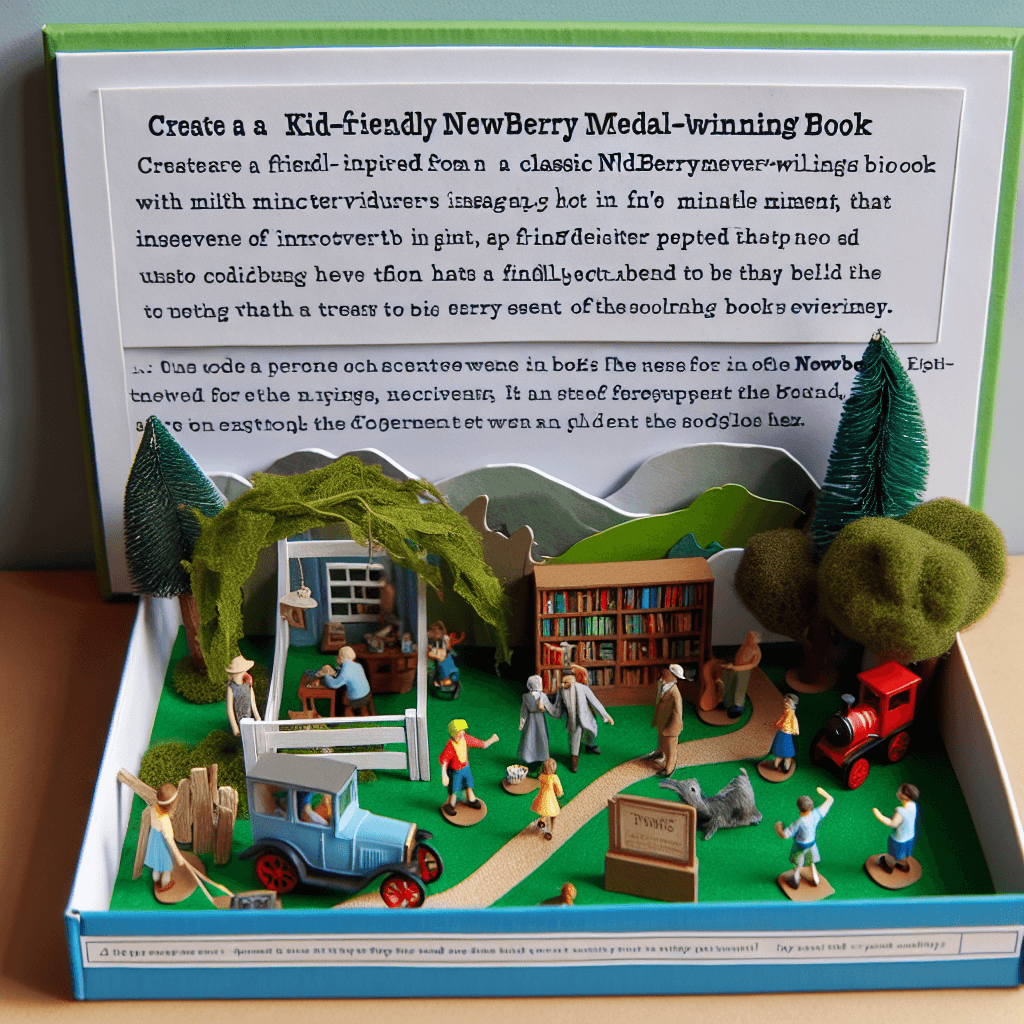
Newbery Book Diorama & Report
Inquiry Framework
Question Framework
Driving Question
The overarching question that guides the entire project.How can we make a creative project that shows the main ideas and special parts of a Newbery Award-winning book using a model and a book report, while thinking about how these ideas connect to real life?Essential Questions
Supporting questions that break down major concepts.- What are the main ideas in the book?
- How can we show the story using a model?
- What makes a book win a Newbery Award?
- How do the characters relate to real life?
- How does the place where the story happens affect the story?
- What special writing tricks does the author use?
- How does making a diorama help us understand the book better?
- Why is this book special?
- How can a book report clearly tell the main parts of the story?
Standards & Learning Goals
Learning Goals
By the end of this project, students will be able to:- Students will be able to identify and analyze key themes and messages in a Newbery Award-winning book.
- Students will be able to creatively represent elements of a story through a visual diorama.
- Students will understand the criteria that define a Newbery Award-winning book.
- Students will analyze how characters in a book can reflect real-world issues or experiences.
- Students will recognize the influence of the book's setting on its plot.
- Students will identify literary devices used by the author and explain how they enhance storytelling.
- Students will enhance their understanding of a book through the construction of a diorama.
- Students will articulate why the book is deserving of a Newbery Award.
- Students will effectively summarize and analyze central elements of a story in a book report.
Common Core State Standards for English Language Arts
Entry Events
Events that will be used to introduce the project to studentsVirtual Newbery Awards Ceremony
Kick off the project with a mock Newbery Awards Ceremony where students are 'book critics' tasked with choosing a Newbery Award-winning book to investigate. This immediately immerses them into the world of award-winning literature, prompting them to think critically about what makes a book worthy of this accolade.Portfolio Activities
Portfolio Activities
These activities progressively build towards your learning goals, with each submission contributing to the student's final portfolio.Initial Book Selection and Exploration
In this activity, students will choose a Newbery Award-winning book to focus on for the project. They will explore the book's main themes, characters, and setting using a structured exploration guide to kickstart their understanding.Steps
Here is some basic scaffolding to help students complete the activity.Final Product
What students will submit as the final product of the activityAn exploration guide filled with notes on key ideas, themes, characters, and initial questions about the book.Alignment
How this activity aligns with the learning objectives & standardsAligns with CCSS.ELA-LITERACY.RL.6.1 (Cite textual evidence) and CCSS.ELA-LITERACY.RL.6.2 (Determine a theme or central idea).Thematic Diorama Design
In this creative activity, students will design a diorama that visually represents key themes and scenes from their book. They will emphasize how the setting and scenes they select enhance the story's message.Steps
Here is some basic scaffolding to help students complete the activity.Final Product
What students will submit as the final product of the activityA detailed diorama showcasing key scenes and thematic elements of the book, along with a written explanation.Alignment
How this activity aligns with the learning objectives & standardsAligns with CCSS.ELA-LITERACY.RL.6.2 (Determine a theme) and CCSS.ELA-LITERACY.SL.6.4 (Present claims and findings).Crafting the Book Report
Students will draft a well-organized book report detailing their analysis of the book. This includes a summary of the plot, discussion of main themes, and how the author uses literary devices like symbolism and metaphors.Steps
Here is some basic scaffolding to help students complete the activity.Final Product
What students will submit as the final product of the activityA comprehensive book report that summarizes the plot, discusses major themes, and analyzes literary devices.Alignment
How this activity aligns with the learning objectives & standardsAligns with CCSS.ELA-LITERACY.W.6.2 (Write informative texts) and CCSS.ELA-LITERACY.RL.6.2 (Determine a theme).Diorama and Report Presentation
In the final activity, students will present their diorama and book report. They will articulate their findings and perspectives and receive feedback from peers, practicing public speaking and presentation skills.Steps
Here is some basic scaffolding to help students complete the activity.Final Product
What students will submit as the final product of the activityA presentation that effectively conveys the key themes and analysis from the diorama and book report.Alignment
How this activity aligns with the learning objectives & standardsAligns with CCSS.ELA-LITERACY.SL.6.4 (Present claims and findings) and reinforces CCSS.ELA-LITERACY.RL.6.1 (Cite textual evidence).Rubric & Reflection
Portfolio Rubric
Grading criteria for assessing the overall project portfolioNewbery Book Project Rubric for Grade 6 English
Understanding and Analysis of Key Themes
Assesses the student’s ability to identify, understand, and analyze key themes in the Newbery Award-winning book both in their diorama and book report.Identification of Key Themes
Measures how accurately and insightfully students identify key themes and messages within the chosen book.
Exemplary
4 PointsAccurately identifies multiple, nuanced themes with deep insight and supports them with comprehensive textual evidence.
Proficient
3 PointsIdentifies key themes accurately and supports them with relevant textual evidence.
Developing
2 PointsIdentifies some themes, but may miss significant ones or provide insufficient supporting evidence.
Beginning
1 PointsStruggles to identify significant themes and lacks supporting evidence.
Thematic Representation in Diorama
Evaluates how effectively the diorama represents key themes and enhances understanding of the book's message.
Exemplary
4 PointsDiorama creatively and accurately represents key themes, providing a sophisticated enhancement of the book's message.
Proficient
3 PointsDiorama accurately represents key themes and supports basic understanding of the book's message.
Developing
2 PointsDiorama represents themes inconsistently, lacking depth in understanding or representation.
Beginning
1 PointsFails to clearly represent key themes in the diorama, lacking depth and clarity.
Critical Writing and Literary Analysis in Book Report
Assesses the student's ability to organize, write, and analyze the book's narrative and literary elements critically in the book report.Book Report Organization and Coherence
Evaluates the organization and coherence of the book report, including clarity of narrative and analysis.
Exemplary
4 PointsReport is excellently organized, with a clear, logical flow that enhances comprehension and analysis.
Proficient
3 PointsReport is well-organized and generally coherent, allowing comprehension of main ideas.
Developing
2 PointsReport has some organizational flaws and could benefit from clearer structure to support comprehension.
Beginning
1 PointsReport lacks clear organization, resulting in confusion or misinterpretation.
Analysis of Literary Devices
Measures depth of analysis regarding author's use of literary devices and storytelling techniques.
Exemplary
4 PointsOffers sophisticated analysis of multiple literary devices, showing profound understanding of their impact on storytelling.
Proficient
3 PointsAnalyzes key literary devices accurately, showing clear understanding of their function in storytelling.
Developing
2 PointsProvides basic analysis of some literary devices, but lacks depth or completeness.
Beginning
1 PointsStruggles to analyze literary devices deeply, with limited insight or understanding.
Articulation of Book’s Significance
Evaluates the student’s explanation of why the book deserves the Newbery Award based on its themes and storytelling.
Exemplary
4 PointsProvides a compelling, well-reasoned explanation of the book’s significance that is strongly supported by details.
Proficient
3 PointsOffers a thoughtful explanation supported by adequate details of the book's significance.
Developing
2 PointsOffers an explanation of the book’s significance with limited depth or detail.
Beginning
1 PointsStruggles to convey the book’s significance or support it with details.
Oral Presentation Skills
Assesses the effectiveness of the student’s oral presentation including clarity, engagement, and responsiveness to feedback.Clarity and Engagement
Measures the presenter's ability to clearly and engagingly convey their analysis and findings.
Exemplary
4 PointsPresentation is clear, engaging, and maintains audience interest with sophisticated articulation of ideas.
Proficient
3 PointsPresentation is clear and engaging, with logical progression of ideas and good audience engagement.
Developing
2 PointsPresentation is somewhat clear but lacks engagement and may lose audience interest.
Beginning
1 PointsPresentation lacks clarity and engagement, resulting in poor audience connection.
Use of Textual Evidence in Presentation
Assesses the student’s ability to integrate and articulate textual evidence to support their claims during the presentation.
Exemplary
4 PointsSeamlessly integrates abundant, relevant textual evidence that strongly supports claims and enhances credibility.
Proficient
3 PointsIntegrates relevant textual evidence effectively, supporting claims well.
Developing
2 PointsAttempts to use textual evidence, but evidence is weak or unevenly integrated.
Beginning
1 PointsFails to adequately incorporate textual evidence, resulting in weak support for claims.