
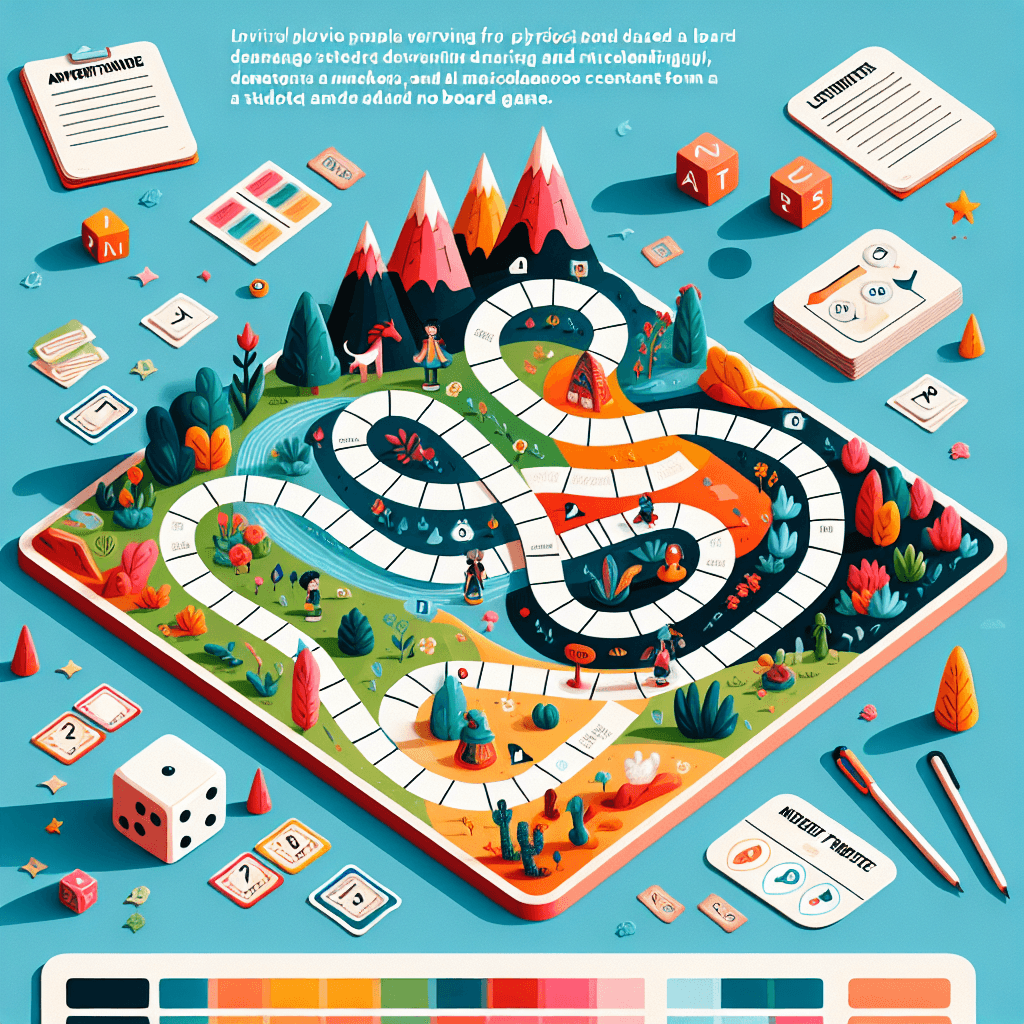
Novel Adventure: Design a Board Game
Inquiry Framework
Question Framework
Driving Question
The overarching question that guides the entire project.How can we design a board game that effectively captures the key elements, themes, and lessons of a novel we have read?Essential Questions
Supporting questions that break down major concepts.- How does understanding the characters, plot, and setting help you design your game?
- How can you use the key events from the story to create challenges and rewards in your game?
- How do the rules of your game reflect the themes and lessons of the novel?
- How can different game mechanics be used to represent different aspects of the novel?
Standards & Learning Goals
Learning Goals
By the end of this project, students will be able to:- Students will be able to identify and summarize the key elements of a novel, including characters, plot, setting, and themes.
- Students will be able to design a board game that accurately reflects the events, characters, and themes of the novel.
- Students will be able to explain how the game mechanics and rules connect to the novel's content and lessons.
- Students will be able to collaborate with peers to create a cohesive and engaging board game.
Common Core Standards
Entry Events
Events that will be used to introduce the project to studentsNovel Escape Room
The classroom becomes an escape room themed around the novel. Students must solve puzzles and challenges related to the book's content to 'escape.' This immersive experience encourages close reading and collaborative problem-solving, generating ideas for game elements.Portfolio Activities
Portfolio Activities
These activities progressively build towards your learning goals, with each submission contributing to the student's final portfolio.Character Cards & Event Cards
Students create a set of character cards, each detailing a character's traits, motivations, and role in the event. These cards will later be used as game pieces in their board game. Event cards: Create cards that describe real historical events, scientific discoveries, or biographical details. A player might draw an "event card" that advances the game's narrative while providing a bite-sized piece of information.Steps
Here is some basic scaffolding to help students complete the activity.Final Product
What students will submit as the final product of the activityA set of four character cards, each with character traits, motivations, role, and a visual representation. A set of 10-15 event cards with materials needed to answer the questions.Alignment
How this activity aligns with the learning objectives & standardsAligns with RI.3.1 (understanding characters) and RI.3.7 (understanding how characters relate to key events).Event Point Path
Students identify the main events of the nonfiction novel and create a sequential path representing the plot. This path will serve as the game board's structure, guiding players through the story's key moments.Steps
Here is some basic scaffolding to help students complete the activity.Final Product
What students will submit as the final product of the activityA visual representation of the story's plot, showing key events in sequential order with brief descriptions.Alignment
How this activity aligns with the learning objectives & standardsAligns with RI.3.1 (understanding the plot) and RI.3.7 (understanding when key events occur).Theme Tokens
Students explore the overarching themes of the event and design tokens representing these themes. These tokens can be collected or used as part of the game mechanics to deepen players' understanding of the novel's central messages.Steps
Here is some basic scaffolding to help students complete the activity.Final Product
What students will submit as the final product of the activityA set of theme tokens, each representing a key theme from the novel, along with supporting quotes.Alignment
How this activity aligns with the learning objectives & standardsAligns with RI.3.1 (understanding the themes) and RI.3.4 (understanding theme-related vocabulary).Rulebook Relay
Students develop a clear and concise rulebook for their board game, ensuring that the rules reflect the novel's plot, characters, and themes. This activity emphasizes clear communication and logical thinking.Steps
Here is some basic scaffolding to help students complete the activity.Final Product
What students will submit as the final product of the activityA complete rulebook for the board game, including the game's objective, step-by-step instructions, and explanations of game components.Alignment
How this activity aligns with the learning objectives & standardsIntegrates RI.3.1 (understanding all elements of the novel) and focuses on clear, explanatory writing.Rubric & Reflection
Portfolio Rubric
Grading criteria for assessing the overall project portfolioBoard Game Design Rubric: Novel Adaptation
Understanding of Novel Elements
This category assesses the student's comprehension of the novel's plot, characters, setting, and themes, and how accurately these elements are represented in the game.Character Representation
Accuracy and depth of character portrayal in the game components (Character Connection Cards).
Exemplary
4 PointsCharacter cards demonstrate a sophisticated understanding of character traits, motivations, and roles. Visual representations are highly creative and insightful, enhancing the understanding of each character's significance in the novel.
Proficient
3 PointsCharacter cards accurately represent the characters' traits, motivations, and roles in the story. Visual representations are appropriate and contribute to the understanding of the characters.
Developing
2 PointsCharacter cards show an emerging understanding of the characters, but some traits or motivations may be unclear or partially inaccurate. Visual representations are basic and may not fully capture the character's essence.
Beginning
1 PointsCharacter cards show limited understanding of the characters. Key traits and motivations are missing or inaccurate. Visual representations are minimal or irrelevant.
Plot Integration
How well the game board (Plot Point Path) integrates the key events and sequence of the novel's plot.
Exemplary
4 PointsThe plot point path innovatively captures the novel's narrative structure, with events sequenced logically and descriptions providing rich context. The path design enhances the player's understanding of the story's progression and conflicts.
Proficient
3 PointsThe plot point path accurately represents the novel's key events in sequential order, with clear descriptions of each event. The path effectively guides players through the main storyline.
Developing
2 PointsThe plot point path includes some of the novel's key events, but the sequence may be unclear or incomplete. Descriptions may lack detail or accuracy, making it difficult to follow the plot's progression.
Beginning
1 PointsThe plot point path demonstrates a limited understanding of the novel's plot. Key events are missing, and the sequence is illogical. Descriptions are minimal or inaccurate.
Thematic Representation
Effectiveness of the theme tokens in representing and reinforcing the novel's central themes.
Exemplary
4 PointsTheme tokens powerfully represent the novel's central themes, with insightful quotes and evocative symbols. The token design enhances the player's understanding of the novel's deeper meaning and moral lessons.
Proficient
3 PointsTheme tokens accurately represent the novel's key themes, with supporting quotes and appropriate symbols. The tokens effectively convey the novel's central messages.
Developing
2 PointsTheme tokens touch upon some of the novel's themes, but the connection may be superficial or unclear. Quotes may be weakly related, and symbols may be generic or confusing.
Beginning
1 PointsTheme tokens show a limited understanding of the novel's themes. The tokens are irrelevant or do not connect to the story's central messages.
Game Design and Mechanics
This category evaluates the creativity, coherence, and playability of the board game, and how well the game mechanics align with the novel's content.Rulebook Clarity
Clarity, completeness, and organization of the game's rulebook (Rulebook Relay).
Exemplary
4 PointsThe rulebook is exceptionally clear, concise, and well-organized, providing step-by-step instructions and detailed explanations of all game components. The rules are innovative and enhance the player's engagement with the novel's content.
Proficient
3 PointsThe rulebook is clear, complete, and well-organized, providing step-by-step instructions and explanations of the game components. The rules are easy to understand and follow.
Developing
2 PointsThe rulebook is partially clear, but some instructions may be confusing or incomplete. Explanations of game components may be lacking, making it difficult to fully understand the game.
Beginning
1 PointsThe rulebook is unclear, incomplete, and disorganized, making it difficult to understand how to play the game. Instructions are missing or confusing.
Game Mechanics & Novel Connection
How well the game mechanics utilize the character cards, plot point path, and theme tokens to create an engaging and educational game experience directly related to the novel.
Exemplary
4 PointsThe game mechanics ingeniously integrate the character cards, plot point path, and theme tokens to create a highly engaging and educational game experience that deepens the player's understanding of the novel.
Proficient
3 PointsThe game mechanics effectively utilize the character cards, plot point path, and theme tokens to create an engaging and educational game experience that is directly related to the novel.
Developing
2 PointsThe game mechanics somewhat utilize the character cards, plot point path, and theme tokens, but the connection to the novel may be weak or superficial. The game may not be fully engaging or educational.
Beginning
1 PointsThe game mechanics show limited integration of the character cards, plot point path, and theme tokens. The game lacks a clear connection to the novel and is not engaging or educational.
Overall Game Design
Assessment of how well all elements of the game design work together.
Exemplary
4 PointsThe game design is exceptionally cohesive, creative, and engaging, demonstrating a deep understanding of the novel and innovative game mechanics. The game is highly playable and enjoyable.
Proficient
3 PointsThe game design is cohesive, creative, and engaging, demonstrating a good understanding of the novel and effective game mechanics. The game is playable and enjoyable.
Developing
2 PointsThe game design is partially cohesive, but some elements may be disjointed or unclear. The game demonstrates a basic understanding of the novel, but the game mechanics may be underdeveloped. The game may be less engaging or playable.
Beginning
1 PointsThe game design is disjointed and lacks cohesion. The game demonstrates a limited understanding of the novel, and the game mechanics are poorly developed. The game is not engaging or playable.