
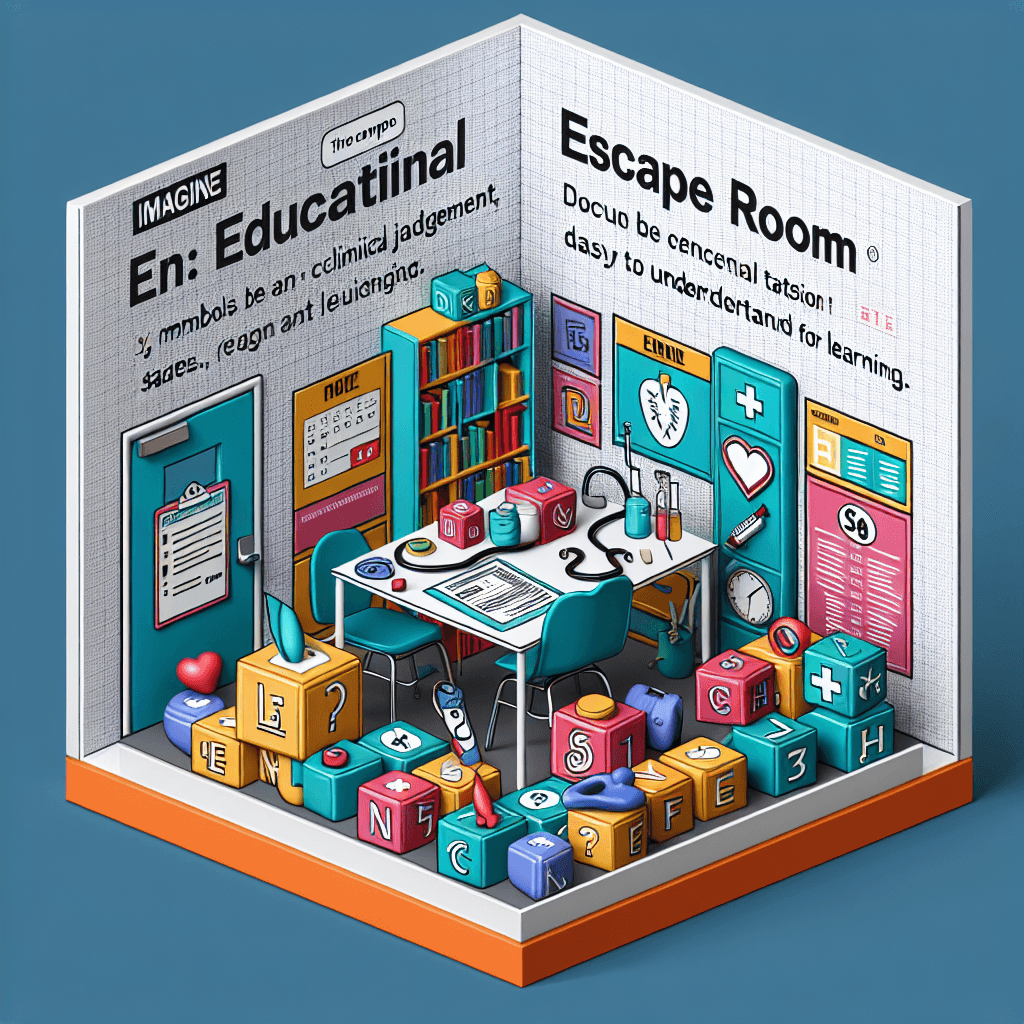
Nursing Escape Room: Exploring Clinical Judgement Phases
Inquiry Framework
Question Framework
Driving Question
The overarching question that guides the entire project.How can we collaboratively design an immersive escape room that effectively teaches and demonstrates Tanner's Clinical Judgement model in nursing, while addressing the challenges of applying these concepts in real-world scenarios?Essential Questions
Supporting questions that break down major concepts.- What are Tanner's Clinical Judgement phases and how do they interconnect?
- How can storytelling enhance understanding and application of clinical judgment in nursing?
- What elements are essential to design an effective nursing-based escape room?
- How does engaging in immersive activities, like escape rooms, aid in the comprehension of complex nursing concepts?
- What are the potential challenges in applying Tanner's Clinical Judgement in practical scenarios, and how can these be addressed?
Standards & Learning Goals
Learning Goals
By the end of this project, students will be able to:- Students will understand the phases of Tanner's Clinical Judgement model and how to apply them in nursing scenarios.
- Students will collaborate to design an escape room that demonstrates their knowledge of clinical judgment.
- Students will engage in storytelling as a method to enhance comprehension of complex nursing concepts.
- Students will identify challenges in applying clinical judgment and develop solutions to address them in real-world settings.
Nursing Education Standards
Entry Events
Events that will be used to introduce the project to studentsThe Missing Protocol
Students walk into a darkened room set up like a hospital ward under pressure. A critical patient file is missing, and students must use Tanner’s Clinical Judgment Model to uncover clues and reconstruct the patient's story before time runs out.Time Capsule Patient
Students encounter a room filled with artifacts and medical records from different decades. They must piece together what happened to a mysterious, long-lost patient using Tanner's phases, thereby connecting past practices with modern clinical reasoning.Virtual Reality Ward
Students don VR headsets to enter various patient care scenarios where they must apply Tanner's Model to navigate complex ethical and clinical decisions, experiencing the impact of different choices in a fully immersive, consequence-driven environment.Portfolio Activities
Portfolio Activities
These activities progressively build towards your learning goals, with each submission contributing to the student's final portfolio.Story-Driven Scenario Design
Students utilize their understanding of Tanner's phases by creating narrative scenarios that could be used within the escape room, integrating storytelling elements to convey complex clinical judgments.Steps
Here is some basic scaffolding to help students complete the activity.Final Product
What students will submit as the final product of the activityA storyboard detailing a complete narrative scenario for use in the escape room, demonstrating the integration of clinical judgment phases.Alignment
How this activity aligns with the learning objectives & standardsSupports the learning goal and standard NURS-1 by applying the model to conceptual scenarios.Escape Room Puzzle Development
Teams design puzzles for the escape room that require application of Tanner's phases to solve, reinforcing practical application of clinical judgments.Steps
Here is some basic scaffolding to help students complete the activity.Final Product
What students will submit as the final product of the activityA set of escape room puzzles incorporating Tanner's Clinical Judgment phases, ready for implementation.Alignment
How this activity aligns with the learning objectives & standardsDirectly applies and assesses understanding of the standard NURS-1 by using the model in practical challenges.Final Escape Room Implementation and Reflection
Students implement and participate in the fully developed escape room, followed by a reflective discussion on the learning experience and its application to real-world nursing scenarios.Steps
Here is some basic scaffolding to help students complete the activity.Final Product
What students will submit as the final product of the activityComplete escape room experience and individual reflections on the educational process and real-world applicability.Alignment
How this activity aligns with the learning objectives & standardsEncapsulates the learning goals and standard NURS-1 by providing a comprehensive, applied learning experience.Rubric & Reflection
Portfolio Rubric
Grading criteria for assessing the overall project portfolioNursing Clinical Judgment Escape Room Rubric
Understanding of Tanner's Model
Assessment of the student's comprehension and application of Tanner's Clinical Judgement phases in realistic nursing scenarios.Identification of Phases
Ability to accurately identify and distinguish between the four phases of Tanner's Clinical Judgement model.
Exemplary
4 PointsAccurately identifies and distinguishes all phases with nuanced understanding across multiple scenarios.
Proficient
3 PointsCorrectly identifies and distinguishes all phases in context, with minor conceptual errors.
Developing
2 PointsIdentifies most phases but shows some gaps or misconceptions in distinctions.
Beginning
1 PointsStruggles to accurately identify and distinguish phases, with significant misconceptions.
Integration of Phases in Storytelling
Effectiveness in incorporating Tanner's phases into the narrative in a cohesive and insightful manner.
Exemplary
4 PointsSeamlessly integrates all phases into a compelling and contextually rich narrative, demonstrating deep understanding and creativity.
Proficient
3 PointsSuccessfully incorporates all phases into the narrative, maintaining coherence, with minor gaps in creativity or context.
Developing
2 PointsIncludes phases in the narrative but with gaps in coherence or creativity, showing basic understanding.
Beginning
1 PointsLimited integration of phases into the narrative, with substantial coherence and understanding issues.
Collaboration and Engagement
Evaluation of student contributions to group dynamics and collective problem-solving efforts during the escape room design and implementation phases.Collaboration and Communication
Level of positive contribution to group efforts, including communication, idea sharing, and feedback acceptance.
Exemplary
4 PointsActively leads and enhances group dynamics with effective communication and inclusive collaboration, consistently encouraging peer contributions.
Proficient
3 PointsEffectively contributes to group efforts, communicating well and supporting peer contributions.
Developing
2 PointsParticipates in group activities but with inconsistent communication or collaboration, occasionally needing prompting.
Beginning
1 PointsLimited contribution to group dynamics, with poor communication and minimal collaborative engagement.
Creative Design and Problem Solving
Assessment of the creativity and efficacy in designing escape room puzzles and narratives that reflect the application of clinical judgment skills.Innovation in Puzzle Design
Creative and practical design of puzzles that effectively require the application of clinical judgment skills and phases.
Exemplary
4 PointsDesigns highly innovative and relevant puzzles that challenge and enhance comprehension of clinical judgment skills, with excellent educational value.
Proficient
3 PointsDesigns effective puzzles that apply clinical judgment skills appropriately, providing good educational value and engagement.
Developing
2 PointsProduces puzzles with basic engagement and application of clinical skills, showing partial innovation.
Beginning
1 PointsStruggles to design appropriate puzzles, with little innovation and ambiguous application of clinical skills.
Reflective Practice
Evaluation of student's ability to reflect on the learning experience, identifying personal growth and potential real-world applications of learned concepts.Depth of Reflection
Ability to critically analyze and articulate personal learning experiences and the application of clinical judgment.
Exemplary
4 PointsProvides highly insightful and comprehensive reflections, identifying nuanced learning experiences and real-world applicability.
Proficient
3 PointsOffers reflective insights that effectively link learning experiences to practical applications.
Developing
2 PointsShows basic reflective skills, with some connections between learning and application identified.
Beginning
1 PointsMinimal reflective insight, with limited connection to personal learning experiences or applications.