
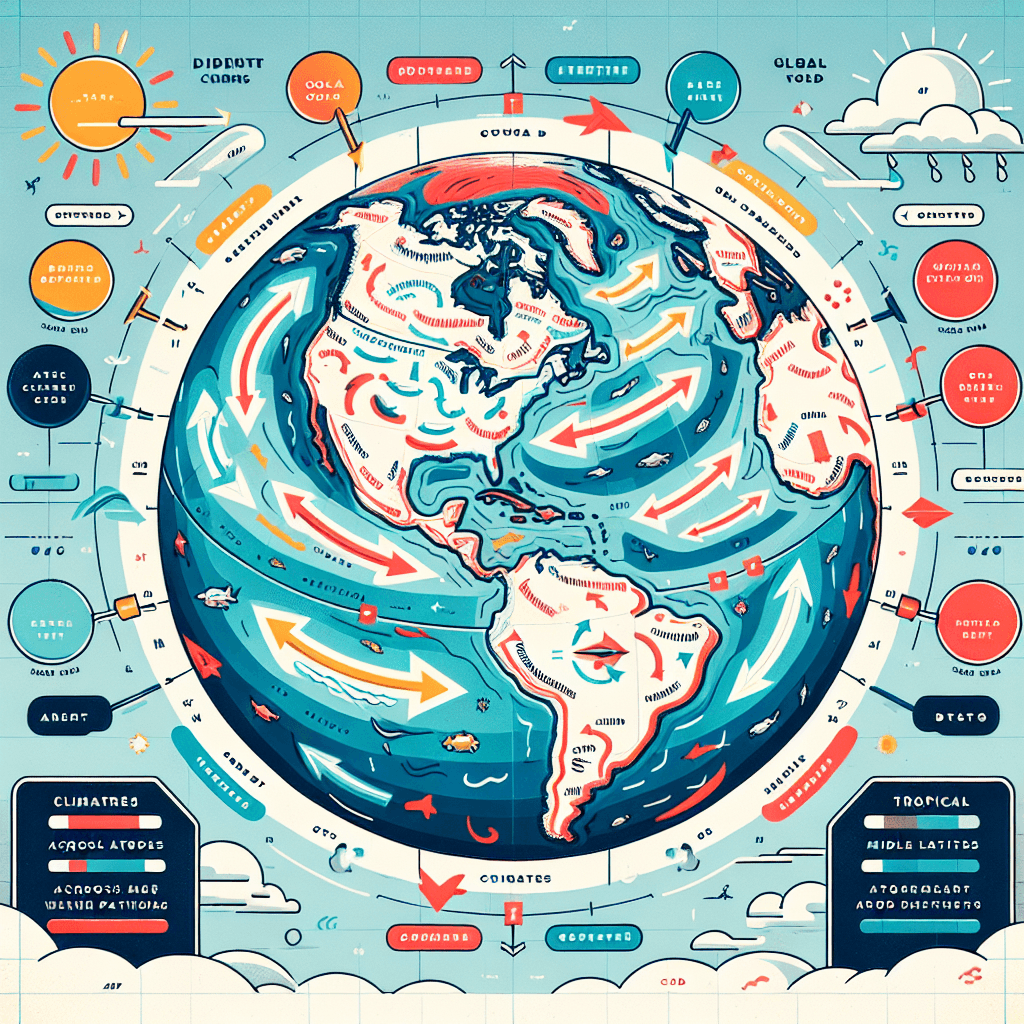
Inquiry Framework
Question Framework
Driving Question
The overarching question that guides the entire project.How do the interactions between ocean currents, atmospheric circulation, and the water cycle contribute to our understanding of global weather patterns and climate?Essential Questions
Supporting questions that break down major concepts.- How do ocean currents influence global weather patterns?
- What role does water cycle play in Earth's systems?
- How does unequal heating of the Earth affect oceanic and atmospheric circulation?
- What evidence can we gather to understand how air mass interactions lead to weather changes?
Standards & Learning Goals
Learning Goals
By the end of this project, students will be able to:- Students will be able to create models that demonstrate the water cycle and its relationship with ocean currents and atmospheric circulation.
- Students will collect and analyze data to observe the impact of ocean currents on weather patterns.
- Students will engage in collaborative discussions to explain how unequal heating affects global climate.
Earth and Space Science Standards
Entry Events
Events that will be used to introduce the project to studentsThe Great Debate: Currents vs. Climate
Students are divided into two teams representing ocean currents and climate. They must present arguments in a class debate about how these two aspects affect global weather patterns, encouraging critical thinking and collaboration.Portfolio Activities
Portfolio Activities
These activities progressively build towards your learning goals, with each submission contributing to the student's final portfolio.Ocean Currents Exploration
Students will delve into ocean currents, exploring their types, movements, and the science behind them. This foundational knowledge will set the stage for understanding the relationships between ocean currents, climate, and weather.Steps
Here is some basic scaffolding to help students complete the activity.Final Product
What students will submit as the final product of the activityA mind map and a brief presentation summarizing ocean currents and their implications for global weather.Alignment
How this activity aligns with the learning objectives & standardsCovers standard 3.3.6-8.H (develop models to describe the cycling of water through Earth's systems).The Warming Planet Simulation
In this activity, students will simulate the effects of unequal heating of the Earth on ocean currents and weather patterns. They'll create a model to visualize their findings and analyze the outcomes based on their research on ocean currents.Steps
Here is some basic scaffolding to help students complete the activity.Final Product
What students will submit as the final product of the activityA group report detailing the simulation process and results, with an explanation connecting unequal heating to ocean currents and weather patterns.Alignment
How this activity aligns with the learning objectives & standardsCovers standard 3.3.6-8.I (develop and use models to describe how unequal heating and rotation of earth cause patterns of circulation).Weather Patterns Data Detective
Students will become 'data detectives' as they collect and analyze real-world weather data influenced by ocean currents. They will use various sources to identify correlations between marine conditions and atmospheric changes.Steps
Here is some basic scaffolding to help students complete the activity.Final Product
What students will submit as the final product of the activityA visual display showing the connection between ocean currents and weather data, including graphs and annotations to explain findings.Alignment
How this activity aligns with the learning objectives & standardsCovers standard 3.3.6-8.J (collect data to provide evidence explaining how motion and interactions of air masses result in weather changes).Rubric & Reflection
Portfolio Rubric
Grading criteria for assessing the overall project portfolioOcean Currents and Global Weather Patterns Rubric
Model Development
Assessment of students' ability to create accurate and meaningful representations of the water cycle, ocean currents, and atmospheric circulation.Accuracy of Model
The extent to which the model correctly represents the scientific concepts of the water cycle, ocean currents, and atmospheric circulation.
Exemplary
4 PointsThe model accurately and comprehensively represents all key aspects of the water cycle, ocean currents, and atmospheric circulation.
Proficient
3 PointsThe model accurately represents most aspects of the water cycle, ocean currents, and atmospheric circulation.
Developing
2 PointsThe model represents basic elements of the water cycle and ocean currents but lacks detail and full accuracy.
Beginning
1 PointsThe model shows minimal understanding of the concepts, with significant inaccuracies.
Creativity in Representation
Evaluation of the creativity and innovation in presenting models and ideas related to ocean currents and weather systems.
Exemplary
4 PointsDemonstrates exceptional creativity, using innovative methods to clearly illustrate complex interactions.
Proficient
3 PointsShows creativity through effective, clear representations of key concepts.
Developing
2 PointsEmploys basic creative elements but lacks full execution in clarity or innovation.
Beginning
1 PointsLimited or unclear creative representation, lacking innovation.
Data Analysis and Interpretation
Assessment of students' skills in collecting, analyzing, and interpreting weather data associated with ocean currents and climate interactions.Data Collection
Quality and thoroughness of data collection methods and sources utilized in the analysis of weather patterns related to ocean currents.
Exemplary
4 PointsData is thoroughly collected using diverse and reliable sources, exceeding project requirements.
Proficient
3 PointsData is collected from reliable sources, meeting project requirements.
Developing
2 PointsData collection is basic with some gaps in source reliability or comprehensiveness.
Beginning
1 PointsMinimal or unreliable data collected, lacking depth.
Data Interpretation
Ability to interpret and draw conclusions from weather data, identifying trends or correlations with oceanic factors.
Exemplary
4 PointsInterpretation reveals deep insights and well-supported conclusions about relationships between data and ocean currents.
Proficient
3 PointsInterpretation is accurate and provides clear conclusions about data relationships.
Developing
2 PointsInterpretation shows basic understanding but lacks depth or clear conclusions.
Beginning
1 PointsInterpretation is minimal or unclear, with unsupported conclusions.
Communication and Collaboration
Evaluation of students' ability to present their findings effectively and work collaboratively during activities.Presentation Skills
Effectiveness of presenting findings related to ocean currents and weather interactions in an engaging manner.
Exemplary
4 PointsPresentation is exceptionally clear, engaging, and well-structured, with strong use of visual aids.
Proficient
3 PointsPresentation is clear and well-structured, using visual aids effectively.
Developing
2 PointsPresentation is understandable but may lack engagement or strong visual aid support.
Beginning
1 PointsPresentation is unclear or poorly structured, with minimal visual support.
Collaboration
Active and productive contribution to group work during simulations and data analysis activities.
Exemplary
4 PointsConsistently leads and collaborates effectively, offering valuable contributions and facilitating team progress.
Proficient
3 PointsWorks well with team members, contributing meaningfully to the group tasks.
Developing
2 PointsParticipates in group work but contributions or engagement may vary.
Beginning
1 PointsLimited participation or contribution to collaborative tasks.