
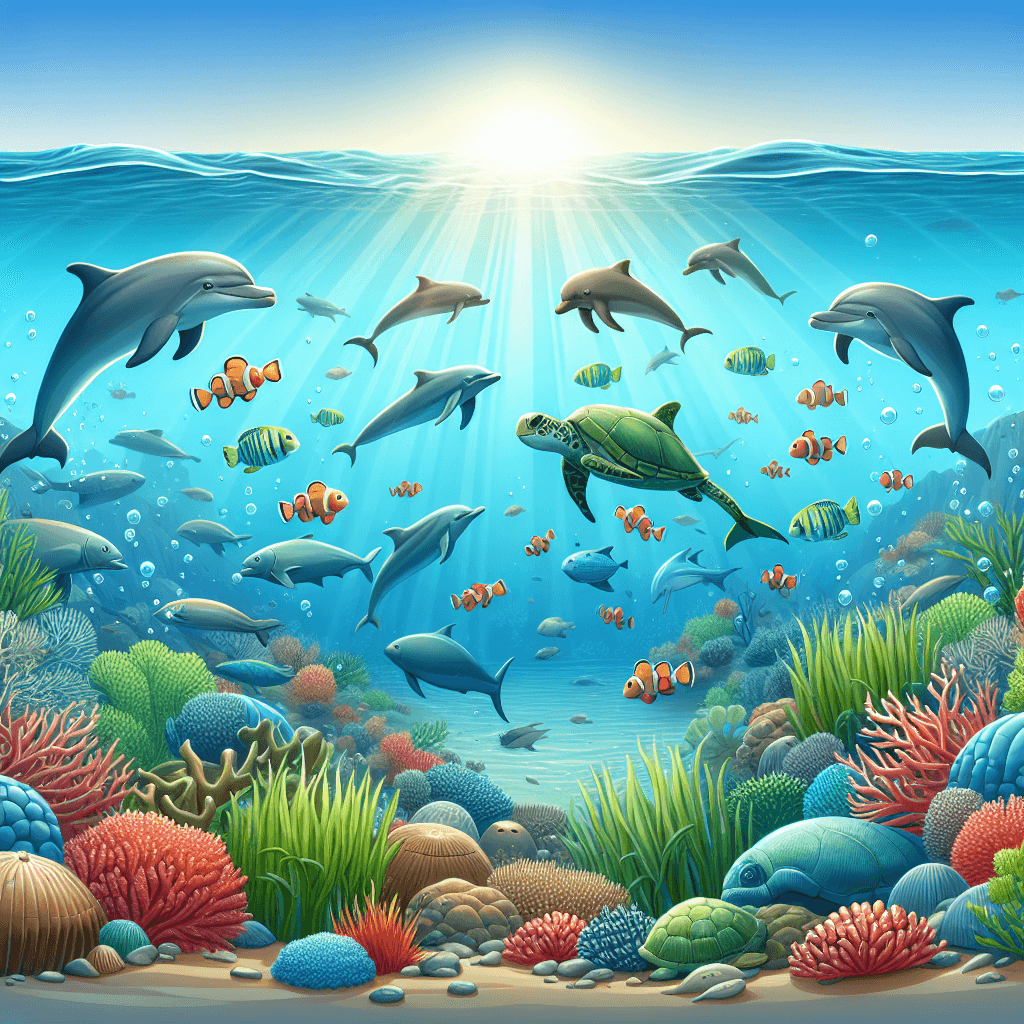
Ocean Guardians: Habitat and Survival Exploration
Inquiry Framework
Question Framework
Driving Question
The overarching question that guides the entire project.How can we understand and communicate the importance of ocean habitats, the survival skills of ocean animals, and the impact of human activities, to foster a more sustainable future for ocean ecosystems?Essential Questions
Supporting questions that break down major concepts.- How do ocean animals adapt to survive in their habitats?
- What are the different habitats of the ocean and how do they support the life within them?
- How do certain survival skills help ocean animals thrive in their environments?
- What is the importance of protecting ocean reefs and how can we contribute to their preservation?
- How do human activities impact ocean habitats and what can be done to reduce negative effects?
- In what ways do ocean animals interact with each other and their environment?
- How do the different ocean zones vary and what types of life can be found in each?
- What role do ocean animals play in the ecosystem and how do they affect the balance of marine life?
- How can storytelling and writing be used to raise awareness about ocean conservation?
- What are some historical or cultural connections humans have with the ocean and its creatures?
Standards & Learning Goals
Learning Goals
By the end of this project, students will be able to:- Understand and explain how ocean animals adapt to survive in their different habitats.
- Identify and describe the different habitats within the ocean and how they support marine life.
- Analyze the survival skills of ocean animals and how they contribute to their thriving in various marine environments.
- Evaluate the importance of protecting ocean reefs and propose strategies for their preservation.
- Investigate the impact of human activities on ocean habitats and suggest ways to mitigate negative effects.
- Describe the interactions between ocean animals and their environment, highlighting ecological relationships.
- Identify life forms in different ocean zones and compare the characteristics of these zones.
- Explain the role of ocean animals in the marine ecosystem and their contribution to ecological balance.
- Utilize storytelling and writing to create awareness about ocean conservation.
- Explore historical and cultural connections between humans and ocean life.
Common Core Standards
Next Generation Science Standards
National Curriculum Standards for Social Studies
Entry Events
Events that will be used to introduce the project to studentsSurvival SOS: Mission Ocean Rescue
Students walk into a classroom transformed into an 'Ocean Exploration Station,' complete with sound effects of whales and waves. They find a mysterious message in a bottle that has 'washed ashore', prompting them to decode messages from endangered sea creatures seeking help for their survival. Curiosity is piqued as they realize they can choose pathways: researching specific animals, exploring ecosystems, or engineering solutions to save coral reefs.Ocean Animals Escape Room Challenge
Students enter a dimly-lit room themed as an underwater cave with clues and puzzles that reveal facts about ocean habitats and animal survival skills. As they solve each mystery, they unlock the secrets of different species and their roles within the ecosystem, leading to discussions on conservation and protection efforts.Portfolio Activities
Portfolio Activities
These activities progressively build towards your learning goals, with each submission contributing to the student's final portfolio.Ocean Animal Journalist
Students will become journalists researching and writing informative pieces about specific ocean animals and their habitats. They will focus on how these animals adapt to their environments and the importance of these adaptations for survival.Steps
Here is some basic scaffolding to help students complete the activity.Final Product
What students will submit as the final product of the activityAn informative article detailing an ocean animal's habitat, adaptations, and survival challenges.Alignment
How this activity aligns with the learning objectives & standardsAligns with CCSS.ELA-LITERACY.W.3.2 for writing informative/explanatory texts.Habitat Explorer Map
In this activity, students will create a map of different ocean habitats, learning about the environmental characteristics that support marine life. They will use geographical tools to enhance understanding.Steps
Here is some basic scaffolding to help students complete the activity.Final Product
What students will submit as the final product of the activityA detailed map illustrating various ocean habitats and corresponding marine life.Alignment
How this activity aligns with the learning objectives & standardsAligns with NCSS.D2.Geo.2.3-5 using geographical tools to explain relationships between locations and characteristics.Survival Skills Showdown
Students will investigate and demonstrate the survival skills of ocean animals through a creative presentation. This activity will help them understand how these skills contribute to thriving in various marine environments.Steps
Here is some basic scaffolding to help students complete the activity.Final Product
What students will submit as the final product of the activityA presentation showcasing the survival skills of ocean animals and their ecological impact.Alignment
How this activity aligns with the learning objectives & standardsAligns with NGSS.3-LS4-3 for constructing arguments and explanations based on evidence gathered from research.Rubric & Reflection
Portfolio Rubric
Grading criteria for assessing the overall project portfolioOcean Animal Portfolio Rubric
Research and Information Gathering
Assessment of students' ability to gather and organize information on ocean animals and their habitats.Source Selection
The ability to choose reliable and credible sources for research.
Exemplary
4 PointsSelects a wide range of highly reliable sources, including books and authoritative websites, ensuring accuracy and depth in information gathering.
Proficient
3 PointsSelects mostly reliable sources, with occasional varied reliability, providing accurate information for most aspects of research.
Developing
2 PointsRelies on a limited range of sources, some of which may lack reliability, leading to incomplete or partially accurate information.
Beginning
1 PointsStruggles to identify reliable sources, frequently using inaccurate or irrelevant materials, resulting in significantly flawed information.
Information Organization
How information is structured and presented in the research.
Exemplary
4 PointsOrganizes information into well-defined sections with clear headings, presenting data in a logical and engaging manner.
Proficient
3 PointsInformation is mostly well organized, with some structure and logical flow, though occasional clarity may waver.
Developing
2 PointsInformation lacks clear organization and logical progression, leading to confusion in understanding.
Beginning
1 PointsFail to organize information logically or coherently, contributing to misunderstanding or misinterpretation.
Writing and Communication
Evaluation of students' ability to effectively communicate research findings through written work.Clarity and Coherence
The clarity and coherence of the written informative text.
Exemplary
4 PointsProduces clear, coherent, and engaging text that effectively explains animal adaptations and habitat information.
Proficient
3 PointsProduces mostly clear and coherent text with minor inconsistencies in explanatory depth or engagement.
Developing
2 PointsText lacks clarity and coherence, with significant portions difficult to follow or understand.
Beginning
1 PointsProduces text that is unclear and disjointed, failing to convey essential information effectively.
Descriptive Details
Use of descriptive details and examples to support the explanation of survival strategies and adaptations.
Exemplary
4 PointsUtilizes rich, descriptive details, and varied examples that vividly illustrate survival strategies and adaptations.
Proficient
3 PointsIncludes relevant descriptive details and examples, with occasional lapses in vividness or variety.
Developing
2 PointsProvides limited descriptive details with few examples, leading to general rather than specific explanations.
Beginning
1 PointsInsufficient use of descriptive details or examples, resulting in vague or incorrect explanations.
Critical Thinking and Problem Solving
Assessment of the ability to analyze issues related to ocean conservation and propose viable solutions.Argument Construction
Quality of arguments regarding the effectiveness of the proposed solutions to environmental problems.
Exemplary
4 PointsConstructs well-reasoned arguments, using substantial evidence to engage effectively with environmental issues and propose innovative solutions.
Proficient
3 PointsBuilds logical arguments with adequate evidence, suggesting thoughtful solutions to environmental problems.
Developing
2 PointsPresents basic arguments with limited evidence, leading to generic or less applicable solutions.
Beginning
1 PointsStruggles to present cohesive arguments, lacking evidence and offering impractical or unclear solutions.
Integration of Evidence
Effective integration of evidence and information to support claims.
Exemplary
4 PointsSeamlessly integrates evidence into arguments, supporting claims with high credibility and relevance.
Proficient
3 PointsIncorporates evidence appropriately, with some minor lapses in integration or relevance.
Developing
2 PointsUses evidence sporadically or ineffectively, leading to weak support for claims.
Beginning
1 PointsFails to integrate evidence, resulting in unsupported or baseless claims.
Presentation and Creativity
Evaluation of students' creativity and effectiveness in delivering presentations through visual and oral components.Use of Visuals
Creativity and effectiveness in using visuals or models during presentations.
Exemplary
4 PointsCreates highly innovative and relevant visuals that enhance understanding and engagement.
Proficient
3 PointsUses effective visuals that enhance presentation, though creativity may be limited.
Developing
2 PointsPresents basic visuals, somewhat connected to content but lacking enhancement in understanding.
Beginning
1 PointsUses visuals that are irrelevant or missing, hindering presentation effectiveness.
Oral Communication Skills
Assessment of the clarity, pace, and engagement in oral presentation.
Exemplary
4 PointsDelivers an articulate, well-paced presentation that engages the audience throughout.
Proficient
3 PointsProvides a clear and generally well-paced presentation with minor lapses in engagement.
Developing
2 PointsPresentation lacks clarity or consistency in pace, leading to reduced audience engagement.
Beginning
1 PointsPresentation is unclear, poorly paced, and does not engage the audience effectively.