
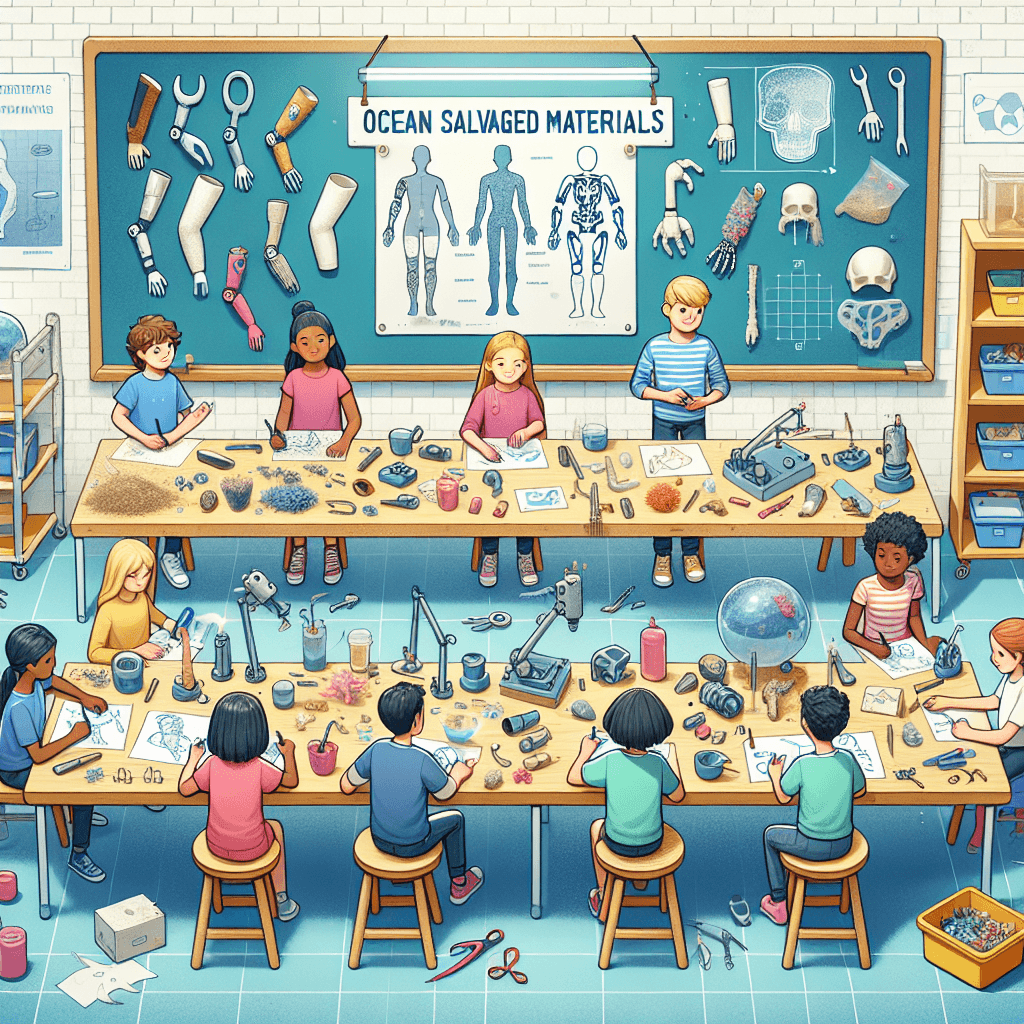
Ocean Salvaged Prosthetics Design
Inquiry Framework
Question Framework
Driving Question
The overarching question that guides the entire project.How can we, as ocean advocates and innovators, design functional prosthetics from recycled ocean plastics while considering the impact on marine life and the environment?Essential Questions
Supporting questions that break down major concepts.- What is the significance of cleaning our oceans from plastic waste?
- How can salvaged ocean plastics be transformed into useful products like prosthetics?
- What impact do plastic prosthetics have on marine life?
- Why is recycling ocean waste for creating prosthetics important ethically and environmentally?
Standards & Learning Goals
Learning Goals
By the end of this project, students will be able to:- Students will understand the significance of cleaning oceans from plastic waste and the environmental impact of plastic in marine ecosystems.
- Students will learn how to design and create useful products like prosthetics from salvaged ocean plastics.
- Students will analyze and evaluate the impact of plastic waste and developed prosthetics on marine life.
- Students will develop skills in innovation and design processes while considering environmental ethics and sustainability.
Next Generation Science Standards
Common Core Standards
Entry Events
Events that will be used to introduce the project to studentsDesign Challenge: From Waste to Wonder
Present students with a challenge to sketch or model prosthetic designs using salvaged ocean plastics. This activity will prompt them to explore artistic design, mechanical functionality, and environmental stewardship.Portfolio Activities
Portfolio Activities
These activities progressively build towards your learning goals, with each submission contributing to the student's final portfolio.Plastic Watchdog Investigation
Students will conduct a research investigation on the impact of plastic waste on marine life, collecting scientific data and multimedia resources to understand the ecological damage caused by ocean plastics.Steps
Here is some basic scaffolding to help students complete the activity.Final Product
What students will submit as the final product of the activityA multimedia presentation illustrating the ecological impact of plastic waste on marine life.Alignment
How this activity aligns with the learning objectives & standardsMS-ESS3-3: Apply scientific principles to design a method for monitoring and minimizing human impact; RI.8.1: Cite textual evidence most strongly supporting an analysis.Prosthetic Blueprints Exploration
Engage students in a brainstorming session to sketch design blueprints for prosthetics using materials salvaged from the ocean, focusing on both artistic elements and mechanical functionality.Steps
Here is some basic scaffolding to help students complete the activity.Final Product
What students will submit as the final product of the activityDetailed sketches and design blueprints for prosthetics made from salvaged ocean plastics.Alignment
How this activity aligns with the learning objectives & standardsMS-ETS1-2: Evaluate competing design solutions using a systematic process; MS-LS2-5: Evaluate solutions for maintaining biodiversity and ecosystem.Ethical Impact Debate
Facilitate a debate on the ethical considerations of using ocean-salvaged plastics for prosthetic design, addressing the pros and cons from environmental and societal viewpoints.Steps
Here is some basic scaffolding to help students complete the activity.Final Product
What students will submit as the final product of the activityRecorded debate session highlighting ethical perspectives on using salvaged plastics for prosthetics.Alignment
How this activity aligns with the learning objectives & standardsRI.8.8: Trace and evaluate arguments assessing reasoning soundness; RI.8.1: Cite textual evidence supporting an argument analysis.Product Prototype Development
Guide students through the process of creating a functional prototype of the prosthetic using only salvaged materials.Steps
Here is some basic scaffolding to help students complete the activity.Final Product
What students will submit as the final product of the activityA working prototype of a prosthetic designed from ocean-salvaged plastics, ready for presentation.Alignment
How this activity aligns with the learning objectives & standardsMS-ETS1-2: Evaluate design solutions to meet criteria effectively; MS-ESS3-3: Apply scientific principles for minimizing human environmental impact.Rubric & Reflection
Portfolio Rubric
Grading criteria for assessing the overall project portfolioOcean Cleanup and Prosthetics Design Rubric
Scientific Understanding
Assessment of students' grasp of scientific principles related to ocean pollution and its impact on marine life.Ecological Impact Analysis
Ability to analyze and communicate the ecological impact of plastics on marine life.
Exemplary
4 PointsThoroughly analyzes the ecological impacts, providing in-depth insights and comprehensive data visuals.
Proficient
3 PointsAccurately analyzes and presents ecological impacts with clear visuals and sound reasoning.
Developing
2 PointsProvides a basic analysis with some visual data representation; reasoning is sometimes unclear or incomplete.
Beginning
1 PointsInitial analysis with little visual representation; reasoning is often unclear.
Application of Scientific Principles
Use of scientific principles to design solutions minimizing environmental impact.
Exemplary
4 PointsInnovatively applies principles to propose solutions with potential for significant impact mitigation.
Proficient
3 PointsApplies scientific principles effectively to propose realistic solutions for impact mitigation.
Developing
2 PointsAttempts to apply scientific principles but solutions are incomplete or partially effective.
Beginning
1 PointsMinimal application of principles with unclear solutions.
Design and Innovation
Assessment of creativity, practicality, and sustainability in design solutions.Design Creativity
Originality and creativity in design concepts for prosthetics.
Exemplary
4 PointsPresents highly original and creative designs that thoughtfully incorporate aesthetic and functional considerations.
Proficient
3 PointsProposes creative designs that effectively balance aesthetics and functionality.
Developing
2 PointsDesigns show some creativity but lack balance in aesthetics and functionality.
Beginning
1 PointsDesigns are basic or lack clear direction; minimal creativity noted.
Sustainable Design
Consideration for environmental sustainability in design.
Exemplary
4 PointsDesigns demonstrate a deep commitment to sustainability, utilizing innovative material reuse and life cycle considerations.
Proficient
3 PointsDesigns show awareness and application of sustainable practices effectively.
Developing
2 PointsAttempts to incorporate sustainable practices but inconsistently or superficially applied.
Beginning
1 PointsLittle to no consideration of sustainability in the design process.
Communication and Collaboration
Evaluation of effective communication and collaboration in presenting ideas and working with peers.Presentation Skills
Effectiveness of communication during presentations and debates.
Exemplary
4 PointsDelivers presentations with clarity, enthusiasm, and comprehensive argumentation that engages and informs the audience thoroughly.
Proficient
3 PointsCommunicates ideas clearly and effectively, using relevant arguments and maintaining audience interest.
Developing
2 PointsPresents ideas with some clarity; arguments are occasionally unclear or less compelling.
Beginning
1 PointsPresentation lacks clarity and engagement; arguments are often unclear or incomplete.
Collaboration Contributions
Ability to work collaboratively with peers to achieve common goals.
Exemplary
4 PointsActively leads group efforts, ensures inclusivity, and facilitates productive teamwork and innovation.
Proficient
3 PointsContributes effectively within group settings, supporting teamwork and collaborative achievement.
Developing
2 PointsParticipates in group efforts with some support needed, occasionally contributing to teamwork.
Beginning
1 PointsRequires substantial support to engage in teamwork and contribute to group goals.