
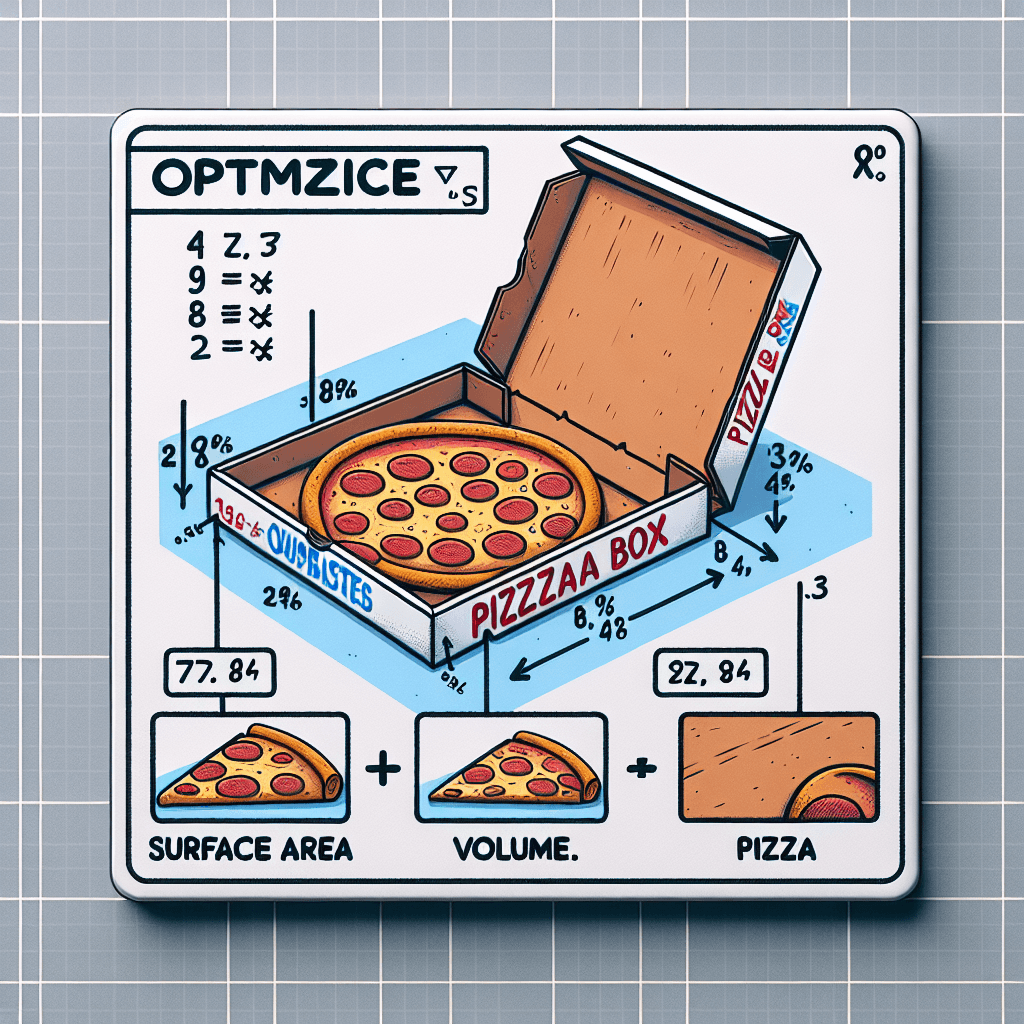
Optimizing Pizza Box Design: Surface Area vs. Volume
Inquiry Framework
Question Framework
Driving Question
The overarching question that guides the entire project.How can we design an innovative pizza box that optimizes both surface area for material efficiency and volume for capacity, while also considering cost-effectiveness and environmental impact?Essential Questions
Supporting questions that break down major concepts.- How do surface area and volume affect the design of a pizza box?
- What are the mathematical formulas for calculating the surface area and volume of different geometric shapes?
- How can understanding geometry help us solve real-world problems, such as designing a more efficient pizza box?
- In what ways do the shapes of the box affect the amount of material used?
- How does changing the dimensions of a box shape affect its surface area and volume?
- Why is it important to consider both surface area and volume in packaging design?
- Can a redesign of a pizza box be both cost-effective and environmentally friendly?
Standards & Learning Goals
Learning Goals
By the end of this project, students will be able to:- Calculate and compare the surface area and volume of various geometrical pizza box designs, including circular, square, and hexagonal shapes.
- Demonstrate an understanding of the mathematical formulas needed to calculate surface area and volume in different geometrical contexts.
- Design and construct a prototype of a pizza box that uses minimal material while maximizing capacity, and explain the design reasoning.
- Evaluate the environmental and cost implications of different design options, focusing on efficiency and sustainability.
Common Core Standards
Entry Events
Events that will be used to introduce the project to studentsVirtual Reality Box Design Experience
Utilize virtual reality tools to give students a hands-on experience of designing and manipulating 3D pizza boxes. This immersive event can prompt students to directly engage with geometric concepts as they try to maximize volume and minimize surface area in a digital environment that simulates real-world challenges.Eco-Friendly Pizza Box Competition
Introduce students to the environmental impact of wasteful packaging by challenging them to create a pizza box using recyclable materials that minimizes waste. Provide data and case studies on current packaging waste issues to stimulate problem-solving around eco-friendly design, linking mathematical calculations to practical, meaningful outcomes.Pizza Box Innovation Fair
Host an interactive innovation fair where students can rotate through stations showcasing different pizza box designs, materials, and technologies. Through hands-on activities, they will explore the importance of design in everyday objects, leading to discussions on how they can innovate their pizza box design. Use this event to kickstart the inquiry into mathematical design principles.Portfolio Activities
Portfolio Activities
These activities progressively build towards your learning goals, with each submission contributing to the student's final portfolio.Geometry in Real Life: 3D Model Exploration
Using 3D modeling software or hands-on construction kits, students create models of circular, square, and hexagonal pizza box designs. This activity allows them to visualize how different designs affect volume and surface area.Steps
Here is some basic scaffolding to help students complete the activity.Final Product
What students will submit as the final product of the activityComparison table and documentation report analyzing the efficiency of each pizza box design.Alignment
How this activity aligns with the learning objectives & standardsCCSS.MATH.CONTENT.HSG.MG.A.3 - Apply geometric methods to solve design problems minimizing surface area and maximizing volume.Innovative Box Design Challenge
Students design their pizza box, starting from sketches to creating a prototype that optimizes material efficiency without compromising volume. They consider environmental impact and cost-effectiveness in their design.Steps
Here is some basic scaffolding to help students complete the activity.Final Product
What students will submit as the final product of the activityA physical or digital prototype of a custom pizza box, complemented by a presentation detailing the design's rationale.Alignment
How this activity aligns with the learning objectives & standardsCCSS.MATH.CONTENT.HSG.CO.D.12 - Make formal geometric constructions and demonstrate understanding of environmental and cost implications.Environmental Impact Evaluation
Students evaluate their pizza box designs, focusing on material efficiency and sustainable practices. They will research the impact of packaging waste and propose improvements to their designs.Steps
Here is some basic scaffolding to help students complete the activity.Final Product
What students will submit as the final product of the activityAn action plan outlining sustainable design modifications and their expected impact, supported by research findings and revised calculations.Alignment
How this activity aligns with the learning objectives & standardsCCSS.MATH.CONTENT.HSG.MG.A.3 - Solve design problems by applying geometric methods to optimize both efficiency and sustainability.Rubric & Reflection
Portfolio Rubric
Grading criteria for assessing the overall project portfolioPizza Box Design & Evaluation Rubric
Geometric Understanding
Evaluates the student's knowledge and application of geometric principles in designing pizza boxes.Calculation Accuracy
Measures the accuracy of surface area and volume calculations for different pizza box designs.
Exemplary
4 PointsCalculations for surface area and volume are consistently accurate and show a sophisticated understanding of geometric principles across all designs.
Proficient
3 PointsMost calculations are accurate, demonstrating a thorough understanding of geometric principles with minor errors in some designs.
Developing
2 PointsCalculations show emerging accuracy with noticeable errors, reflecting a basic understanding of the geometric principles.
Beginning
1 PointsCalculations are often inaccurate, indicating minimal understanding of geometric principles.
Design Efficiency
Assesses the ability to apply geometric methods to create efficient designs minimizing surface area while maximizing volume.
Exemplary
4 PointsDesigns are exceptionally efficient, innovatively minimizing material usage while optimizing volume, supported by strong geometric evidence.
Proficient
3 PointsDesigns show efficient use of materials and good volume optimization, based on clear geometric reasoning.
Developing
2 PointsDesigns demonstrate some efficiency in material use and volume optimization but lack consistency in geometric application.
Beginning
1 PointsDesigns are inefficient in material and volume considerations, showing limited application of geometric concepts.
Environmental Consideration
Evaluates the environmental impact awareness and integration in the design process.Sustainability Practices
Measures the extent to which sustainability is considered and integrated into the design.
Exemplary
4 PointsDemonstrates profound understanding and application of sustainability principles, integrating significant innovative design elements that reduce environmental impact.
Proficient
3 PointsShows a good understanding of sustainability principles with effective integration into the design.
Developing
2 PointsUnderstanding of sustainability is developing, with limited integration into design elements.
Beginning
1 PointsShows minimal understanding and integration of sustainability principles in design.
Communication and Presentation
Assesses the clarity and depth of the student's presentation regarding their design approach and results.Clarity of Explanation
Measures how clearly the student explains their design choices, mathematical rationale, and environmental considerations.
Exemplary
4 PointsPresents an exceptionally clear and detailed explanation of design choices with strong, coherent mathematical and environmental justifications.
Proficient
3 PointsProvides a clear explanation of design choices backed by solid mathematical and environmental reasoning with few gaps.
Developing
2 PointsExplanation of design choices is unclear at times and lacks strong mathematical or environmental justification.
Beginning
1 PointsProvides minimal explanation of design choices, with weak mathematical and environmental justification.
Engagement and Innovation
Assesses how effectively students engage others with their presentation and the originality of their design solutions.
Exemplary
4 PointsDemonstrates high engagement with the audience, showcasing innovative design solutions that set standards for creativity.
Proficient
3 PointsEngages audience effectively with a creative approach to design solutions, though not groundbreaking.
Developing
2 PointsSome engagement with the audience with moderately creative design solutions.
Beginning
1 PointsLimited engagement and minimal creativity in design solutions.