
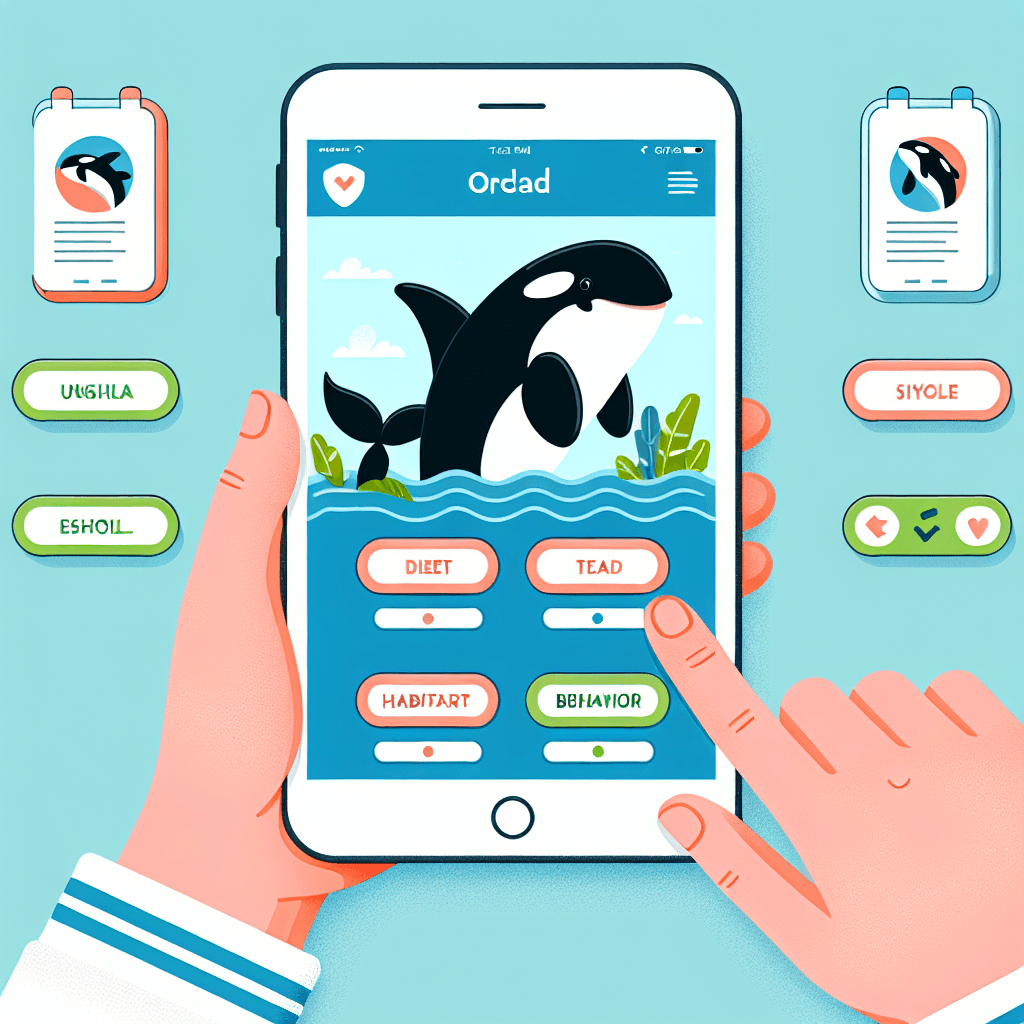
OrcaEd: Design an Educational App About Orcas
Inquiry Framework
Question Framework
Driving Question
The overarching question that guides the entire project.How can we design an engaging and informative app to educate others about the unique characteristics, behaviors, and ecological challenges faced by orcas and other creatures in the Salish Sea ecosystem?Essential Questions
Supporting questions that break down major concepts.- What are the characteristics of orcas?
- What is the difference between resident and transient orcas?
- How do orcas communicate?
- How do orcas hunt?
- What threats do orcas face in the Salish Sea?
- What is the Salish Sea ecosystem?
- What other creatures live in the Salish Sea?
- How can we design an app to teach others about orcas and the Salish Sea?
Standards & Learning Goals
Learning Goals
By the end of this project, students will be able to:- Students will be able to research and identify key characteristics, behaviors, and ecological challenges faced by orcas and other creatures in the Salish Sea ecosystem.
- Students will be able to design an engaging and informative app to educate others about orcas and the Salish Sea ecosystem.
- Students will be able to effectively communicate information about orcas and the Salish Sea ecosystem through a digital platform.
Entry Events
Events that will be used to introduce the project to studentsThe Orca SOS
Students receive a cryptic message from a fictional marine biologist studying orcas in the Salish Sea, detailing a concerning new threat to the orca population. They must analyze the message and conduct initial research to uncover the nature of the threat and propose possible solutions, setting the stage for their app development.Portfolio Activities
Portfolio Activities
These activities progressively build towards your learning goals, with each submission contributing to the student's final portfolio.Orca 101: Unveiling Basic Characteristics
Students will begin by researching the basic characteristics of orcas, including their physical attributes, social structure, and life cycle. This foundational knowledge will prepare them for more in-depth investigations into their behaviors and ecological roles.Steps
Here is some basic scaffolding to help students complete the activity.Final Product
What students will submit as the final product of the activityA detailed fact sheet about orca characteristics, including physical traits, social structure, and life cycle.Alignment
How this activity aligns with the learning objectives & standardsLearning Goal: Students will be able to research and identify key characteristics, behaviors, and ecological challenges faced by orcas and other creatures in the Salish Sea ecosystem.Resident vs. Transient: A Comparative Dive
Students will delve into the distinctions between resident and transient orcas, examining their different hunting techniques, communication styles, and dietary preferences. This activity encourages comparative analysis and a deeper understanding of orca diversity.Steps
Here is some basic scaffolding to help students complete the activity.Final Product
What students will submit as the final product of the activityA Venn diagram comparing and contrasting resident and transient orcas.Alignment
How this activity aligns with the learning objectives & standardsLearning Goal: Students will be able to research and identify key characteristics, behaviors, and ecological challenges faced by orcas and other creatures in the Salish Sea ecosystem.SOS Orcas: Addressing the Threats
Students will research the threats that orcas face in the Salish Sea, such as pollution, habitat loss, and prey depletion. They will analyze the impact of these threats on orca populations.Steps
Here is some basic scaffolding to help students complete the activity.Final Product
What students will submit as the final product of the activityA persuasive essay outlining the threats to orcas in the Salish Sea and proposing potential solutions.Alignment
How this activity aligns with the learning objectives & standardsLearning Goal: Students will be able to research and identify key characteristics, behaviors, and ecological challenges faced by orcas and other creatures in the Salish Sea ecosystem.Salish Sea Neighbors: Creature Connections
Students will explore other creatures that live in the Salish Sea, such as salmon, seals, and seabirds. They will learn about the relationships between these species and orcas.Steps
Here is some basic scaffolding to help students complete the activity.Final Product
What students will submit as the final product of the activityA series of illustrated fact cards featuring different Salish Sea creatures and their relationship to orcas.Alignment
How this activity aligns with the learning objectives & standardsLearning Goal: Students will be able to research and identify key characteristics, behaviors, and ecological challenges faced by orcas and other creatures in the Salish Sea ecosystem.App Blueprint: Designing the Orca Experience
Students will brainstorm and outline the content and features of their orca education app. This activity involves creative thinking and planning to ensure the app is both informative and engaging.Steps
Here is some basic scaffolding to help students complete the activity.Final Product
What students will submit as the final product of the activityA detailed app outline, including descriptions of each screen, feature, and content element.Alignment
How this activity aligns with the learning objectives & standardsLearning Goals: Students will be able to design an engaging and informative app to educate others about orcas and the Salish Sea ecosystem. ; Students will be able to effectively communicate information about orcas and the Salish Sea ecosystem through a digital platform.App Storyboard: Visualizing the User Journey
Students will create a storyboard for their app, visualizing the user interface and flow. This activity helps them refine the user experience and ensure the app is easy to navigate.Steps
Here is some basic scaffolding to help students complete the activity.Final Product
What students will submit as the final product of the activityA storyboard illustrating the app's user interface and flow.Alignment
How this activity aligns with the learning objectives & standardsLearning Goals: Students will be able to design an engaging and informative app to educate others about orcas and the Salish Sea ecosystem. ; Students will be able to effectively communicate information about orcas and the Salish Sea ecosystem through a digital platform.App Prototype: Bringing the App to Life
Students will develop a prototype of their app, using simple tools to create a basic interactive version. This activity allows them to test their design and gather feedback.Steps
Here is some basic scaffolding to help students complete the activity.Final Product
What students will submit as the final product of the activityA working prototype of the orca education app.Alignment
How this activity aligns with the learning objectives & standardsLearning Goals: Students will be able to design an engaging and informative app to educate others about orcas and the Salish Sea ecosystem. ; Students will be able to effectively communicate information about orcas and the Salish Sea ecosystem through a digital platform.Rubric & Reflection
Portfolio Rubric
Grading criteria for assessing the overall project portfolioOrca App Design Portfolio Rubric
Research and Understanding
Assesses the student's ability to research orca characteristics, behaviors, and ecological challenges in the Salish Sea.Research Completeness
Extent to which the student researches and identifies key characteristics, behaviors, and ecological challenges of orcas.
Exemplary
4 PointsDemonstrates sophisticated understanding with extensive research, covering all key characteristics, behaviors, and challenges of orcas.
Proficient
3 PointsDemonstrates thorough understanding with comprehensive research on key characteristics, behaviors, and challenges of orcas.
Developing
2 PointsShows emerging understanding with basic research on orca characteristics, behaviors, and challenges.
Beginning
1 PointsShows initial understanding with minimal research on orca features and challenges.
Ecological Context
Understanding of the Salish Sea ecosystem and the relationships between orcas and other inhabitants.
Exemplary
4 PointsDemonstrates strong ecological understanding and effectively connects orcas to the wider Salish Sea ecosystem.
Proficient
3 PointsShows good understanding of the Salish Sea ecosystem and orca relationships with other species.
Developing
2 PointsDisplays partial understanding with basic connections between orcas and other sea creatures.
Beginning
1 PointsLimited understanding of ecological context and relations within the Salish Sea.
Design and Creativity
Assesses the creativity and planning put into the app design and feature development.Creativity
Innovation and creativity in designing app features and content.
Exemplary
4 PointsDisplays exceptional creativity with innovative features and engaging content that captivates users.
Proficient
3 PointsShows good creativity with interesting features and engaging content.
Developing
2 PointsShows limited creativity with basic app features and content.
Beginning
1 PointsMinimal creativity with simplistic features and unengaging content.
App Structure and Design
Logical organization of the app and clarity of the user interface.
Exemplary
4 PointsExhibits a well-organized app with a clear and intuitive user interface.
Proficient
3 PointsDisplays a coherent app structure with a clear user interface that is generally easy to navigate.
Developing
2 PointsShows some organization, but app navigation and interface may confuse users.
Beginning
1 PointsUnorganized app structure and confusing interface severely limit usability.
Communication and Collaboration
Evaluates the ability to communicate information effectively and work collaboratively.Information Communication
Clarity and accuracy in presenting researched information about orcas and the Salish Sea.
Exemplary
4 PointsDelivers information with clarity and accuracy, greatly enhancing user understanding and engagement.
Proficient
3 PointsPresents information clearly and accurately, ensuring user comprehension.
Developing
2 PointsConveys information with some inaccuracies and lack of clarity affecting user understanding.
Beginning
1 PointsStruggles to communicate accurate information, leading to significant user misunderstanding.
Collaboration
Effectiveness in working collaboratively during the app design process.
Exemplary
4 PointsExhibits leadership and highly effective collaboration throughout the project.
Proficient
3 PointsParticipates actively and collaborates well with peers in the design process.
Developing
2 PointsShows basic collaboration with limited participation in group efforts.
Beginning
1 PointsMinimal collaboration effort with little contribution to the group project.