
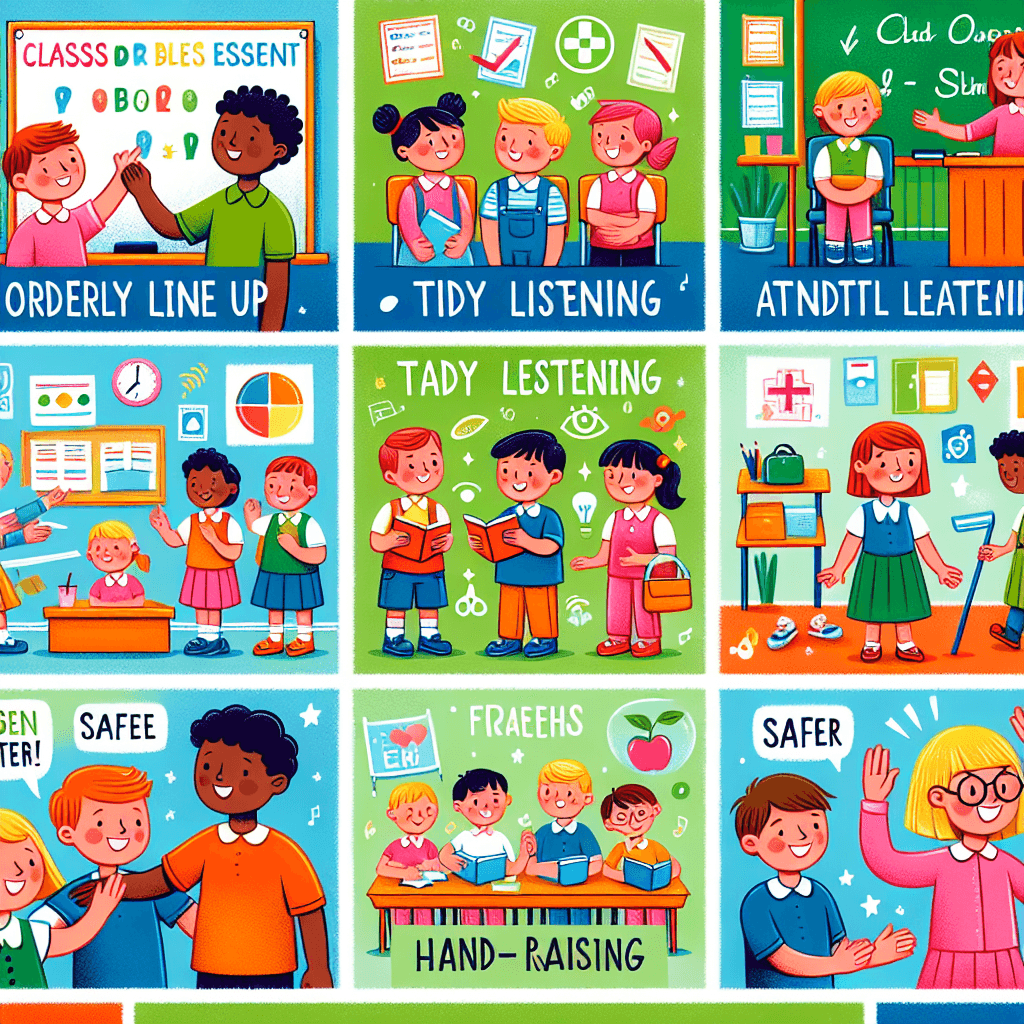
Our Class: Rules, Routines, Safety, and Friendships
Inquiry Framework
Question Framework
Driving Question
The overarching question that guides the entire project.How can we create a guide to help ourselves and others navigate our school and community safely and build friendships, using rules and routines?Essential Questions
Supporting questions that break down major concepts.- How do rules and routines help us at school?
- How can we make new friends?
- What are the important places in our school?
- How can we stay safe near roads?
- How can we stay safe near water?
Standards & Learning Goals
Learning Goals
By the end of this project, students will be able to:- Understand the importance of rules and routines in maintaining organization and safety.
- Develop strategies for building and maintaining friendships.
- Identify key locations within the school building and understand their functions.
- Learn and apply road safety rules.
- Learn and apply water safety rules.
- Create a guide to help kindergarteners navigate the school and community safely and build friendships, using rules and routines
PHSe
Entry Events
Events that will be used to introduce the project to studentsHelp a Toy Learn the Rules!
The class receives a video message from a 'lost' toy who needs help understanding the classroom rules and routines. Students create a visual guide (posters, picture cards) to teach the toy how to follow the rules and stay safe, reinforcing their understanding of expectations and promoting empathy.The Mystery of the School Day
A 'Mystery Box' arrives in the classroom containing items related to school routines (e.g., a lunchbox, a school bell). Students work together to guess what the items represent and how they help us stay organized and safe at school. This sparks discussion about creating classroom rules and understanding the purpose of different routines.Classroom Rescue Mission
The teacher stages a 'classroom chaos' scenario (e.g., toys scattered, books misplaced) and asks students to help 'fix' the problem. This hands-on activity encourages students to think about the importance of organization and creating systems for putting things away, linking to safety and smooth transitions.Secret Agent School Safety
Students receive a 'secret agent' mission: to create a map of the school, marking important safety locations (nurse's office, fire exits) and identifying safe routes. This activity promotes spatial awareness, navigation skills, and understanding of safety protocols within the school environment, connecting to real-world problem-solving.The Case of the Unsafe Character
The teacher reads a story about a character who gets into trouble because they don't follow safety rules (e.g., crossing the road without looking). Students act out different scenarios and discuss how to make safe choices, connecting literature to real-life safety practices and promoting critical thinking about consequences.Portfolio Activities
Portfolio Activities
These activities progressively build towards your learning goals, with each submission contributing to the student's final portfolio.Classroom Safety Map
Students create a simple map of the classroom, marking key areas (e.g., the door, the teacher's desk, the reading corner) and identifying potential hazards (e.g., where to not run).Steps
Here is some basic scaffolding to help students complete the activity.Final Product
What students will submit as the final product of the activityA classroom map with labeled areas and highlighted safety considerations.Alignment
How this activity aligns with the learning objectives & standardsAligns with PHSe-3 (Identifying and avoiding potential hazards), PHSe-6 (Navigating the school building), and the learning goals of understanding school layout and safety.Friendship Rules Poster
Students create a 'Friendship Rules' poster illustrating how to be a good friend at school. They will draw pictures and use simple words to show actions like sharing, listening, and helping.Steps
Here is some basic scaffolding to help students complete the activity.Final Product
What students will submit as the final product of the activityA colorful poster displaying the class's agreed-upon rules for friendship, with illustrations.Alignment
How this activity aligns with the learning objectives & standardsAligns with PHSe-1 (Understanding and following school rules), PHSe-2 (Developing and maintaining friendships), and the learning goals of understanding rules/routines and developing friendships.Rubric & Reflection
Portfolio Rubric
Grading criteria for assessing the overall project portfolioKindergarten Safety and Friendship Rubric
Classroom Safety Map Assessment
Assesses the accuracy, completeness, and thoughtfulness demonstrated in the 'Classroom Safety Map' activity.Classroom Representation
Accuracy and completeness of the classroom map, including key areas and labeled features.
Exemplary
4 PointsMap is meticulously detailed, accurately representing all key areas and features of the classroom with precise labels. Demonstrates a comprehensive understanding of spatial relationships.
Proficient
3 PointsMap accurately represents most key areas and features of the classroom with clear labels. Demonstrates a good understanding of spatial relationships.
Developing
2 PointsMap includes some key areas and features of the classroom, but may have inaccuracies or missing labels. Demonstrates a basic understanding of spatial relationships.
Beginning
1 PointsMap is incomplete and lacks key areas and features of the classroom. Labels are minimal or missing. Demonstrates a limited understanding of spatial relationships.
Hazard Identification
Identification and marking of potential hazards within the classroom environment.
Exemplary
4 PointsConsistently identifies and accurately marks all potential hazards on the map with clear and appropriate symbols. Demonstrates a thorough understanding of safety considerations.
Proficient
3 PointsIdentifies and marks most potential hazards on the map with appropriate symbols. Demonstrates a good understanding of safety considerations.
Developing
2 PointsIdentifies and marks some potential hazards on the map, but may miss a few or use unclear symbols. Demonstrates a basic understanding of safety considerations.
Beginning
1 PointsStruggles to identify and mark potential hazards on the map. Symbols are unclear or missing. Demonstrates a limited understanding of safety considerations.
Safety Strategies
Explanations of safety strategies for each area of the classroom, demonstrating understanding of safety rules.
Exemplary
4 PointsProvides comprehensive and insightful safety strategies for each area of the classroom, demonstrating a deep understanding of safety rules and their application.
Proficient
3 PointsProvides clear and relevant safety strategies for most areas of the classroom, demonstrating a good understanding of safety rules.
Developing
2 PointsProvides basic safety strategies for some areas of the classroom, but may lack detail or relevance. Demonstrates a basic understanding of safety rules.
Beginning
1 PointsStruggles to provide safety strategies for the classroom areas. Demonstrates a limited understanding of safety rules.
Friendship Rules Poster Assessment
Evaluates the visual and textual elements of the 'Friendship Rules' poster, as well as collaborative skills.Friendship Illustrations
Illustrations that clearly depict actions that represent friendship.
Exemplary
4 PointsIllustrations are exceptionally detailed, creative, and clearly represent a wide range of friendship actions. Demonstrates a sophisticated understanding of friendship.
Proficient
3 PointsIllustrations are clear, colorful, and accurately represent several actions that show friendship. Demonstrates a good understanding of friendship.
Developing
2 PointsIllustrations are simple and represent a few basic actions that show friendship. Demonstrates a basic understanding of friendship.
Beginning
1 PointsIllustrations are unclear or do not accurately represent actions that show friendship. Demonstrates a limited understanding of friendship.
Descriptive Language
Use of simple words or phrases to describe the friendship actions in the illustrations.
Exemplary
4 PointsWords and phrases are descriptive, insightful, and accurately capture the meaning of the friendship actions in the illustrations. Shows a sophisticated understanding of language use.
Proficient
3 PointsWords and phrases are clear, accurate, and effectively describe the friendship actions in the illustrations. Shows a good understanding of language use.
Developing
2 PointsWords and phrases are simple and partially describe the friendship actions in the illustrations. Shows a basic understanding of language use.
Beginning
1 PointsWords and phrases are minimal or do not accurately describe the friendship actions in the illustrations. Shows a limited understanding of language use.
Collaborative Skills
Contribution to the class 'Friendship Rules' poster and demonstration of collaborative skills.
Exemplary
4 PointsActively leads the collaboration, contributing insightful ideas and demonstrating exceptional teamwork skills in creating the 'Friendship Rules' poster.
Proficient
3 PointsContributes effectively to the collaboration, sharing ideas and working well with others to create the 'Friendship Rules' poster.
Developing
2 PointsParticipates in the collaboration, contributing some ideas but may need occasional guidance in working with others to create the 'Friendship Rules' poster.
Beginning
1 PointsRequires significant support to participate in the collaboration and contribute to the creation of the 'Friendship Rules' poster. Shows limited teamwork skills.