
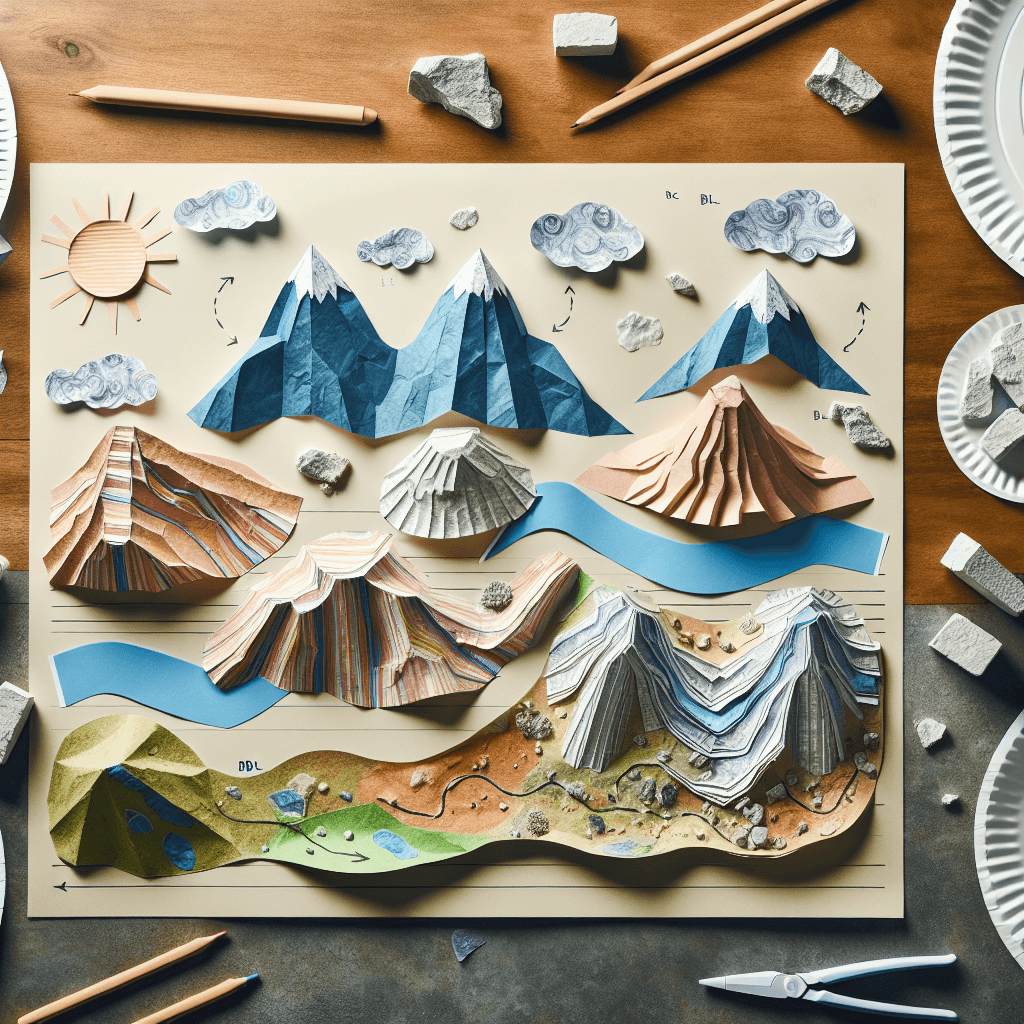
Paper Plate Landforms with Weathering and Erosion
Inquiry Framework
Question Framework
Driving Question
The overarching question that guides the entire project.How can we use everyday materials to model the creation and transformation of landforms through weathering and erosion, while understanding the role of natural forces like water, wind, and ice?Essential Questions
Supporting questions that break down major concepts.- What are the main types of landforms and how are they created?
- How do weathering and erosion shape and change landforms over time?
- What role do natural forces like water, wind, and ice play in the weathering and erosion of landforms?
- How can we model the processes of weathering and erosion using everyday materials?
Standards & Learning Goals
Learning Goals
By the end of this project, students will be able to:- Define and identify various landforms and explain how they are created through natural processes.
- Describe the processes of weathering and erosion and provide examples of how they shape and change landforms over time.
- Model the processes of weathering and erosion using everyday materials, demonstrating the role of natural forces such as water, wind, and ice.
- Develop critical thinking and problem-solving skills by designing and constructing a model that illustrates the processes of weathering and erosion.
Next Generation Science Standards
Entry Events
Events that will be used to introduce the project to studentsLandform Adventure Quest
Students embark on a virtual reality adventure where they travel to different landforms around the world. Along their journey, they witness firsthand the effects of weathering and erosion, capturing evidence and insights for their landform creation project.Portfolio Activities
Portfolio Activities
These activities progressively build towards your learning goals, with each submission contributing to the student's final portfolio.Landform Exploration Journal
Students create a journal to document their research and discoveries about various landforms, focusing on the effects of weathering and erosion.Steps
Here is some basic scaffolding to help students complete the activity.Final Product
What students will submit as the final product of the activityA comprehensive journal including written observations and sketches of the selected landform.Alignment
How this activity aligns with the learning objectives & standardsThis activity aligns with 4-ESS2-1, focusing on making observations about the effects of weathering and erosion.Weathering and Erosion Simulation
Students use everyday materials to simulate weathering and erosion processes, observing how different forces affect landforms.Steps
Here is some basic scaffolding to help students complete the activity.Final Product
What students will submit as the final product of the activityA series of observations and notes describing the effects of simulated weathering and erosion on the mini landform model.Alignment
How this activity aligns with the learning objectives & standardsThis activity aligns with 4-ESS2-1, as it involves modeling and observing the effects of weathering and erosion using scientific simulations.Landform Creation & Presentation
Students create a 3D model of a landform using paper plates and other materials, incorporating the processes of weathering and erosion.Steps
Here is some basic scaffolding to help students complete the activity.Final Product
What students will submit as the final product of the activityA 3D model of a landform with detailed features showing the effects of weathering and erosion, along with a presentation.Alignment
How this activity aligns with the learning objectives & standardsThis activity supports standard 4-ESS2-1 and 4-ESS3-2 by modeling natural processes and considering their impact on structures.Rubric & Reflection
Portfolio Rubric
Grading criteria for assessing the overall project portfolioLandform Creation and Simulation Rubric
Research and Inquiry Skills
Assessment of student's ability to research, gather information, and document their findings effectively, showcasing understanding of landform processes.Information Gathering
Analyzing the thoroughness and relevance of information collected during the research phase.
Exemplary
4 PointsGathers detailed and relevant information from multiple sources; consistently records insightful observations about landform processes.
Proficient
3 PointsGathers relevant information from several sources; records clear observations regarding landform processes.
Developing
2 PointsGathers some relevant information, but observations are limited or occasionally unclear.
Beginning
1 PointsGathers minimal information with unclear or incomplete observations.
Documentation and Presentation
Evaluating the clarity, organization, and depth of journal entries and presentations.
Exemplary
4 PointsPresents information clearly and logically with comprehensive details, supporting illustrations, and a structured presentation that engages the audience.
Proficient
3 PointsPresents information clearly, with relevant details and organized structure in both journal entries and presentations.
Developing
2 PointsPresents information with some clarity; includes basic details but lacks consistent organization.
Beginning
1 PointsPresents information unclearly with few details or noticeable disorganization.
Scientific Modeling and Creativity
Assessment of students' ability to creatively model scientific processes using materials and demonstrate understanding of weathering and erosion.Model Design and Execution
Evaluates creativity, accuracy, and effectiveness of the model in depicting weathering and erosion processes.
Exemplary
4 PointsConstructs an innovative and scientifically accurate model that effectively demonstrates weathering and erosion processes with multiple materials.
Proficient
3 PointsConstructs a scientifically accurate model that demonstrates weathering and erosion mainly with appropriate materials.
Developing
2 PointsModels some aspects of weathering and erosion; uses limited materials with varying accuracy.
Beginning
1 PointsDisplays an incomplete or inaccurate model with minimal demonstration of processes.
Creative Problem Solving
Evaluates the student's ability to integrate their understanding into a creative and meaningful expression of scientific concepts.
Exemplary
4 PointsDemonstrates highly creative solutions and problem-solving skills in model creation and presentation.
Proficient
3 PointsApplies creative solutions and effective problem-solving strategies in completing the project.
Developing
2 PointsAttempts some creative solutions with limited effectiveness.
Beginning
1 PointsShows minimal creativity or effectiveness in solving problems related to the project.
Collaboration and Reflection
Assessment of student participation in collaborative activities and reflective processes, critical for understanding complex scientific concepts.Collaborative Work
Evaluates contribution and leadership in collaborative tasks during the project.
Exemplary
4 PointsLeads group in productive collaboration, contributing innovative ideas and fostering team success.
Proficient
3 PointsActively contributes ideas and works well with others to achieve project goals.
Developing
2 PointsParticipates in group activities with occasional contributions to the project.
Beginning
1 PointsParticipates minimally in group activities with limited contributions.
Reflective Practice
Evaluates student's ability to engage in reflective thinking about their learning and the project's scientific concepts.
Exemplary
4 PointsEngages deeply in reflective practice, providing comprehensive insights and evaluations of personal learning and project outcomes.
Proficient
3 PointsEngages in reflective practice with clear insights about learning and project work.
Developing
2 PointsShows some reflection on learning experiences with basic insights.
Beginning
1 PointsEngages minimally in reflection with limited insights into learning.